Mission Terrace, San Francisco
Updated · 12,235 residents
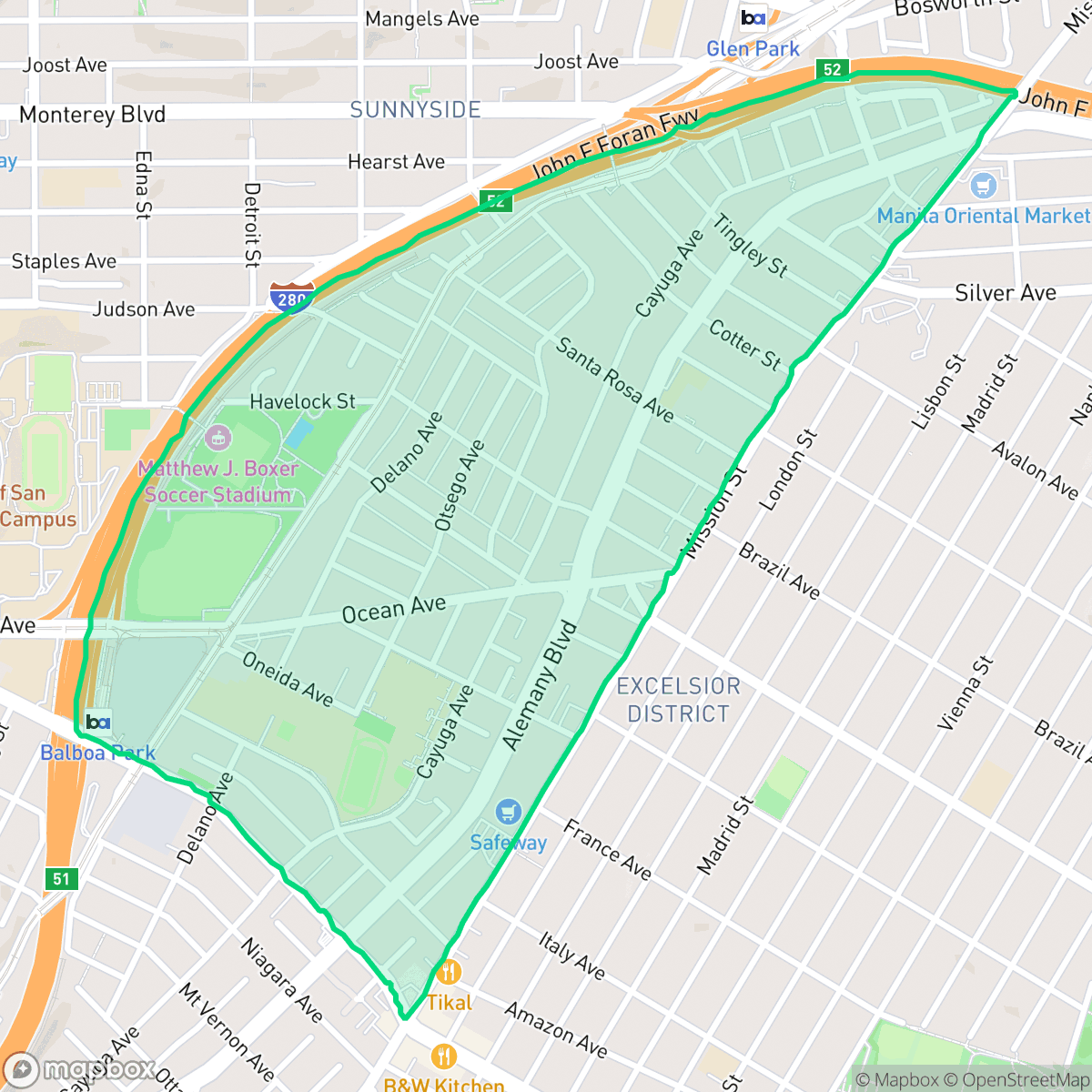
Mission Terrace is a highly walkable, dense neighborhood characterized by its early 20th-century Craftsman architecture and proximity to Balboa Park. While the area offers a lively atmosphere with diverse local dining, residents should expect notable noise levels from nearby highway traffic and limited residential privacy.
Key Highlights
About Mission Terrace
Before its development, the south-central San Francisco neighborhood of Mission Terrace was agricultural land farmed by Italian and French truck gardeners, primarily known for its extensive broccoli crops. In 1911, the prominent real estate firm Baldwin & Howell surveyed the tract to build an affordable residential community. Throughout the 1910s and 1920s, the area was built up with single and one-and-a-half-story Craftsman bungalows. Distinctive stone monuments, some featuring a ball and chain, were erected on street corners during this initial development and remain local curiosities. The neighborhood is also home to the historic 25-acre Balboa Park, dedicated in 1909. Today, Mission Terrace retains much of its early 20th-century architectural character, including its original neighborhood clubhouse, which has since been converted into a private residence.
The neighborhood serves as a dense, residential enclave that maintains a strong connection to its early 20th-century roots. It is defined by a consistent grid layout that makes it exceptionally easy to navigate on foot. Residents benefit from access to a variety of local eateries and the expansive green space of Balboa Park, which provides a necessary recreational outlet in an otherwise compact urban environment. The area is strictly residential and light commercial, with no heavy industrial sites nearby.
Prospective residents should consider that the neighborhood experiences significant road noise due to the major freeway that bisects the area. Housing density is high, often resulting in shared walls and minimal private outdoor space. This makes the area well-suited for those who prioritize walkability and proximity to community amenities over quiet suburban solitude or expansive private property.
Neighborhood Scores Across 15 Qualities
Residential structures are characterized by dense, row-house style development with shared walls or very narrow gaps between buildings. This level of proximity is consistent with the city average for San Francisco.
Continuous sidewalks and marked crosswalks provide easy navigation throughout the residential grid. Pedestrian bridges over the freeway ensure connectivity, making the area nearly as walkable as the rest of San Francisco.
Standard tract housing features consistent rooflines and small, shared yards. This visual landscape is slightly less varied than the San Francisco average, according to iHuus data.
Access to dog walking areas is primarily concentrated near the edges of the neighborhood by Balboa Park and various athletic fields. Aside from these perimeter parks, the dense residential streets offer fewer grassy verges or green spaces for pets compared to the San Francisco average.
Residential streets and green spaces are balanced here, creating a more suburban feel than the typical dense urban environment found across San Francisco. According to iHuus data, the area features a mix of multi-story housing and consistent street grids with more open space than the city average.
Diverse dining options and social spots create an energetic atmosphere that is more active than the San Francisco average. According to iHuus data, the area offers a mix of mid-rise urban pockets and green spaces featuring a wide variety of local cafes and eateries.
Frequent disturbances from nearby freeway traffic and railroad lines characterize this area. According to iHuus data, acoustic comfort in Mission Terrace is significantly lower than the San Francisco average.
Air quality remains consistently clear with rare instances of elevated readings, performing slightly better than the San Francisco average according to iHuus data.
No warehouses or heavy industrial facilities are present within the neighborhood, making it even more free of industrial hazards than the San Francisco average. According to iHuus data, the area consists entirely of residential and light commercial uses without visible industrial chimneys or large-scale manufacturing sites.
Health insurance enrollment among residents is slightly below the San Francisco average, according to iHuus data.
Voting patterns and census indicators show a deeply liberal political leaning that is consistent with the city average, according to iHuus data.
A balanced mix of young adults, families, and older residents defines the area. This demographic distribution is largely consistent with the broader San Francisco average, according to iHuus data.
Properties in this area are located within a designated floodplain, which represents a higher risk level than much of San Francisco. According to iHuus data, residents may find that flood insurance is a standard requirement for properties here.
Address-Level Insights for Mission Terrace


iHuus Neighborhood Intelligence Insights
Get address-level neighborhood insights for Mission Terrace
- Street-level scores — see how individual blocks compare, not just neighborhood averages
- Micro-zone boundaries — identify quiet pockets, flood boundaries, and walkable clusters before you visit
- 15 dimensions in full — walkability, noise, air quality, school quality, insurance coverage, population age profile, urban/rural index, and more
- Boundary risk alerts — know if your address sits near a block boundary where scores drop, the kind of detail no listing will ever mention
- School insights — individual school ratings and insights, not just district-level data
- Compare before you commit — side-by-side data across neighborhoods, down to block precision
No credit card required
Compare with Any Neighborhood
| Dimension | Mission Terrace | Alamo Square |
|---|---|---|
| 🚶 Walkabilityavg 9.91 | ||
| 🔊 Acoustic Comfortavg 3.4 | ||
| 🤫 Privacy Indexavg 2.14 | ||
| 🎨 Visual Appealavg 6.26 | ||
| 🐕 Dog Friendlinessavg 6.55 | ||
| 🗺️ Urban-Rural Indexavg 4.07 | ||
| ✨ Neighborhood Vibeavg 6.4 | ||
| 🏥 Health Insurance Coverageavg 7.87 | ||
| 🌿 Air Qualityavg 7.78 | ||
| 🏭 Industrial Proximityavg 9.37 | ||
| 🌊 Flood Safetyavg 1.89 | ||
| 🗳️ Ideological Leanavg 9.92 | ||
| 👥 Population Age Profileavg 5.18 | ||
| 🔥 Fire Safetyavg 0.01 | ||
| 🏫 School Quality |
Mission Terrace Rankings
School Districts Serving Mission Terrace
School Insights for Mission Terrace
Below average outcomes; significant attendance and academic challenges.
School Insights
See what's really behind every school rating near Mission Terrace
- Individual school ratings — each school's own score with outcome context, not just a district average
- Enrollment & class size data — student-to-teacher ratio and how it compares to the state average
- Full demographics breakdown — ethnicity and gender composition for every school in the enrollment zone
- Every school in the district — all schools within the enrollment boundary ranked by rating, not just the closest one
- Grade levels & benchmarks — elementary through high school, with below/above state-average flags
No credit card required