Mission Bay, San Francisco
Updated · 2,799 residents
Mission Bay is a modern, high-density neighborhood characterized by its sleek, multi-story residential complexes and proximity to major landmarks like the Chase Center. Residents benefit from exceptional walkability and easy access to waterfront parks, though the area is notably loud due to consistent road traffic.
Key Highlights
About Mission Bay
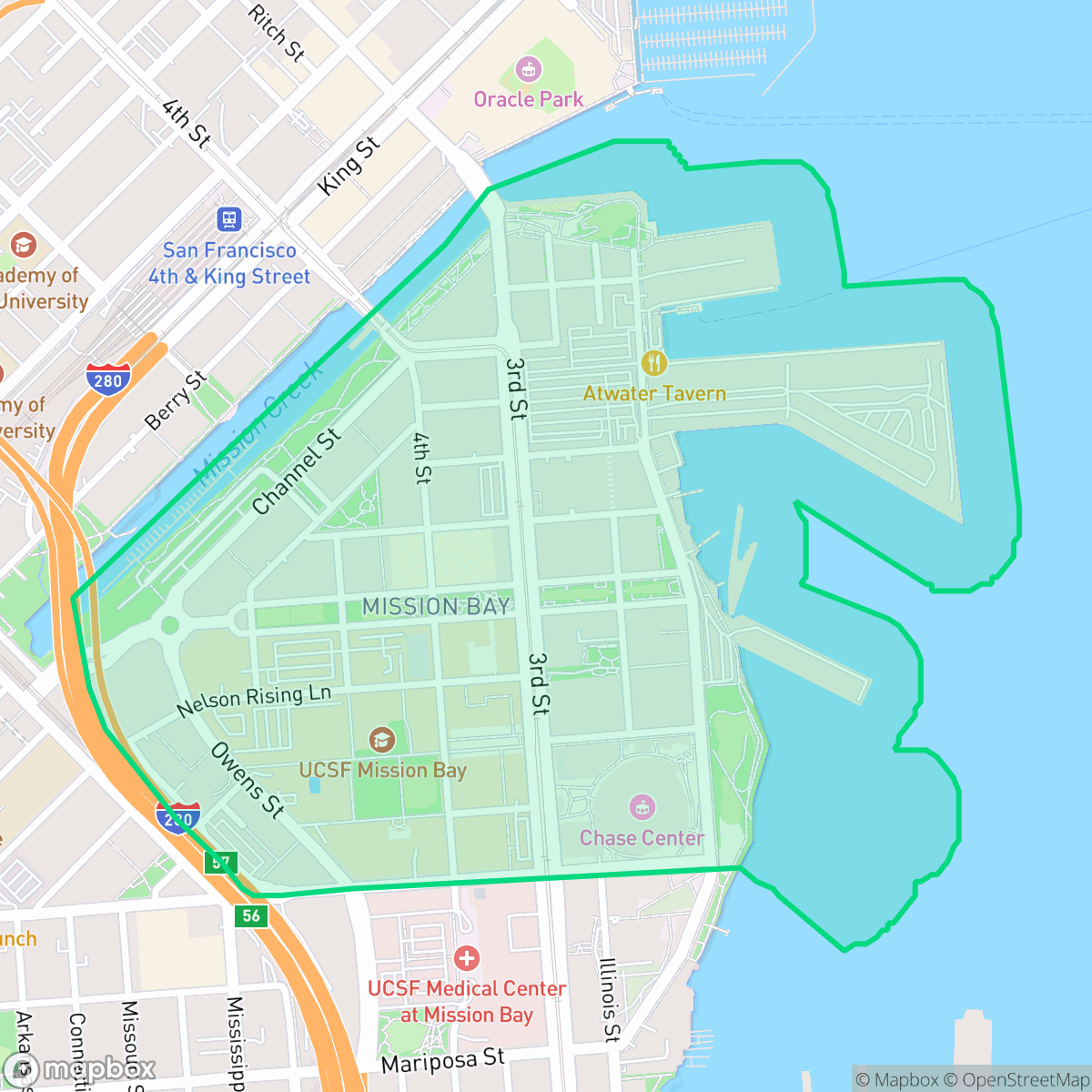
Before urbanization, San Francisco’s Mission Bay was a 500-acre salt marsh and tidal lagoon inhabited by the Yelamu Ohlone people. During the mid-19th century, the area hosted shipbuilding, oyster harvesting, and slaughterhouses. Between 1860 and 1910, the bay was systematically filled with soil from leveled city hills and debris from the 1906 earthquake, transforming the wetlands into an industrial district dominated by Southern Pacific Railroad yards and warehouses. Today, the historic Mission Creek channel is the only remaining trace of the original waterway. In 1998, the city initiated a massive redevelopment project that revitalized the industrial wasteland into a modern hub for biotechnology and research, anchored by the University of California, San Francisco (UCSF) campus, waterfront parks, and major landmarks like the Chase Center.
The neighborhood serves as a primary hub for biotechnology and research, defined by its contemporary architecture and professional landscaping. It functions as a dense urban core where high-rise living meets significant commercial activity. The area offers a highly walkable environment with convenient access to amenities such as Blue Bottle Coffee, Philz Coffee, and various waterfront dining options along the Mission Creek channel.
Living here involves distinct trade-offs, particularly regarding acoustic comfort and privacy. The dense layout of apartment buildings often results in limited personal space, and road traffic noise remains a constant factor for residents. According to iHuus data, the area is well-suited for professionals seeking proximity to the UCSF campus and the city's tech sector, though it may be less ideal for those prioritizing quiet or seclusion.
Neighborhood Scores Across 15 Qualities
Close proximity to adjacent structures and minimal separation between buildings result in very limited personal privacy. This density of multi-unit buildings and narrow alleyways is consistent with the broader San Francisco average according to iHuus data.
Wide sidewalks, pedestrian plazas, and waterfront trails create an exceptionally walkable environment that is slightly above the San Francisco average. According to iHuus data, the neighborhood features a complete sidewalk grid and clear crosswalks throughout the district.
Modern high-density developments and professional landscaping define much of the area, though the overall visual variety sits slightly below the city average. The skyline features a mix of contemporary apartment complexes and large-scale commercial structures like the Chase Center.
High concrete density and minimal green verges make the area less dog friendly than most of San Francisco. While waterfront paths and stadium parks offer walking opportunities, soft ground and accessible greenery are relatively scarce according to iHuus data.
Extremely high-density development characterizes this area, featuring large-scale commercial structures and significant highway infrastructure. This environment provides a concentrated urban experience that is much denser than the typical San Francisco neighborhood, according to iHuus data.
Diverse dining and social hubs provide a consistent level of activity, though the overall energy is slightly below the San Francisco average. Local spots like Crane Cove Park and various waterfront eateries offer a balanced mix of social and industrial surroundings.
Frequent noise from nearby freeway traffic and railroad proximity creates a much louder environment than the San Francisco average. According to iHuus data, this area experiences significant acoustic disruption due to its location near major transportation corridors.
Air quality remains consistently high with rare instances of elevated readings. According to iHuus data, the atmosphere in Mission Bay is slightly cleaner than the San Francisco average.
Active maritime piers, warehouses, and nearby freeway interchanges contribute to moderate commercial traffic and noise. According to iHuus data, this level of industrial proximity is notably lower than the citywide average.
Nearly all residents have access to health insurance, which is significantly higher than the San Francisco average according to iHuus data.
Voting patterns and census indicators reflect a deeply liberal political landscape, aligning closely with the broader San Francisco average according to iHuus data.
Residents live alongside a varied demographic of young professionals, families, and seniors. This age distribution is slightly lower than the San Francisco average, according to iHuus data.
Flood risk is significantly lower here than the San Francisco average, though some residual risk remains due to the area's location within the 500-year floodplain. According to iHuus data, the neighborhood sits in a zone with much greater stability than most parts of the city.
Address-Level Insights for Mission Bay


iHuus Neighborhood Intelligence Insights
Get address-level neighborhood insights for Mission Bay
- Street-level scores — see how individual blocks compare, not just neighborhood averages
- Micro-zone boundaries — identify quiet pockets, flood boundaries, and walkable clusters before you visit
- 15 dimensions in full — walkability, noise, air quality, school quality, insurance coverage, population age profile, urban/rural index, and more
- Boundary risk alerts — know if your address sits near a block boundary where scores drop, the kind of detail no listing will ever mention
- School insights — individual school ratings and insights, not just district-level data
- Compare before you commit — side-by-side data across neighborhoods, down to block precision
No credit card required
Compare with Any Neighborhood
| Dimension | Mission Bay | Alamo Square |
|---|---|---|
| 🚶 Walkabilityavg 9.91 | ||
| 🔊 Acoustic Comfortavg 3.4 | ||
| 🤫 Privacy Indexavg 2.14 | ||
| 🎨 Visual Appealavg 6.26 | ||
| 🐕 Dog Friendlinessavg 6.55 | ||
| 🗺️ Urban-Rural Indexavg 4.07 | ||
| ✨ Neighborhood Vibeavg 6.4 | ||
| 🏥 Health Insurance Coverageavg 7.87 | ||
| 🌿 Air Qualityavg 7.78 | ||
| 🏭 Industrial Proximityavg 9.37 | ||
| 🌊 Flood Safetyavg 1.89 | ||
| 🗳️ Ideological Leanavg 9.92 | ||
| 👥 Population Age Profileavg 5.18 | ||
| 🔥 Fire Safetyavg 0.01 | ||
| 🏫 School Quality |
Mission Bay Rankings
School Districts Serving Mission Bay
School Insights for Mission Bay
Below average outcomes; significant attendance and academic challenges.
School Insights
See what's really behind every school rating near Mission Bay
- Individual school ratings — each school's own score with outcome context, not just a district average
- Enrollment & class size data — student-to-teacher ratio and how it compares to the state average
- Full demographics breakdown — ethnicity and gender composition for every school in the enrollment zone
- Every school in the district — all schools within the enrollment boundary ranked by rating, not just the closest one
- Grade levels & benchmarks — elementary through high school, with below/above state-average flags
No credit card required