Miraloma Park, San Francisco
Updated · 4,821 residents
Miraloma Park is a tranquil residential neighborhood situated on the slopes of Mount Davidson, offering residents exceptional walkability and high air quality. While the area provides a quiet, suburban atmosphere with access to local dining, the compact housing layout means residents experience limited privacy between properties.
Key Highlights
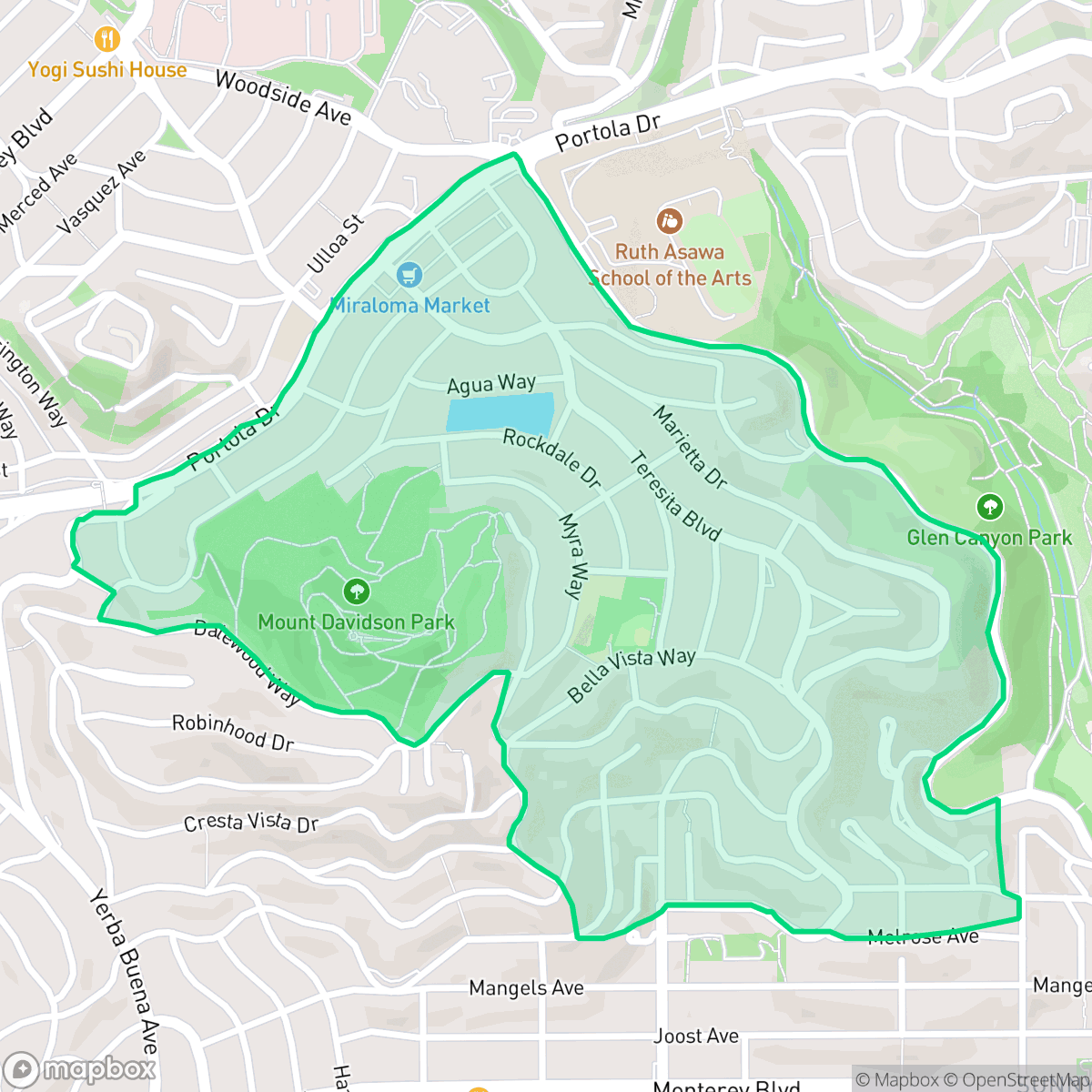
About Miraloma Park
Developed primarily between 1926 and the 1950s by the Meyer Brothers, Miraloma Park is a residential neighborhood built on the slopes of Mount Davidson. The land was acquired from the Adolph Sutro estate—which required clearing a dense eucalyptus forest—and Wells Fargo & Company. Designed as a "City in Itself" for families of moderate means, the master-planned community features winding, contour-following streets that reflect City Beautiful principles. Its architectural character is defined by single-family, one-story-over-garage homes built in Spanish Revival, English Cottage, and Art Deco styles. Rather than utilizing grand entrance gates, the neighborhood was originally landmarked by large painted rock letters on the hillside. Local institutions include the historic Miraloma Park Improvement Club (founded in 1936) and the landmark Tower Market.
The neighborhood functions as a quiet residential enclave characterized by its hilly topography and lush urban forest canopy. According to iHuus data, the area maintains a high level of acoustic comfort and excellent air quality, making it a serene retreat from the city center. Residents enjoy a highly walkable environment with continuous sidewalk networks that facilitate easy access to nearby recreational spaces and local eateries such as Shanghai Dumpling King. This community is defined by its peaceful, nature-adjacent character, which remains free from industrial activity and noise pollution.
Prospective residents should note that the neighborhood features densely packed, low-rise housing, which results in a lower privacy index for many properties. While the community benefits from high health insurance coverage and a stable, residential-focused environment, families should consider the current fiscal challenges facing the local school district. The area is well-suited for those who prioritize a peaceful lifestyle over high-density urban amenities, provided they are prepared for the inherent environmental risks associated with the local fire and flood safety profiles.
Neighborhood Scores Across 15 Qualities
Residential structures are positioned closely together with minimal separation between properties. According to iHuus data, this level of density is slightly higher than the typical San Francisco average.
Continuous sidewalk networks and dedicated park paths make navigating the area on foot easy. This neighborhood offers a pedestrian-friendly environment that is slightly more accessible than the San Francisco average, according to iHuus data.
Large, well-maintained homes with complex rooflines and private amenities define the area. According to iHuus data, the neighborhood offers a higher level of visual interest and property scale compared to the San Francisco average.
Extensive wooded trails and proximity to Balboa Park offer superior space for pets compared to the city average. According to iHuus data, the area features connected green spaces and wide paths that are well-separated from heavy traffic.
Frequent open land and significant urban forest canopy create a semi-rural feel that is much more spacious than the dense urban average for San Francisco. According to iHuus data, the area features scattered homes integrated with greenery and large nature preserves.
Residential streets and green spaces dominate the area, offering a more tranquil atmosphere than the San Francisco average. While some blocks feature local favorites like Tasty Coffee and Monterey Pizza, most parts of the neighborhood are characterized by a subdued, suburban pace.
Frequent noise from nearby transit corridors and major thoroughfares makes this area louder than much of San Francisco. According to iHuus data, residents may experience regular disturbances from heavy traffic and proximity to transit paths.
Air quality remains consistently high with rare instances of elevated readings. According to iHuus data, the atmosphere in this area is slightly cleaner than the San Francisco average.
Industrial activity and warehouses are entirely absent from this area. According to iHuus data, the neighborhood contains only residential, educational, and recreational zones, making it even more free of industrial proximity than the San Francisco average.
Health insurance accessibility is exceptionally high for residents here, significantly surpassing the San Francisco average according to iHuus data.
Voting patterns and census indicators reflect a deeply liberal political landscape that is consistent with the city average.
Residents live alongside a balanced variety of young professionals, families, and seniors. This demographic spread is slightly more varied than the typical San Francisco profile, according to iHuus data.
Property within the 100-year floodplain is subject to increased flood risk, which according to iHuus data, is higher than the San Francisco average. Residents in this area should be aware that flood insurance is typically required for properties in this zone.
Address-Level Insights for Miraloma Park


iHuus Neighborhood Intelligence Insights
Get address-level neighborhood insights for Miraloma Park
- Street-level scores — see how individual blocks compare, not just neighborhood averages
- Micro-zone boundaries — identify quiet pockets, flood boundaries, and walkable clusters before you visit
- 15 dimensions in full — walkability, noise, air quality, school quality, insurance coverage, population age profile, urban/rural index, and more
- Boundary risk alerts — know if your address sits near a block boundary where scores drop, the kind of detail no listing will ever mention
- School insights — individual school ratings and insights, not just district-level data
- Compare before you commit — side-by-side data across neighborhoods, down to block precision
No credit card required
Compare with Any Neighborhood
| Dimension | Miraloma Park | Alamo Square |
|---|---|---|
| 🚶 Walkabilityavg 9.91 | ||
| 🔊 Acoustic Comfortavg 3.4 | ||
| 🤫 Privacy Indexavg 2.14 | ||
| 🎨 Visual Appealavg 6.26 | ||
| 🐕 Dog Friendlinessavg 6.55 | ||
| 🗺️ Urban-Rural Indexavg 4.07 | ||
| ✨ Neighborhood Vibeavg 6.4 | ||
| 🏥 Health Insurance Coverageavg 7.87 | ||
| 🌿 Air Qualityavg 7.78 | ||
| 🏭 Industrial Proximityavg 9.37 | ||
| 🌊 Flood Safetyavg 1.89 | ||
| 🗳️ Ideological Leanavg 9.92 | ||
| 👥 Population Age Profileavg 5.18 | ||
| 🔥 Fire Safetyavg 0.01 | ||
| 🏫 School Quality |
Miraloma Park Rankings
School Districts Serving Miraloma Park
School Insights for Miraloma Park
Below average outcomes; significant attendance and academic challenges.
School Insights
See what's really behind every school rating near Miraloma Park
- Individual school ratings — each school's own score with outcome context, not just a district average
- Enrollment & class size data — student-to-teacher ratio and how it compares to the state average
- Full demographics breakdown — ethnicity and gender composition for every school in the enrollment zone
- Every school in the district — all schools within the enrollment boundary ranked by rating, not just the closest one
- Grade levels & benchmarks — elementary through high school, with below/above state-average flags
No credit card required