Marina, San Francisco
Updated · 11,979 residents
The Marina is a vibrant, highly walkable neighborhood known for its polished waterfront views and bustling commercial corridors along Chestnut and Union Streets. While it offers excellent access to parks and a lively social scene, residents experience limited privacy due to dense housing and persistent noise from nearby transit and flight paths.
Key Highlights
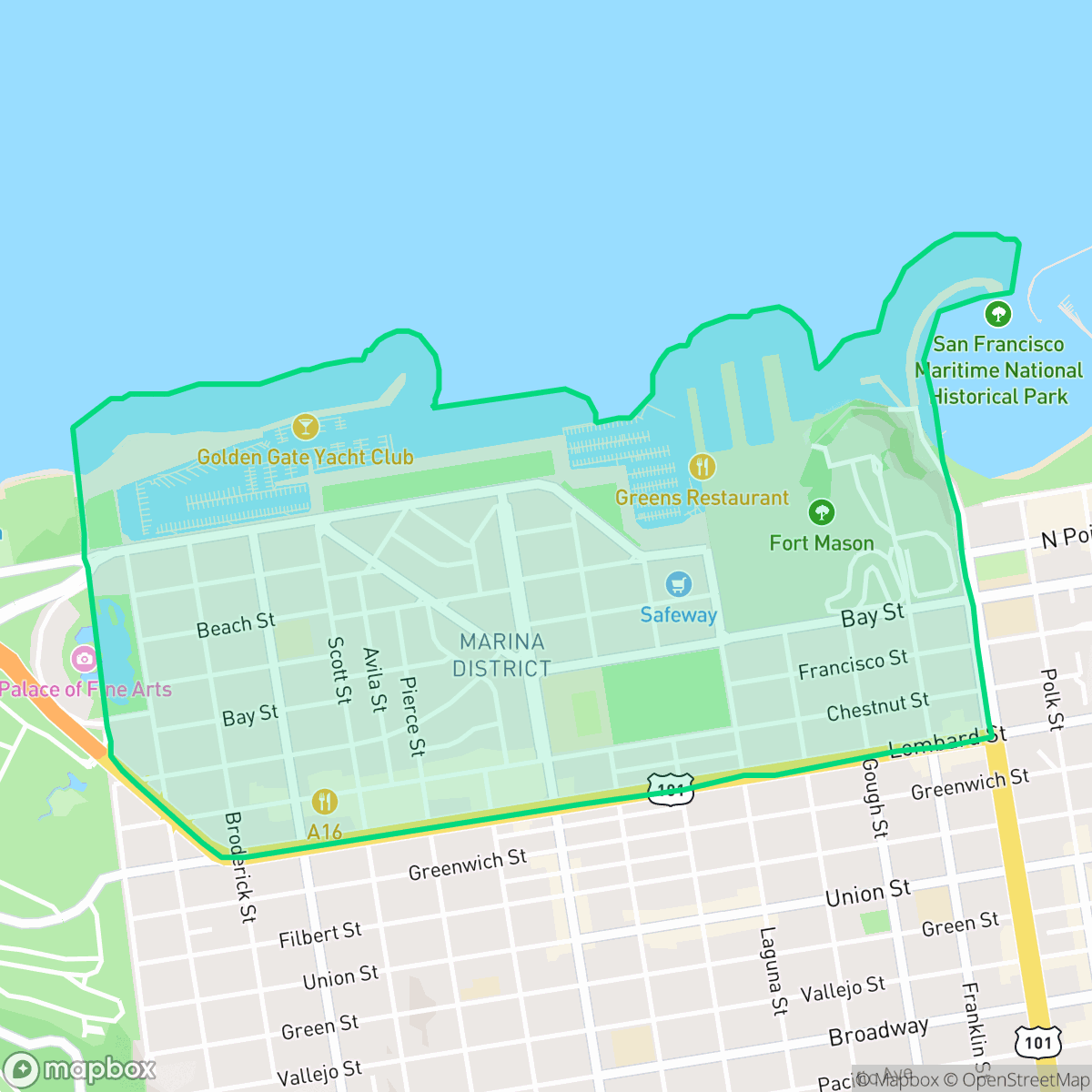
About Marina
Originally a shallow cove and marshland, the Marina District was transformed into a residential neighborhood following the 1915 Panama-Pacific International Exposition. This world's fair, intended to celebrate San Francisco’s recovery from the 1906 earthquake, utilized extensive land reclamation to create the site. After the exposition, the temporary fair structures were demolished, leaving only the neoclassical Palace of Fine Arts, designed by Bernard Maybeck. The area was subsequently developed in the 1920s with a mix of Period Revival, Art Deco, and Streamline Moderne architecture. The neighborhood’s reliance on landfill made it particularly vulnerable to soil liquefaction during the 1989 Loma Prieta earthquake, which caused significant structural damage. Today, the Marina is defined by its scenic waterfront, the historic Fort Mason center, and the bustling commercial corridors of Chestnut and Union Streets.
The neighborhood serves as a prominent social hub, defined by its blend of upscale residential architecture and active commercial life. With its proximity to the bay and expansive green spaces, the area is particularly well-suited for dog owners and those who prioritize outdoor recreation and pedestrian access. The streetscape is characterized by a mix of mid-rise buildings and manicured parks, creating a polished aesthetic that remains distinct from the city’s more industrial zones. According to iHuus data, the area maintains clean air and high levels of health insurance coverage, contributing to its appeal among a diverse demographic of young professionals and families.
Prospective residents should consider the trade-offs inherent to this dense urban environment. The area experiences persistent noise from transit corridors and flight paths, and the close proximity of row houses results in limited individual privacy. Additionally, the neighborhood faces moderate flood risks and relies on the broader San Francisco Unified School District, which currently faces significant fiscal challenges and operational instability. Despite these factors, the area remains a highly active and accessible community for those who value a suburban feel within an urban setting.
Neighborhood Scores Across 15 Qualities
Dense row houses and apartment buildings feature shared walls or minimal separation between structures. According to iHuus data, this level of density is roughly in line with the typical urban privacy found across San Francisco.
Pedestrian movement is seamless due to a dense grid of wide sidewalks, clear crossings, and continuous waterfront paths. This level of accessibility is slightly above the San Francisco average, according to iHuus data.
Manicured parks and well-maintained waterfront architecture provide a more aesthetically pleasing environment than the San Francisco average. According to iHuus data, the presence of large, upscale multi-story homes and premium amenities contributes to a highly visually appealing streetscape.
Extensive public parks, waterfront paths, and green spaces provide far more area for pet exercise than typical San Francisco neighborhoods. According to iHuus data, the abundance of large open fields and wooded trails makes this an ideal area for dog owners.
Street grids and low-to-mid rise buildings are balanced by significant public park infrastructure. This area is slightly more suburban than the San Francisco average, offering a mix of paved urban density and accessible green space.
A diverse array of dining, retail, and social destinations creates a high-energy atmosphere that is significantly more active than the San Francisco average. This coastal area features a dense mix of mid-rise urban spots and green spaces, offering far more local activity than most parts of the city.
Frequent noise from nearby major transit corridors and flight paths makes this area significantly louder than the San Francisco average. According to iHuus data, residents can expect persistent acoustic disturbances throughout the day.
Air quality remains consistently high with infrequent periods of poor circulation. According to iHuus data, these levels are slightly better than the city average.
Industrial activity is nonexistent in this area, as the neighborhood consists strictly of residential, recreational, and light commercial spaces. According to iHuus data, this absence of warehouses and hazardous sites is even more pronounced than the city average.
Health insurance access is exceptionally high for residents, significantly surpassing the San Francisco average according to iHuus data.
Voting patterns and census indicators reflect a political landscape that is very similar to the broader San Francisco area. According to iHuus data, the neighborhood aligns closely with the city's overall progressive lean.
Residents represent a varied demographic of young professionals, families, and seniors. This population distribution is slightly lower than the city average, according to iHuus data.
Flood risk levels in this area are notably higher than the San Francisco average. According to iHuus data, the neighborhood sits in an area where detailed federal flood studies are currently incomplete.
Address-Level Insights for Marina


iHuus Neighborhood Intelligence Insights
Get address-level neighborhood insights for Marina
- Street-level scores — see how individual blocks compare, not just neighborhood averages
- Micro-zone boundaries — identify quiet pockets, flood boundaries, and walkable clusters before you visit
- 15 dimensions in full — walkability, noise, air quality, school quality, insurance coverage, population age profile, urban/rural index, and more
- Boundary risk alerts — know if your address sits near a block boundary where scores drop, the kind of detail no listing will ever mention
- School insights — individual school ratings and insights, not just district-level data
- Compare before you commit — side-by-side data across neighborhoods, down to block precision
No credit card required
Compare with Any Neighborhood
| Dimension | Marina | Alamo Square |
|---|---|---|
| 🚶 Walkabilityavg 9.91 | ||
| 🔊 Acoustic Comfortavg 3.4 | ||
| 🤫 Privacy Indexavg 2.14 | ||
| 🎨 Visual Appealavg 6.26 | ||
| 🐕 Dog Friendlinessavg 6.55 | ||
| 🗺️ Urban-Rural Indexavg 4.07 | ||
| ✨ Neighborhood Vibeavg 6.4 | ||
| 🏥 Health Insurance Coverageavg 7.87 | ||
| 🌿 Air Qualityavg 7.78 | ||
| 🏭 Industrial Proximityavg 9.37 | ||
| 🌊 Flood Safetyavg 1.89 | ||
| 🗳️ Ideological Leanavg 9.92 | ||
| 👥 Population Age Profileavg 5.18 | ||
| 🔥 Fire Safetyavg 0.01 | ||
| 🏫 School Quality |
Marina Rankings
School Districts Serving Marina
School Insights for Marina
Below average outcomes; significant attendance and academic challenges.
School Insights
See what's really behind every school rating near Marina
- Individual school ratings — each school's own score with outcome context, not just a district average
- Enrollment & class size data — student-to-teacher ratio and how it compares to the state average
- Full demographics breakdown — ethnicity and gender composition for every school in the enrollment zone
- Every school in the district — all schools within the enrollment boundary ranked by rating, not just the closest one
- Grade levels & benchmarks — elementary through high school, with below/above state-average flags
No credit card required