Lone Mountain, San Francisco
Updated · 6,167 residents
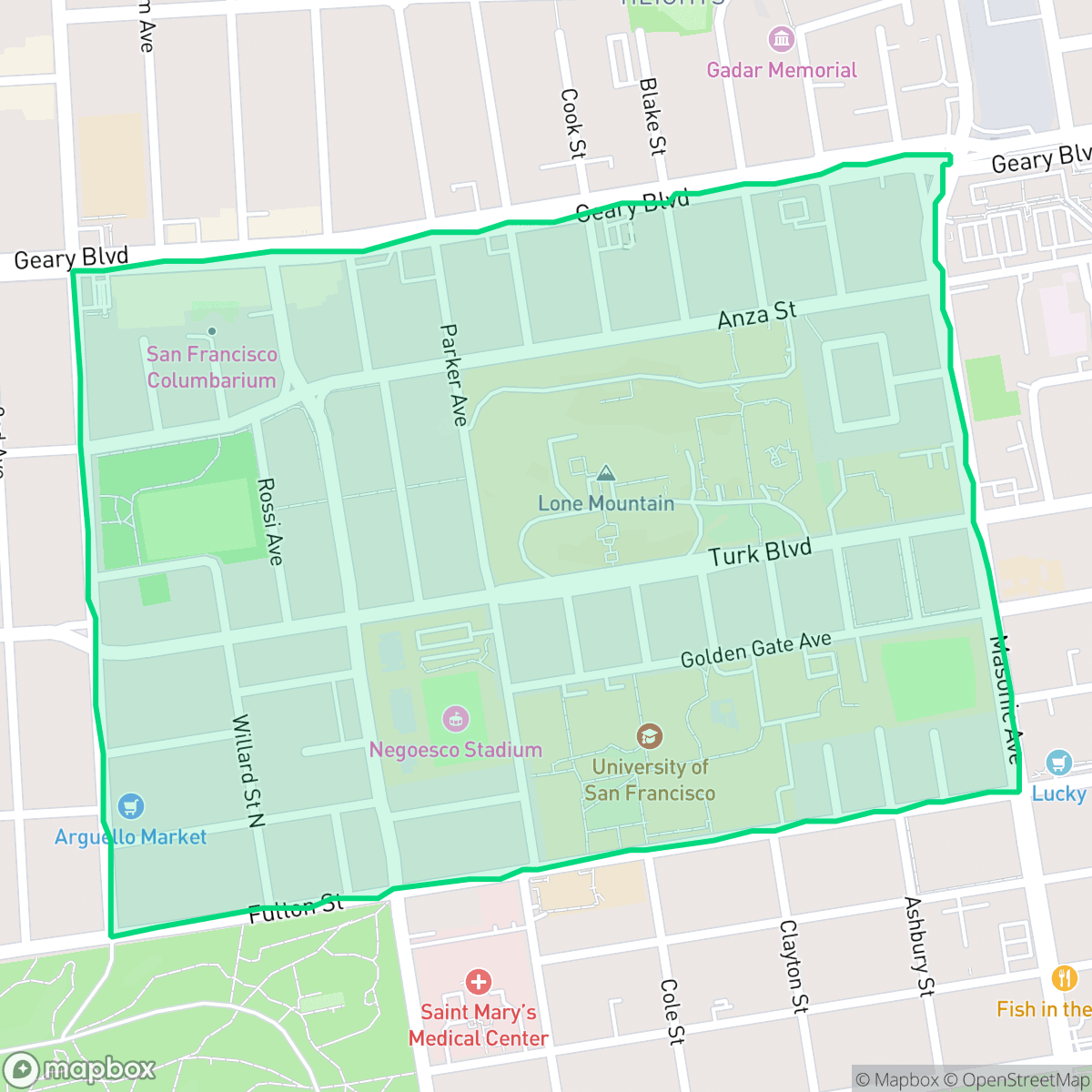
Lone Mountain is a dense, highly walkable San Francisco neighborhood defined by its academic atmosphere and proximity to the University of San Francisco. Residents benefit from excellent air quality and a quiet residential environment, though the area features tightly packed housing with limited privacy.
Key Highlights
About Lone Mountain
Once known by the Spanish as El Divisadero, San Francisco’s Lone Mountain neighborhood was defined in the 19th century by a massive necropolis of four major cemeteries: Laurel Hill, Calvary, Masonic, and Odd Fellows. In the 1930s, the graves were relocated to Colma, and 75 feet of the hill’s summit was shaved down to construct the Spanish Gothic-style San Francisco College for Women. Completed in 1932, this landmark building features a grand garden stairway known as the "Spanish Steps" and was acquired by the adjacent University of San Francisco in 1978. The neighborhood’s architectural character is further anchored by the majestic, Neo-Baroque St. Ignatius Church, built between 1910 and 1914, whose twin towers historically served as a beacon for ships at sea.
The neighborhood functions as a quiet, residential, and institutional enclave situated within a dense urban grid of multi-story row houses and apartment buildings. According to data, the area is characterized by a complete absence of industrial facilities, contributing to a clean and stable atmosphere. The presence of the University of San Francisco significantly shapes the local character, fostering a steady, moderate level of activity that caters to a younger demographic. Residents enjoy high levels of health insurance coverage and a consistent, walkable lifestyle that connects local dining, playgrounds, and school athletic fields.
Living in this area requires comfort with high-density housing, as buildings are often situated in close proximity to one another with minimal space between structures. While the neighborhood lacks the high-intensity nightlife found in other parts of the city, it offers a reliable, pedestrian-friendly environment with relatively low noise levels. It is well-suited for those who prioritize walkability, acoustic comfort, and proximity to academic institutions over expansive private outdoor space.
Neighborhood Scores Across 15 Qualities
Residential buildings are positioned very closely together with minimal separation between structures. According to iHuus data, this density of housing results in a privacy level that is slightly lower than the San Francisco average.
Continuous sidewalks and frequent crosswalks make navigating the area on foot very easy. According to iHuus data, the infrastructure is slightly more pedestrian-oriented than the typical San Francisco neighborhood.
Residential structures typically feature uniform, boxy architecture and small yards, which is largely consistent with the city average. Most housing consists of densely packed units with limited private outdoor amenities.
Extensive access to Golden Gate Park and various athletic fields provides significantly more space for pet exercise than the San Francisco average. Neighborhood sidewalks and local green spaces offer ample opportunities for walking dogs near home.
Mid-rise buildings and multi-family units define the landscape, offering a less dense environment than the typical San Francisco urban core. According to iHuus data, the area features a more spread out layout with fewer concentrated commercial blocks compared to the city average.
Local dining hubs and diverse cafes provide a steady social energy that is slightly higher than the San Francisco average. While some pockets remain quiet and remote, many blocks offer walkable access to various eateries and community landmarks.
Steady traffic noise from nearby busy streets is a common feature of the area, though it remains quieter than many other parts of San Francisco according to iHuus data.
Air quality remains consistently high with rare instances of elevated readings. According to iHuus data, the air in this area is slightly cleaner than the San Francisco average.
Industrial hazards and warehouses are absent from this area, which consists almost entirely of residential, institutional, and recreational spaces. According to iHuus data, this lack of heavy industry makes the neighborhood slightly cleaner of industrial proximity than the San Francisco average.
Health insurance enrollment is very high among residents, significantly exceeding the San Francisco average according to iHuus data.
Voting patterns and census indicators in Lone Mountain reflect a predominantly liberal political landscape, which is very similar to the broader San Francisco average according to iHuus data.
A varied mix of young adults, families, and older residents defines the area. This demographic spread is slightly less concentrated than the San Francisco average, according to iHuus data.
Flood risk is higher than the San Francisco average because portions of the area fall within a designated floodplain. According to iHuus data, properties in this zone may require flood insurance.
Address-Level Insights for Lone Mountain


iHuus Neighborhood Intelligence Insights
Get address-level neighborhood insights for Lone Mountain
- Street-level scores — see how individual blocks compare, not just neighborhood averages
- Micro-zone boundaries — identify quiet pockets, flood boundaries, and walkable clusters before you visit
- 15 dimensions in full — walkability, noise, air quality, school quality, insurance coverage, population age profile, urban/rural index, and more
- Boundary risk alerts — know if your address sits near a block boundary where scores drop, the kind of detail no listing will ever mention
- School insights — individual school ratings and insights, not just district-level data
- Compare before you commit — side-by-side data across neighborhoods, down to block precision
No credit card required
Compare with Any Neighborhood
| Dimension | Lone Mountain | Alamo Square |
|---|---|---|
| 🚶 Walkabilityavg 9.91 | ||
| 🔊 Acoustic Comfortavg 3.4 | ||
| 🤫 Privacy Indexavg 2.14 | ||
| 🎨 Visual Appealavg 6.26 | ||
| 🐕 Dog Friendlinessavg 6.55 | ||
| 🗺️ Urban-Rural Indexavg 4.07 | ||
| ✨ Neighborhood Vibeavg 6.4 | ||
| 🏥 Health Insurance Coverageavg 7.87 | ||
| 🌿 Air Qualityavg 7.78 | ||
| 🏭 Industrial Proximityavg 9.37 | ||
| 🌊 Flood Safetyavg 1.89 | ||
| 🗳️ Ideological Leanavg 9.92 | ||
| 👥 Population Age Profileavg 5.18 | ||
| 🔥 Fire Safetyavg 0.01 | ||
| 🏫 School Quality |
Lone Mountain Rankings
School Districts Serving Lone Mountain
School Insights for Lone Mountain
Below average outcomes; significant attendance and academic challenges.
School Insights
See what's really behind every school rating near Lone Mountain
- Individual school ratings — each school's own score with outcome context, not just a district average
- Enrollment & class size data — student-to-teacher ratio and how it compares to the state average
- Full demographics breakdown — ethnicity and gender composition for every school in the enrollment zone
- Every school in the district — all schools within the enrollment boundary ranked by rating, not just the closest one
- Grade levels & benchmarks — elementary through high school, with below/above state-average flags
No credit card required