Little Hollywood, San Francisco
Updated · 1,555 residents
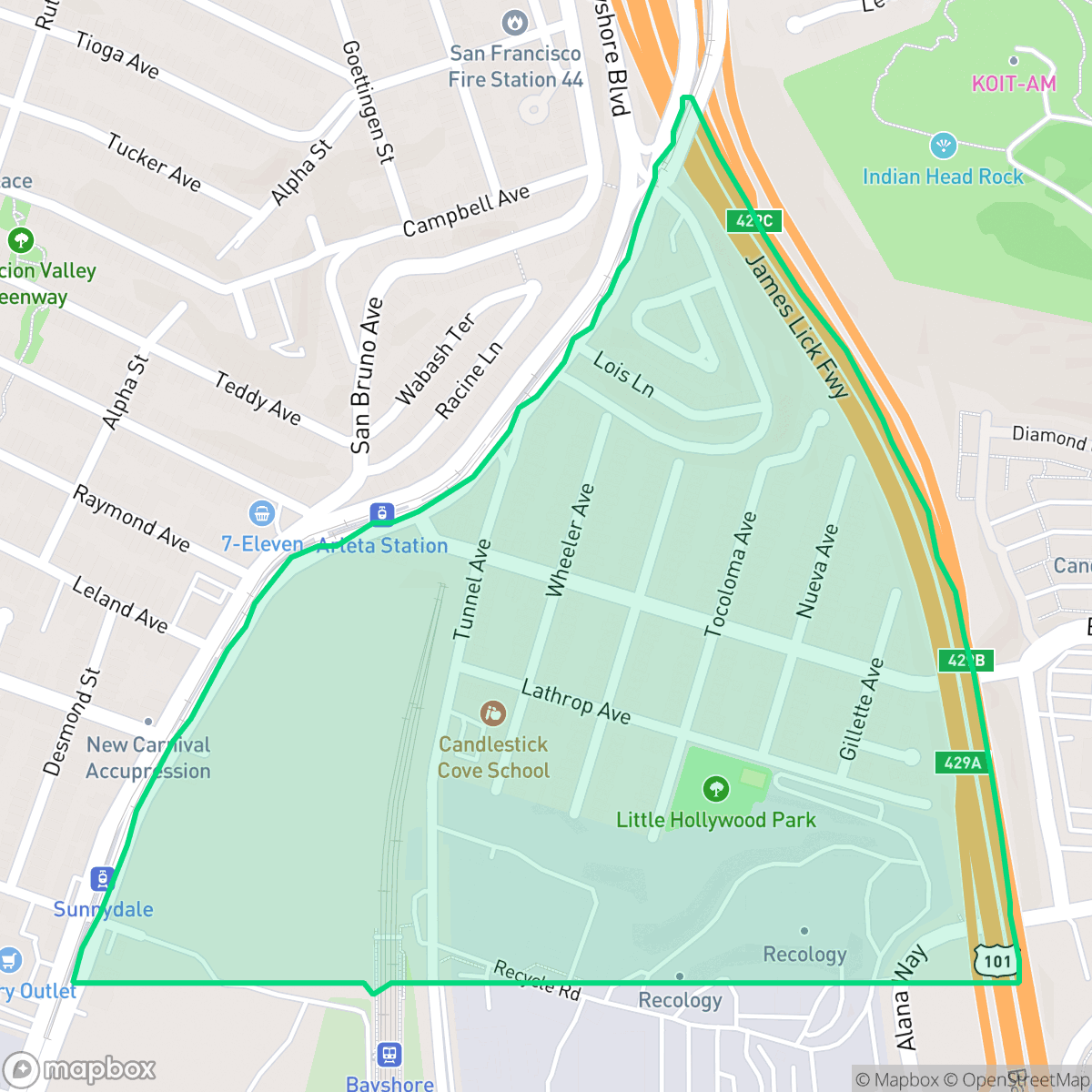
Little Hollywood is a quiet enclave on the southeastern edge of San Francisco, defined by its distinctive Spanish and Mediterranean-style bungalows. While the area offers good air quality and access to local green spaces, residents experience noticeable noise from nearby road traffic and a dense, industrial-adjacent setting.
Key Highlights
About Little Hollywood
Tucked into San Francisco’s southeastern edge, Little Hollywood was developed in the 1920s by the Crocker Estate Company as the "Bayshore Tract". In 1929, builder William H. Grahn and architect Charles Strothoff began constructing Spanish and Mediterranean-style bungalows along Tocoloma Avenue. Real estate agents coined the name "Little Hollywood" in 1943, noting the homes' resemblance to the whimsical, Hollywood Hills-style architecture. A prominent neighborhood landmark is "Casa Bahia Loma," a 1933 Mission Revival home built as a model home for a local brewery executive, which local legend famously (though falsely) claims was a secret getaway for actress Mae West. Today, this quiet enclave is also known for its proximity to the neighboring Recology facility, which features a unique hillside sculpture garden showcasing art crafted entirely from discarded materials.
The neighborhood maintains a unique, low-rise residential character that stands apart from the high-density urban core of San Francisco. According to iHuus data, it provides a stable environment for its residents, characterized by high rates of health insurance coverage and a strong sense of community. The street grid is generally consistent, though the proximity to industrial corridors and rail lines often necessitates detours for pedestrians moving through the area.
Living here involves certain trade-offs, particularly regarding acoustic comfort and home privacy. The area features a tightly packed housing pattern, which limits personal space, and ambient noise levels are primarily influenced by significant road traffic. It is best suited for those who value a quiet, suburban feel within city limits and prioritize proximity to open space over immediate access to a bustling commercial center.
Neighborhood Scores Across 15 Qualities
Residential structures are characterized by a row-house pattern with shared walls or very narrow gaps between buildings. This close-quarters arrangement is typical for the area and is largely in line with the broader San Francisco average.
Wide sidewalks and clear crosswalks provide a safe environment for pedestrians, though industrial blocks and railway tracks can occasionally necessitate detours. This area remains slightly below the city average for overall ease of walking.
Uniform, high-density housing with modest yards defines the local landscape. This visual character is slightly below the San Francisco average due to a lack of large estates or lush greenery.
Access to large public parks and significant green space makes this area more dog friendly than the San Francisco average. Large undeveloped fields and tree-lined streets provide ample space for walking and recreation according to iHuus data.
Streets and green spaces exist in roughly equal measure, providing a more suburban feel than much of the dense San Francisco core. According to iHuus data, the landscape varies from high-density residential blocks to industrial corridors and large open lots.
Local activity is notably subdued compared to the San Francisco average, characterized by quiet residential blocks and industrial areas near the coastline. While a few dining options exist, there is a lack of concentrated commercial activity or walkable social hubs according to iHuus data.
Frequent noise from nearby transportation infrastructure makes this area significantly louder than most parts of San Francisco. Residents can expect persistent sound from heavy rail or aircraft proximity according to iHuus data.
Air quality in this area is consistently good, with levels slightly higher than the San Francisco average according to iHuus data.
Industrial presence is minimal in this area, consisting only of occasional light commercial activity. This neighborhood features less industrial density than the San Francisco average, providing a primarily residential environment according to iHuus data.
Health insurance access is very high among residents, significantly exceeding the San Francisco average according to iHuus data.
Voting patterns and census indicators show a highly liberal political landscape that aligns with the broader San Francisco average.
Residents live alongside a balanced mix of young professionals, families, and seniors. This demographic distribution is consistent with the broader San Francisco population, according to iHuus data.
Located within a coastal high-hazard zone with significant wave action, this area carries a higher risk of flooding than the San Francisco average. Residents should prepare for elevated or potentially prohibitive flood insurance costs according to iHuus data.
Address-Level Insights for Little Hollywood


iHuus Neighborhood Intelligence Insights
Get address-level neighborhood insights for Little Hollywood
- Street-level scores — see how individual blocks compare, not just neighborhood averages
- Micro-zone boundaries — identify quiet pockets, flood boundaries, and walkable clusters before you visit
- 15 dimensions in full — walkability, noise, air quality, school quality, insurance coverage, population age profile, urban/rural index, and more
- Boundary risk alerts — know if your address sits near a block boundary where scores drop, the kind of detail no listing will ever mention
- School insights — individual school ratings and insights, not just district-level data
- Compare before you commit — side-by-side data across neighborhoods, down to block precision
No credit card required
Compare with Any Neighborhood
| Dimension | Little Hollywood | Alamo Square |
|---|---|---|
| 🚶 Walkabilityavg 9.91 | ||
| 🔊 Acoustic Comfortavg 3.4 | ||
| 🤫 Privacy Indexavg 2.14 | ||
| 🎨 Visual Appealavg 6.26 | ||
| 🐕 Dog Friendlinessavg 6.55 | ||
| 🗺️ Urban-Rural Indexavg 4.07 | ||
| ✨ Neighborhood Vibeavg 6.4 | ||
| 🏥 Health Insurance Coverageavg 7.87 | ||
| 🌿 Air Qualityavg 7.78 | ||
| 🏭 Industrial Proximityavg 9.37 | ||
| 🌊 Flood Safetyavg 1.89 | ||
| 🗳️ Ideological Leanavg 9.92 | ||
| 👥 Population Age Profileavg 5.18 | ||
| 🔥 Fire Safetyavg 0.01 | ||
| 🏫 School Quality |
Little Hollywood Rankings
School Districts Serving Little Hollywood
School Insights for Little Hollywood
Below average outcomes; significant attendance and academic challenges.
School Insights
See what's really behind every school rating near Little Hollywood
- Individual school ratings — each school's own score with outcome context, not just a district average
- Enrollment & class size data — student-to-teacher ratio and how it compares to the state average
- Full demographics breakdown — ethnicity and gender composition for every school in the enrollment zone
- Every school in the district — all schools within the enrollment boundary ranked by rating, not just the closest one
- Grade levels & benchmarks — elementary through high school, with below/above state-average flags
No credit card required