Lakeside, San Francisco
Updated · 1,957 residents
Lakeside is a highly walkable San Francisco enclave defined by its mid-century architecture and proximity to the retail hubs along Ocean Avenue. Residents benefit from excellent air quality and convenient access to local services, though the area is characterized by dense housing and notable road traffic noise.
Key Highlights
About Lakeside
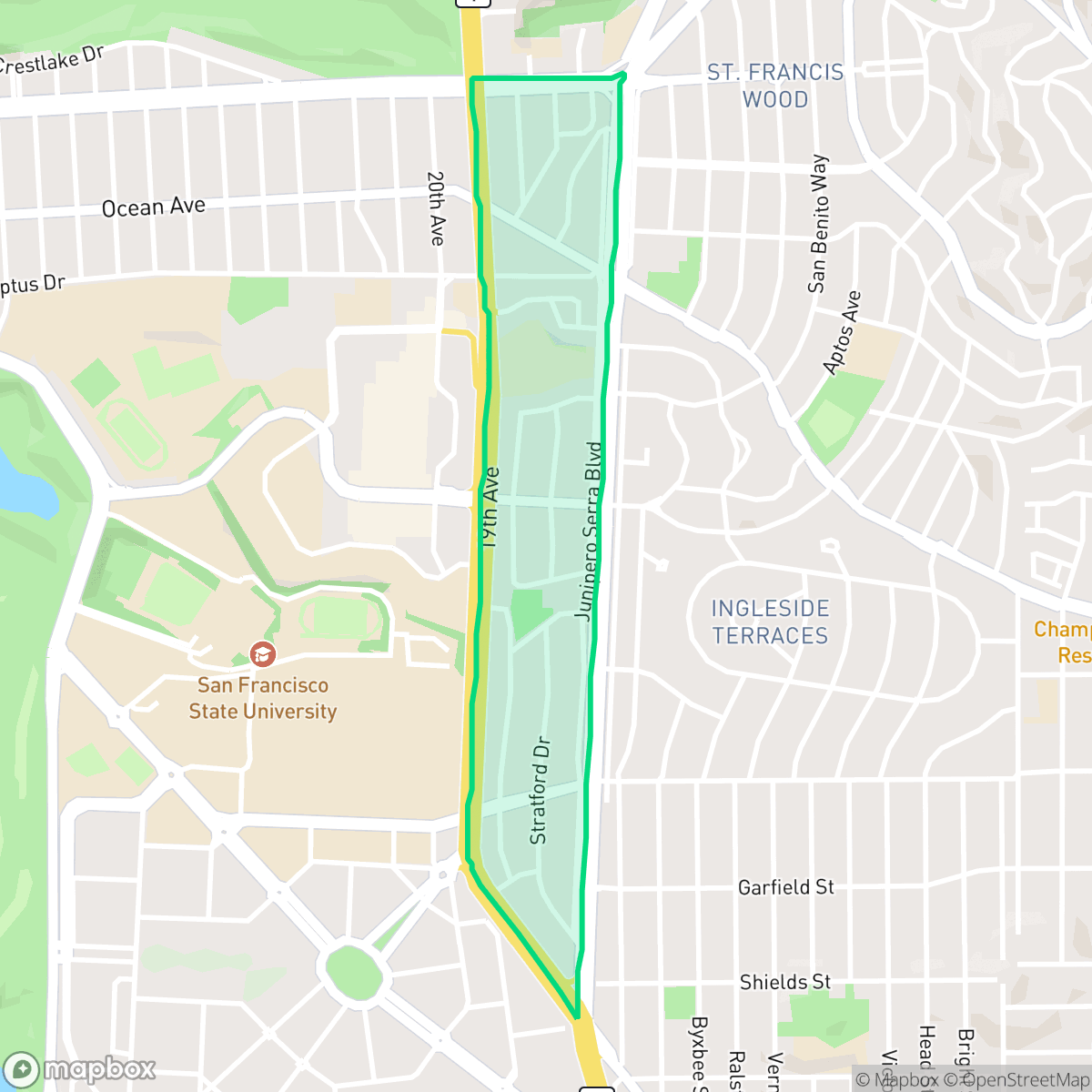
Conceived by Icelandic immigrant developers Ellis and Henry Stoneson, the Lakeside neighborhood in San Francisco was constructed between 1936 and 1950 as a "garden community" for professionals. Designed largely by architect Harold G. Stoner, the development was one of the first in the city to feature entirely underground public utilities, preserving views along its tidy, tree-lined streets. Lakeside is characterized by its distinctive white picket fences and highly varied architectural details, blending Colonial Revival and Streamline Moderne styles. The neighborhood’s commercial hub, Lakeside Village along Ocean Avenue, features the prominent Lakeside Medical Building—a striking, futuristic Art Deco tower often described as "rocket-ship colonial". The Stoneson brothers also constructed their own grand personal mansions within this highly planned, cohesive residential enclave.
This neighborhood functions as a dense, urban-oriented community that balances residential comfort with immediate access to commercial amenities. The area maintains a lively atmosphere, supported by a diverse array of local businesses and restaurants. With high rates of health insurance coverage and a complete lack of industrial hazards, the environment is well-suited for professionals and families who prioritize connectivity and convenience over expansive private outdoor space.
Living here involves specific trade-offs, particularly regarding acoustic comfort and personal privacy. The proximity to major transit corridors contributes to a consistent ambient noise level, while the tightly packed housing layout results in minimal setbacks between properties. The area is an ideal choice for those who value a pedestrian-centric lifestyle and want to remain close to the city's active commercial centers, provided they are comfortable with a more urban, high-density residential experience.
Neighborhood Scores Across 15 Qualities
Buildings are closely packed with minimal separation between structures, though this density is slightly higher than the San Francisco average. According to iHuus data, many residences feature narrow side yards and shared walls.
Complete sidewalk networks and clearly marked crosswalks make navigating the area on foot easy. This neighborhood offers superior pedestrian infrastructure compared to the San Francisco average, according to iHuus data.
Standard mid-century tract housing and boxy rooflines define the area. The visual landscape is slightly less varied than the San Francisco average due to the high density and uniform lot coverage.
Abundant green spaces, including a large central park and continuous sidewalk verges, provide superior walking options for pet owners compared to the city average. Multiple neighborhood parks and wide paths offer safe, connected areas for exercise away from traffic.
Residential streets and green spaces are distributed in a way that feels more suburban than the dense urban core of San Francisco. According to iHuus data, the area features a blend of single-family homes and low-rise apartments that provides a more balanced landscape than the city average.
Local hubs and diverse eateries provide a noticeable level of social activity that is slightly higher than the San Francisco average. While some blocks offer a calm, suburban feel, others feature concentrated clusters of businesses and parks near major transit corridors.
Persistent ambient noise is significantly higher here than the city average. Residents can expect frequent auditory disturbances due to heavy traffic and surrounding industrial activity, according to iHuus data.
Air quality remains consistently high with infrequent periods of poor ventilation. This level of cleanliness is slightly above the San Francisco average, according to iHuus data.
Industrial activity and warehouses are entirely absent from this area, providing a cleaner environment than the San Francisco average. According to iHuus data, the neighborhood consists solely of residential, retail, and recreational spaces with no detectable hazardous facilities.
Health insurance access is exceptionally high among residents, significantly surpassing the San Francisco average according to iHuus data.
Voting patterns and census indicators show a deeply liberal political leaning that is consistent with the broader San Francisco average, according to iHuus data.
A balanced mix of young professionals, families, and seniors characterizes the area. This demographic distribution aligns with the broader San Francisco average according to iHuus data.
Flood risk in this area is significant due to its location within a designated floodplain; according to iHuus data, this level of vulnerability is slightly higher than the San Francisco average.
Address-Level Insights for Lakeside


iHuus Neighborhood Intelligence Insights
Get address-level neighborhood insights for Lakeside
- Street-level scores — see how individual blocks compare, not just neighborhood averages
- Micro-zone boundaries — identify quiet pockets, flood boundaries, and walkable clusters before you visit
- 15 dimensions in full — walkability, noise, air quality, school quality, insurance coverage, population age profile, urban/rural index, and more
- Boundary risk alerts — know if your address sits near a block boundary where scores drop, the kind of detail no listing will ever mention
- School insights — individual school ratings and insights, not just district-level data
- Compare before you commit — side-by-side data across neighborhoods, down to block precision
No credit card required
Compare with Any Neighborhood
| Dimension | Lakeside | Alamo Square |
|---|---|---|
| 🚶 Walkabilityavg 9.91 | ||
| 🔊 Acoustic Comfortavg 3.4 | ||
| 🤫 Privacy Indexavg 2.14 | ||
| 🎨 Visual Appealavg 6.26 | ||
| 🐕 Dog Friendlinessavg 6.55 | ||
| 🗺️ Urban-Rural Indexavg 4.07 | ||
| ✨ Neighborhood Vibeavg 6.4 | ||
| 🏥 Health Insurance Coverageavg 7.87 | ||
| 🌿 Air Qualityavg 7.78 | ||
| 🏭 Industrial Proximityavg 9.37 | ||
| 🌊 Flood Safetyavg 1.89 | ||
| 🗳️ Ideological Leanavg 9.92 | ||
| 👥 Population Age Profileavg 5.18 | ||
| 🔥 Fire Safetyavg 0.01 | ||
| 🏫 School Quality |
Lakeside Rankings
School Districts Serving Lakeside
School Insights for Lakeside
Below average outcomes; significant attendance and academic challenges.
School Insights
See what's really behind every school rating near Lakeside
- Individual school ratings — each school's own score with outcome context, not just a district average
- Enrollment & class size data — student-to-teacher ratio and how it compares to the state average
- Full demographics breakdown — ethnicity and gender composition for every school in the enrollment zone
- Every school in the district — all schools within the enrollment boundary ranked by rating, not just the closest one
- Grade levels & benchmarks — elementary through high school, with below/above state-average flags
No credit card required