Lakeshore, San Francisco
Updated · 9,605 residents
Lakeshore is a quiet, suburban enclave in southwestern San Francisco defined by its proximity to Lake Merced and expansive green spaces. While the area offers high walkability and excellent access to pet-friendly trails, residents should note the high density of housing and frequent noise from nearby transit corridors.
Key Highlights
About Lakeshore
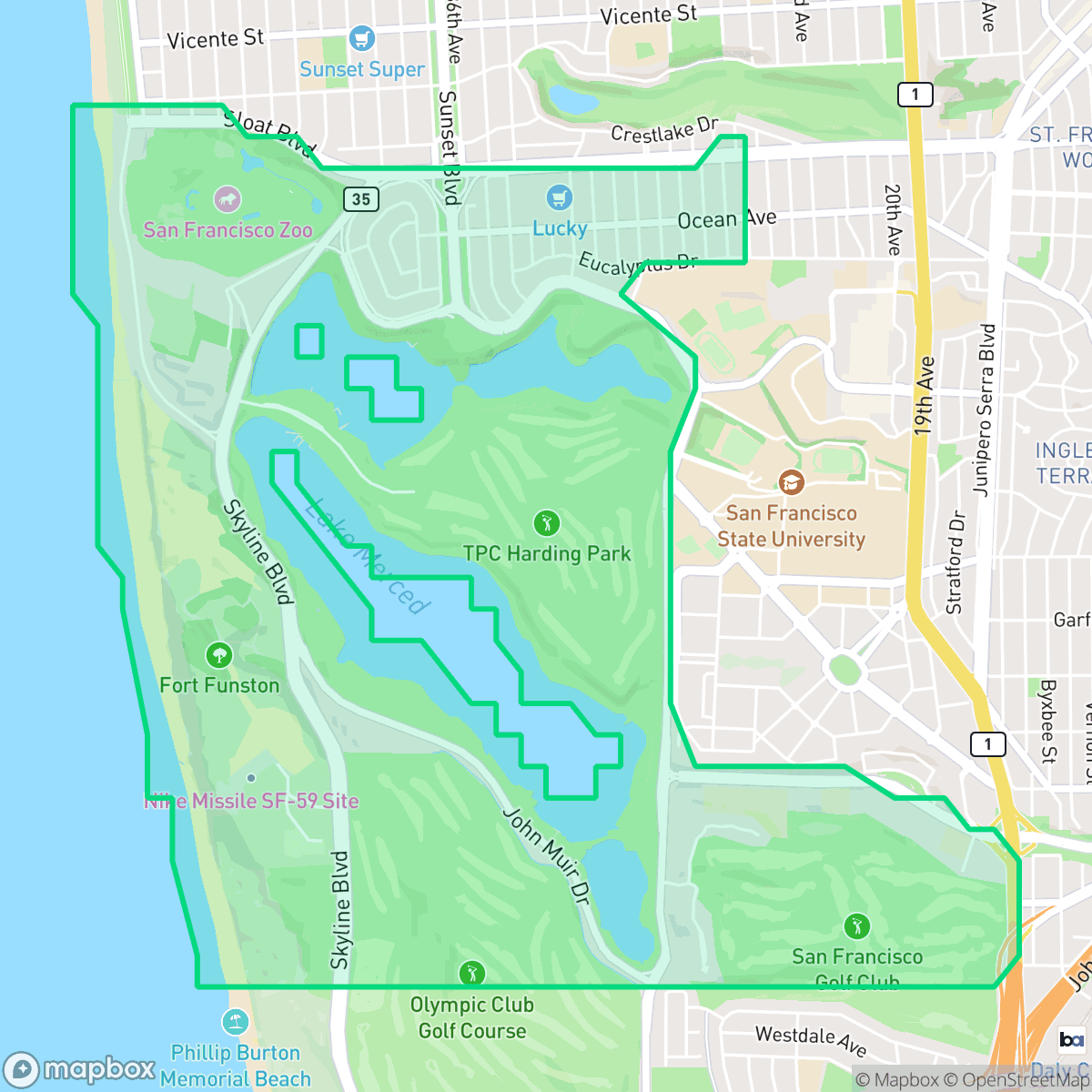
The Lakeshore neighborhood in southwestern San Francisco was primarily developed in the late 1930s and 1940s by brothers Ellis and Henry Stoneson. Built on land that was formerly used for dairy farming and sand dunes, the area is characterized by its distinct mid-century modern residential architecture, featuring well-preserved homes that reflect the post-war suburban growth of the city. Lakeshore is situated adjacent to Lake Merced and the Stonestown Galleria—the latter named after the developers themselves—which serves as a significant commercial anchor for the area. The neighborhood maintains a cohesive residential character, defined by its proximity to the lake and its role in the mid-20th-century expansion of San Francisco’s southwestern corridor.
The area offers a distinct semi-rural atmosphere within the city limits, characterized by its abundant open land and managed greenery. It is a highly walkable community with a dense network of sidewalks that connects residents to essential services and local recreation. The demographic profile is notably mixed, supporting a range of households from young professionals to seniors who value a more serene, residential pace compared to the bustling urban core. Residents benefit from high levels of health insurance coverage and a strong sense of community, reflecting the area's stable and established nature.
Prospective residents should weigh the benefits of this quiet environment against specific livability trade-offs. The neighborhood experiences elevated noise levels from nearby highways and rail lines, and the high residential density means that privacy is often limited by shared walls. Additionally, the area faces a notable flood risk due to its location, and while it provides access to various school districts, academic performance varies significantly across those institutions. According to iHuus data, the area remains a primarily residential landscape, largely free from industrial activity.
Neighborhood Scores Across 15 Qualities
Shared walls and minimal separation between structures are common throughout the area. This level of proximity is higher than the San Francisco average, according to iHuus data.
Pedestrian movement is facilitated by a dense network of sidewalks and frequent crosswalks throughout most residential zones. While the area remains very walkable, it is slightly less accessible on foot than the San Francisco average due to certain segments being severed by major highways and transit rail.
Uniform tract housing and dense apartment complexes characterize the area. This level of visual variety is roughly in line with the city average.
Extensive green spaces, including a massive golf course and large parklands, provide significantly more room for dogs to roam than the San Francisco average. According to iHuus data, the neighborhood offers abundant trails and direct access to beach areas for active pets.
Expansive parks and managed green spaces provide a semi-rural feel that is significantly more open than the typical San Francisco urban landscape. According to iHuus data, the area features frequent open land and a notable presence of greenery compared to the city average.
Low-density residential blocks and expansive green spaces create a serene environment that is notably calmer than the San Francisco average. While a few local eateries and essential services are available, the area lacks the high-energy urban activity found in more central parts of the city.
Frequent sounds from nearby highways and rail lines contribute to a noisy environment. According to iHuus data, acoustic comfort in Lakeshore is slightly below the city average.
Air quality remains consistently clear with rare instances of elevated readings, performing slightly better than the San Francisco average according to iHuus data.
Industrial activity is virtually non-existent in this area, providing a landscape free of warehouses or heavy machinery. While a nearby rail yard and transit maintenance facility may introduce some noise, the neighborhood remains slightly more residential than the San Francisco average according to iHuus data.
Health insurance access is exceptionally high among residents, significantly surpassing the San Francisco average according to iHuus data.
Voting patterns and census indicators show a deeply liberal political landscape that is largely consistent with the broader San Francisco area, according to iHuus data.
A diverse range of age groups, including young professionals, families, and seniors, resides in this area. This demographic spread is slightly more varied than the average seen across San Francisco, according to iHuus data.
Significant flood risk exists due to the area's location within a 100-year floodplain; according to iHuus data, this vulnerability is notably higher than the San Francisco average.
Fire safety levels in Lakeshore are consistent with the rest of San Francisco. No significant deviations in fire risk or protection infrastructure were identified according to iHuus data.
Address-Level Insights for Lakeshore


iHuus Neighborhood Intelligence Insights
Get address-level neighborhood insights for Lakeshore
- Street-level scores — see how individual blocks compare, not just neighborhood averages
- Micro-zone boundaries — identify quiet pockets, flood boundaries, and walkable clusters before you visit
- 15 dimensions in full — walkability, noise, air quality, school quality, insurance coverage, population age profile, urban/rural index, and more
- Boundary risk alerts — know if your address sits near a block boundary where scores drop, the kind of detail no listing will ever mention
- School insights — individual school ratings and insights, not just district-level data
- Compare before you commit — side-by-side data across neighborhoods, down to block precision
No credit card required
Compare with Any Neighborhood
| Dimension | Lakeshore | Alamo Square |
|---|---|---|
| 🚶 Walkabilityavg 9.91 | ||
| 🔊 Acoustic Comfortavg 3.4 | ||
| 🤫 Privacy Indexavg 2.14 | ||
| 🎨 Visual Appealavg 6.26 | ||
| 🐕 Dog Friendlinessavg 6.55 | ||
| 🗺️ Urban-Rural Indexavg 4.07 | ||
| ✨ Neighborhood Vibeavg 6.4 | ||
| 🏥 Health Insurance Coverageavg 7.87 | ||
| 🌿 Air Qualityavg 7.78 | ||
| 🏭 Industrial Proximityavg 9.37 | ||
| 🌊 Flood Safetyavg 1.89 | ||
| 🗳️ Ideological Leanavg 9.92 | ||
| 👥 Population Age Profileavg 5.18 | ||
| 🔥 Fire Safetyavg 0.01 | ||
| 🏫 School Quality |
Lakeshore Rankings
School Districts Serving Lakeshore
School Insights for Lakeshore
Below average outcomes; significant attendance and academic challenges.
School Insights
See what's really behind every school rating near Lakeshore
- Individual school ratings — each school's own score with outcome context, not just a district average
- Enrollment & class size data — student-to-teacher ratio and how it compares to the state average
- Full demographics breakdown — ethnicity and gender composition for every school in the enrollment zone
- Every school in the district — all schools within the enrollment boundary ranked by rating, not just the closest one
- Grade levels & benchmarks — elementary through high school, with below/above state-average flags
No credit card required