Lake, San Francisco
Updated · 6,518 residents
The Lake neighborhood is a premier residential enclave defined by its grand historic architecture and exceptional quiet. With near-perfect walkability and immediate access to the Presidio, it offers a serene, highly desirable living environment for those seeking a blend of urban convenience and tranquil, leafy streets.
Key Highlights
About Lake
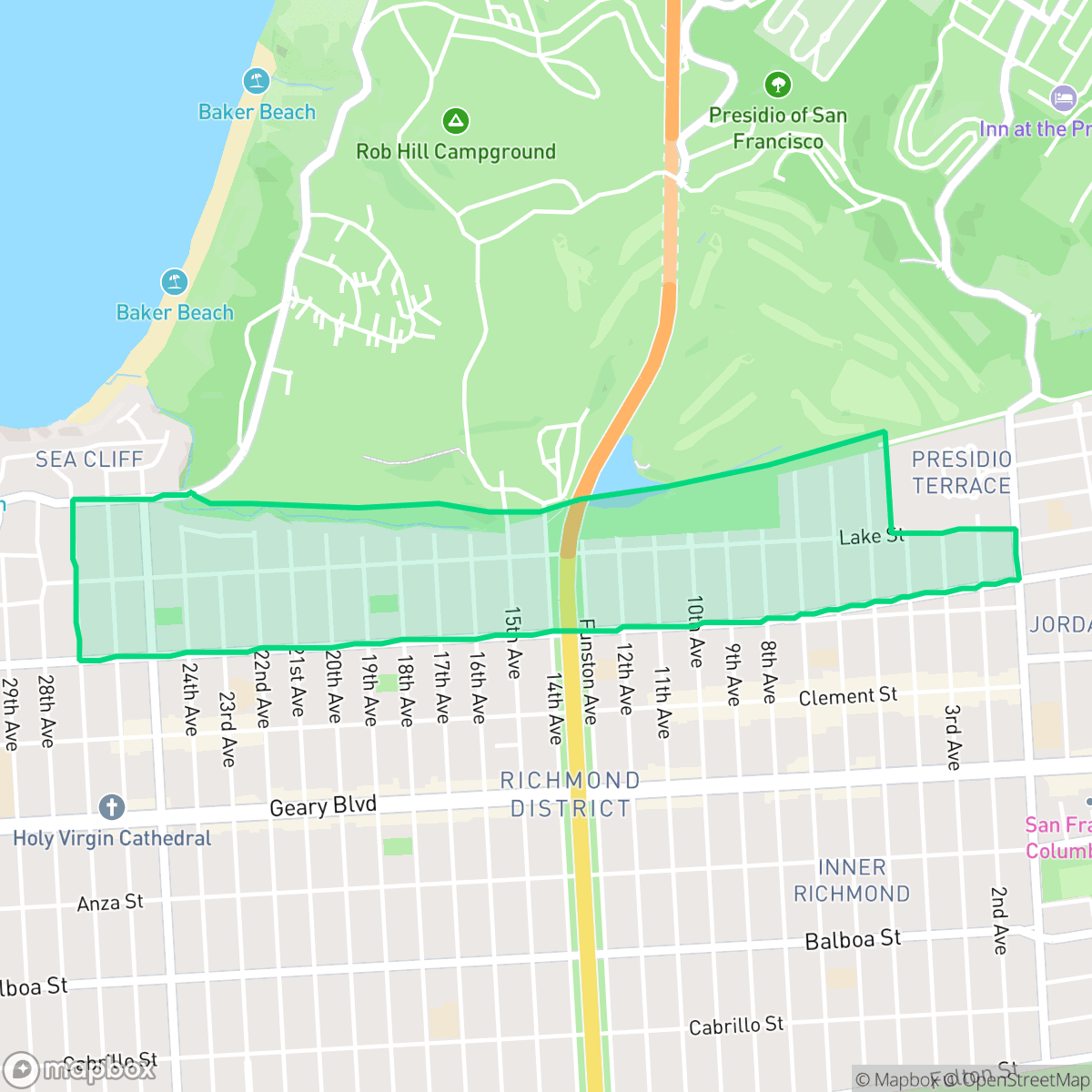
The Lake Street District, or Lake, is a historic residential enclave in San Francisco bounded by the Presidio to the north. The neighborhood's history is anchored by Mountain Lake, one of the city's last natural freshwater lakes, where Spanish explorer Juan Bautista de Anza camped in 1776 while identifying a site for the Presidio. Originally composed of sand dunes, the area rapidly developed after the 1906 earthquake as wealthy residents sought refuge from downtown. They commissioned leading architects to build grand Edwardian, Victorian, and Queen Anne homes. The neighborhood features West Clay Park, a master-planned "residence park" established in 1910 with curvilinear streets and underground utilities. This scenic enclave was the childhood home of legendary photographer Ansel Adams.
This area stands out for its serene residential atmosphere and high visual appeal, characterized by a mix of stately Edwardian and Queen Anne homes. Residents benefit from an extremely quiet environment, with acoustic levels significantly lower than the city average. The neighborhood maintains a strong connection to nature, serving as a gateway to the Presidio’s vast trail systems and golf course, while local culinary staples like Arsicault Bakery and diverse eateries on the periphery provide a balanced, high-quality lifestyle.
While the area offers an elite living experience, prospective residents should note the limited privacy inherent in its dense, zero-lot-line housing layout. Additionally, families should consider the current operational challenges facing the San Francisco Unified School District, which may impact long-term educational planning. Despite these trade-offs, the neighborhood remains a top choice for professionals and families who prioritize a peaceful, walkable, and architecturally rich environment in a central San Francisco location.
Neighborhood Scores Across 15 Qualities
Residential structures feature very tight spacing and frequent shared walls, resulting in a level of density that is similar to the San Francisco average. According to iHuus data, many homes are built with zero-lot-line construction where buildings are nearly touching.
Extensive sidewalk networks and frequent crosswalks make navigating the area on foot exceptionally easy. According to iHuus data, the neighborhood offers a level of walkability that is slightly above the San Francisco average.
Manicured landscapes and large residential properties contribute to a visual quality that is above the city average. Residents can expect a mix of architectural variety ranging from high-value coastal estates to dense urban housing.
Access to large coastal parks, forested trails, and nearby green boulevards provides excellent walking space for pets. This level of accessibility to open space is above the city average according to iHuus data.
Residential streets and green spaces exist in roughly equal measure, providing a more suburban character than the dense urban core of San Francisco. According to iHuus data, the area features a mix of high-density housing grids and significant access to large parklands and coastal preserves.
Social hubs and diverse dining options are more concentrated here than the city average. Residents can find a mix of quiet, green residential streets and busier urban corridors featuring various local cafes and eateries.
A steady hum of local traffic from nearby busy streets is present. This level of acoustic activity is higher than the city average for San Francisco.
Air quality in this area is generally good, though it remains slightly below the San Francisco average according to iHuus data.
Industrial activity and warehouses are entirely absent from this area, providing a landscape of residential and recreational spaces that is even more purely residential than the San Francisco average. According to iHuus data, there are no detected industrial hazards or heavy manufacturing sites within the neighborhood boundaries.
Health insurance accessibility is exceptionally high among residents, sitting well above the San Francisco average according to iHuus data.
Voting patterns and census indicators reflect a deeply liberal political environment that is consistent with the citywide average, according to iHuus data.
Residents live alongside a diverse mix of young professionals, families, and seniors. This demographic spread is consistent with the broader San Francisco area according to iHuus data.
Flood risk in this area is notably higher than the San Francisco average, though detailed federal studies for this specific location are currently unavailable. Residents should account for potential uncertainty regarding localized drainage and inundation levels.
Address-Level Insights for Lake


iHuus Neighborhood Intelligence Insights
Get address-level neighborhood insights for Lake
- Street-level scores — see how individual blocks compare, not just neighborhood averages
- Micro-zone boundaries — identify quiet pockets, flood boundaries, and walkable clusters before you visit
- 15 dimensions in full — walkability, noise, air quality, school quality, insurance coverage, population age profile, urban/rural index, and more
- Boundary risk alerts — know if your address sits near a block boundary where scores drop, the kind of detail no listing will ever mention
- School insights — individual school ratings and insights, not just district-level data
- Compare before you commit — side-by-side data across neighborhoods, down to block precision
No credit card required
Compare with Any Neighborhood
| Dimension | Lake | Alamo Square |
|---|---|---|
| 🚶 Walkabilityavg 9.91 | ||
| 🔊 Acoustic Comfortavg 3.4 | ||
| 🤫 Privacy Indexavg 2.14 | ||
| 🎨 Visual Appealavg 6.26 | ||
| 🐕 Dog Friendlinessavg 6.55 | ||
| 🗺️ Urban-Rural Indexavg 4.07 | ||
| ✨ Neighborhood Vibeavg 6.4 | ||
| 🏥 Health Insurance Coverageavg 7.87 | ||
| 🌿 Air Qualityavg 7.78 | ||
| 🏭 Industrial Proximityavg 9.37 | ||
| 🌊 Flood Safetyavg 1.89 | ||
| 🗳️ Ideological Leanavg 9.92 | ||
| 👥 Population Age Profileavg 5.18 | ||
| 🔥 Fire Safetyavg 0.01 | ||
| 🏫 School Quality |
Lake Rankings
School Districts Serving Lake
School Insights for Lake
Below average outcomes; significant attendance and academic challenges.
School Insights
See what's really behind every school rating near Lake
- Individual school ratings — each school's own score with outcome context, not just a district average
- Enrollment & class size data — student-to-teacher ratio and how it compares to the state average
- Full demographics breakdown — ethnicity and gender composition for every school in the enrollment zone
- Every school in the district — all schools within the enrollment boundary ranked by rating, not just the closest one
- Grade levels & benchmarks — elementary through high school, with below/above state-average flags
No credit card required