Jordan Park - Laurel Heights, San Francisco
Updated · 4,424 residents
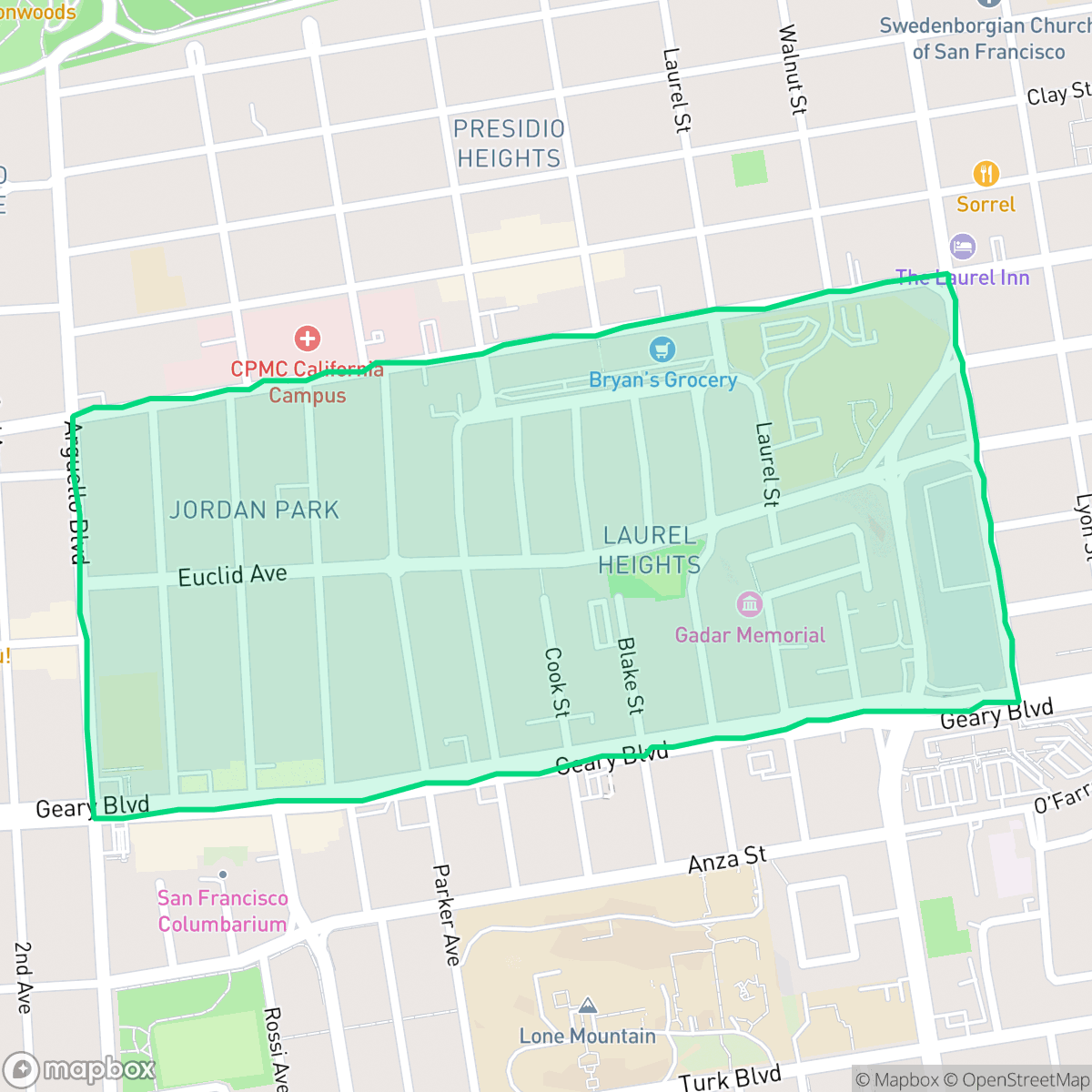
Jordan Park - Laurel Heights is a highly walkable residential neighborhood defined by its dense urban grid and convenient access to local amenities like Laurel Village. Residents enjoy a quiet atmosphere with good air quality and consistent pedestrian access, though the area is characterized by tightly packed housing with limited privacy.
Key Highlights
About Jordan Park - Laurel Heights
The Jordan Park - Laurel Heights neighborhood has a history shaped by military use, early 20th-century urban planning, and major land transformations. In 1891, James Clark Jordan purchased the land that became Jordan Park. Initially used as a military camp (Camp Merritt) during the Spanish-American War in 1898, Jordan developed it from 1900 to 1920 as one of San Francisco’s early "residence parks," featuring 80-foot-wide streets and deep setbacks. Unlike other master-planned communities, Jordan Park uniquely permitted multi-family housing from its inception. Laurel Heights stands on the former site of the sprawling 19th-century Laurel Hill Cemetery. Between 1939 and 1941, approximately 35,000 bodies were reinterred to Colma to clear the land for mid-century residential and commercial development, including the Laurel Village shopping center.
The neighborhood serves as a quiet, primarily residential enclave in San Francisco that balances urban convenience with a steady neighborhood feel. It features a dense grid of row houses and apartment buildings, with the commercial hub of Laurel Village providing central access to shopping and dining. The area is notable for its high walkability and strong acoustic comfort, offering a reprieve from the city's typical noise levels. Local families are served by institutions like Roosevelt Middle School, which remains a focal point for the community despite broader challenges within the regional school district.
Living in this part of the city involves trade-offs regarding residential privacy, as the dense layout often results in buildings being separated by very narrow margins. While the area lacks large public parks, the presence of school athletic fields and the overall pedestrian-friendly design make it suitable for dog owners and those who prioritize a walkable lifestyle. It is well-suited for residents who prefer a stable, institutional environment over high-intensity nightlife, favoring proximity to local amenities and a consistent, quiet atmosphere.
Neighborhood Scores Across 15 Qualities
Close quarters and shared walls are common throughout the neighborhood, resulting in a level of privacy that is slightly below the San Francisco average. Many structures feature zero-lot-line construction where buildings are nearly touching or separated by very narrow gaps.
Continuous sidewalks and prominent crosswalks ensure a seamless walking experience across the entire neighborhood. This level of pedestrian infrastructure is slightly above the San Francisco average according to iHuus data.
Large homes and unique architectural features characterize much of the area. Proximity to major parklands and presence of upscale amenities contribute to a visual appeal that is slightly above the city average, according to iHuus data.
Abundant access to the Presidio Golf Course, athletic fields, and neighborhood parks provides ample space for walking dogs. According to iHuus data, the area offers more connected green spaces and safer walking paths than the San Francisco average.
Residential streets and green spaces are distributed in roughly equal measure, providing a slightly more suburban character than the San Francisco average. According to iHuus data, the area transitions from dense urban grids into significant park and golf course landscapes.
Suburban pockets and calm residential streets alternate with lively blocks featuring diverse dining and local landmarks. While some areas offer walkable access to amenities, the overall activity level is slightly below the San Francisco average according to iHuus data.
Acoustic levels are significantly lower than the San Francisco average, consisting primarily of infrequent distant traffic or passing trains. Residents can expect a calm environment with very little ambient street noise according to iHuus data.
Air quality remains consistently high with rare instances of elevated readings, performing slightly better than the San Francisco average according to iHuus data.
Industrial activity and heavy warehouses are absent from this area, matching the city average for minimal industrial exposure. Residents can expect a landscape composed primarily of residential and institutional uses without the presence of nearby hazard sites.
Nearly all residents in this area are covered by health insurance, a rate that is significantly higher than the San Francisco average according to iHuus data.
Voting patterns and census indicators align closely with the broader San Francisco political landscape. According to iHuus data, the area shares the same strong liberal leaning found across the city.
Residents live alongside a balanced blend of young professionals, families, and older adults. This demographic variety is slightly lower than the city average, according to iHuus data.
Flood risk levels in this area are notably higher than the San Francisco average. According to iHuus data, the lack of detailed FEMA studies means residents should remain aware of potential vulnerabilities during extreme weather events.
Address-Level Insights for Jordan Park - Laurel Heights


iHuus Neighborhood Intelligence Insights
Get address-level neighborhood insights for Jordan Park - Laurel Heights
- Street-level scores — see how individual blocks compare, not just neighborhood averages
- Micro-zone boundaries — identify quiet pockets, flood boundaries, and walkable clusters before you visit
- 15 dimensions in full — walkability, noise, air quality, school quality, insurance coverage, population age profile, urban/rural index, and more
- Boundary risk alerts — know if your address sits near a block boundary where scores drop, the kind of detail no listing will ever mention
- School insights — individual school ratings and insights, not just district-level data
- Compare before you commit — side-by-side data across neighborhoods, down to block precision
No credit card required
Compare with Any Neighborhood
| Dimension | Jordan Park - Laurel Heights | Alamo Square |
|---|---|---|
| 🚶 Walkabilityavg 9.91 | ||
| 🔊 Acoustic Comfortavg 3.4 | ||
| 🤫 Privacy Indexavg 2.14 | ||
| 🎨 Visual Appealavg 6.26 | ||
| 🐕 Dog Friendlinessavg 6.55 | ||
| 🗺️ Urban-Rural Indexavg 4.07 | ||
| ✨ Neighborhood Vibeavg 6.4 | ||
| 🏥 Health Insurance Coverageavg 7.87 | ||
| 🌿 Air Qualityavg 7.78 | ||
| 🏭 Industrial Proximityavg 9.37 | ||
| 🌊 Flood Safetyavg 1.89 | ||
| 🗳️ Ideological Leanavg 9.92 | ||
| 👥 Population Age Profileavg 5.18 | ||
| 🔥 Fire Safetyavg 0.01 | ||
| 🏫 School Quality |
Jordan Park - Laurel Heights Rankings
School Districts Serving Jordan Park - Laurel Heights
School Insights for Jordan Park - Laurel Heights
Below average outcomes; significant attendance and academic challenges.
School Insights
See what's really behind every school rating near Jordan Park - Laurel Heights
- Individual school ratings — each school's own score with outcome context, not just a district average
- Enrollment & class size data — student-to-teacher ratio and how it compares to the state average
- Full demographics breakdown — ethnicity and gender composition for every school in the enrollment zone
- Every school in the district — all schools within the enrollment boundary ranked by rating, not just the closest one
- Grade levels & benchmarks — elementary through high school, with below/above state-average flags
No credit card required