Inner Sunset, San Francisco
Updated · 13,207 residents
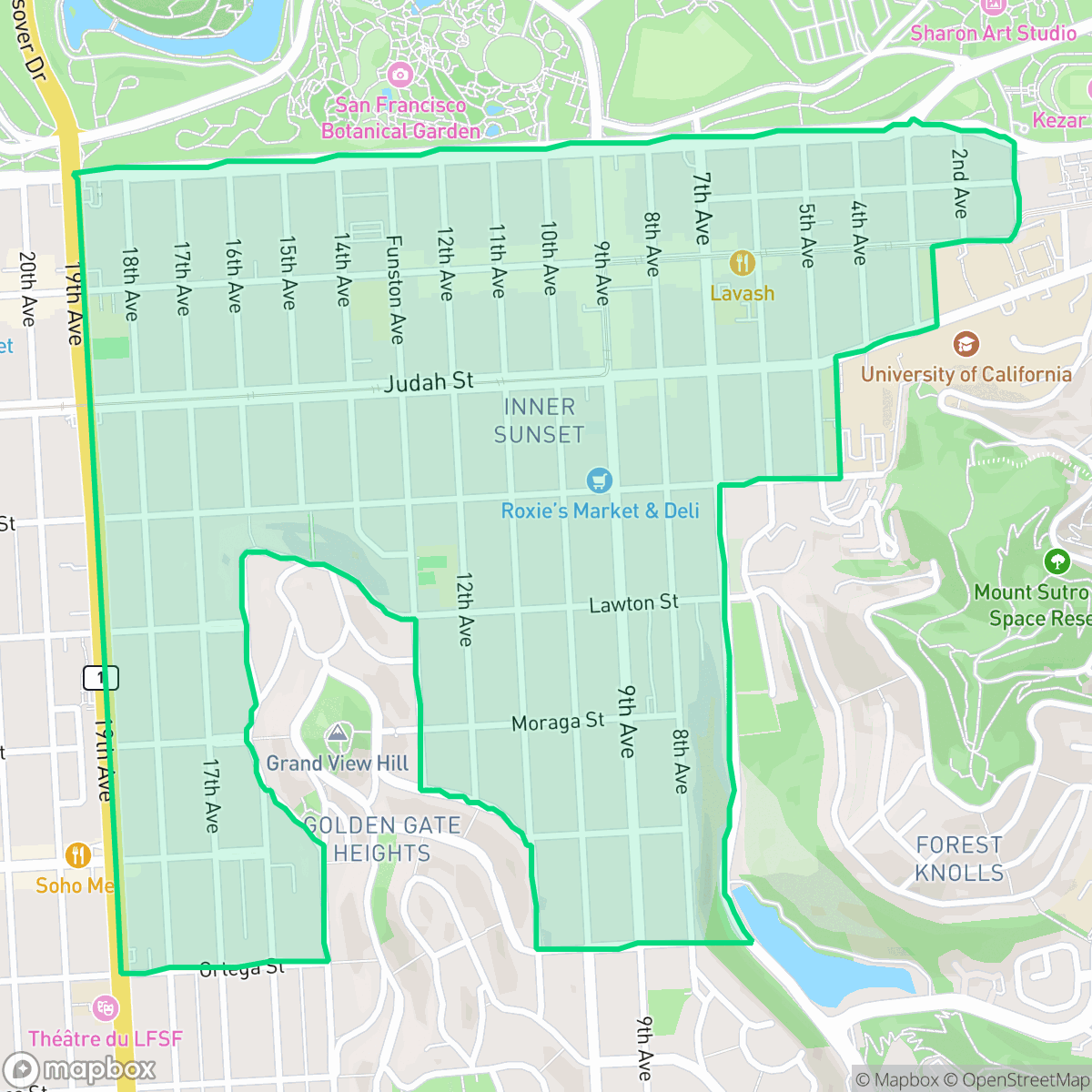
Inner Sunset is a dense, highly walkable neighborhood defined by its vibrant commercial corridor along Irving Street and its immediate proximity to Golden Gate Park. Residents enjoy a lively urban atmosphere with diverse dining options, though the area features tightly packed housing with limited privacy and consistent road traffic noise.
Key Highlights
About Inner Sunset
Originally a vast expanse of sand dunes known as the "Outside Lands," San Francisco's Inner Sunset began its transformation in 1887 when developer Aurelius E. Buckingham purchased land near 5th Avenue and Lincoln Way. The neighborhood's growth accelerated following the 1894 California Midwinter International Exposition in adjacent Golden Gate Park, the establishment of the UCSF medical center uphill in 1897, and an influx of refugees after the 1906 earthquake. Today, the Inner Sunset is defined by its vibrant, highly walkable commercial corridor centered at 9th Avenue and Irving Street, served by the historic N Judah streetcar line. The neighborhood's rich architectural heritage and development history were formally recognized in 2024 with the adoption of the Inner Sunset Historic Context Statement by the San Francisco Historic Preservation Commission.
The neighborhood serves as a central hub for students, families, and professionals who prioritize accessibility and local amenities. Its dense grid layout provides seamless pedestrian access to daily needs, including popular bakeries and international restaurants that contribute to a high level of neighborhood liveliness. With its proximity to the UCSF medical center and the vast green expanse of Golden Gate Park, the area effectively balances urban energy with access to outdoor recreation and high-quality healthcare services.
Prospective residents should note the density of the residential fabric, which results in shared walls and minimal privacy between homes. While the air quality is favorable and industrial hazards are absent, the acoustic environment is influenced by steady road traffic. The community is well-served by local schools like Alice Fong Yu Elementary, though the broader school district faces significant financial and operational challenges that prospective families should consider.
Neighborhood Scores Across 15 Qualities
Residential structures are characterized by closely spaced row houses and multi-unit buildings with shared walls or very narrow gaps. This level of density is consistent with the broader San Francisco average.
Extensive sidewalk networks and frequent crosswalks make navigating the area easy on foot. This neighborhood offers pedestrian access that is slightly better than the San Francisco average.
Standard San Francisco row houses and multi-story apartment complexes define the streetscape. This visual density is consistent with the city average, featuring typical urban architecture and limited private yard space.
Extensive access to Golden Gate Park and connected green corridors provides ample space for pets. This level of accessibility to trails and open greenery is slightly below the city average for urban pet-friendly features.
Residential streets and developed parkland exist in roughly equal measure. This balance of low-rise urban density and accessible green space makes the area feel more suburban than the typical San Francisco neighborhood, according to iHuus data.
A diverse array of local eateries and social spots provides a high level of activity that is notably more energetic than the San Francisco average. According to iHuus data, the area features a dense concentration of dining destinations ranging from casual bakeries to specialized international cuisine.
Frequent acoustic disturbances from nearby transit corridors and flight paths make this area noisier than the San Francisco average. According to iHuus data, residents may encounter higher levels of ambient sound due to proximity to major roadways and rail lines.
Air quality remains consistently good with rare instances of elevated readings. According to iHuus data, these levels are on par with the rest of San Francisco.
Residential and light commercial uses define this area, with no warehouses, industrial facilities, or hazardous sites detected. This lack of industrial activity makes the neighborhood even more purely residential than the San Francisco average, according to iHuus data.
Health insurance access is exceptionally high among residents, significantly outpacing the San Francisco average according to iHuus data.
Voting patterns and census indicators reflect a deeply liberal political environment, which is consistent with the broader San Francisco area according to iHuus data.
Residents live among a diverse blend of young professionals, families, and seniors. This demographic distribution is largely consistent with the broader San Francisco area, according to iHuus data.
Flood risk in this area is higher than the San Francisco average, though the specific level of danger remains undetermined due to a lack of detailed federal studies. Residents should remain aware of potential vulnerabilities during heavy precipitation events according to iHuus data.
Address-Level Insights for Inner Sunset


iHuus Neighborhood Intelligence Insights
Get address-level neighborhood insights for Inner Sunset
- Street-level scores — see how individual blocks compare, not just neighborhood averages
- Micro-zone boundaries — identify quiet pockets, flood boundaries, and walkable clusters before you visit
- 15 dimensions in full — walkability, noise, air quality, school quality, insurance coverage, population age profile, urban/rural index, and more
- Boundary risk alerts — know if your address sits near a block boundary where scores drop, the kind of detail no listing will ever mention
- School insights — individual school ratings and insights, not just district-level data
- Compare before you commit — side-by-side data across neighborhoods, down to block precision
No credit card required
Compare with Any Neighborhood
| Dimension | Inner Sunset | Alamo Square |
|---|---|---|
| 🚶 Walkabilityavg 9.91 | ||
| 🔊 Acoustic Comfortavg 3.4 | ||
| 🤫 Privacy Indexavg 2.14 | ||
| 🎨 Visual Appealavg 6.26 | ||
| 🐕 Dog Friendlinessavg 6.55 | ||
| 🗺️ Urban-Rural Indexavg 4.07 | ||
| ✨ Neighborhood Vibeavg 6.4 | ||
| 🏥 Health Insurance Coverageavg 7.87 | ||
| 🌿 Air Qualityavg 7.78 | ||
| 🏭 Industrial Proximityavg 9.37 | ||
| 🌊 Flood Safetyavg 1.89 | ||
| 🗳️ Ideological Leanavg 9.92 | ||
| 👥 Population Age Profileavg 5.18 | ||
| 🔥 Fire Safetyavg 0.01 | ||
| 🏫 School Quality |
Inner Sunset Rankings
School Districts Serving Inner Sunset
School Insights for Inner Sunset
Below average outcomes; significant attendance and academic challenges.
School Insights
See what's really behind every school rating near Inner Sunset
- Individual school ratings — each school's own score with outcome context, not just a district average
- Enrollment & class size data — student-to-teacher ratio and how it compares to the state average
- Full demographics breakdown — ethnicity and gender composition for every school in the enrollment zone
- Every school in the district — all schools within the enrollment boundary ranked by rating, not just the closest one
- Grade levels & benchmarks — elementary through high school, with below/above state-average flags
No credit card required