Inner Richmond, San Francisco
Updated · 15,414 residents
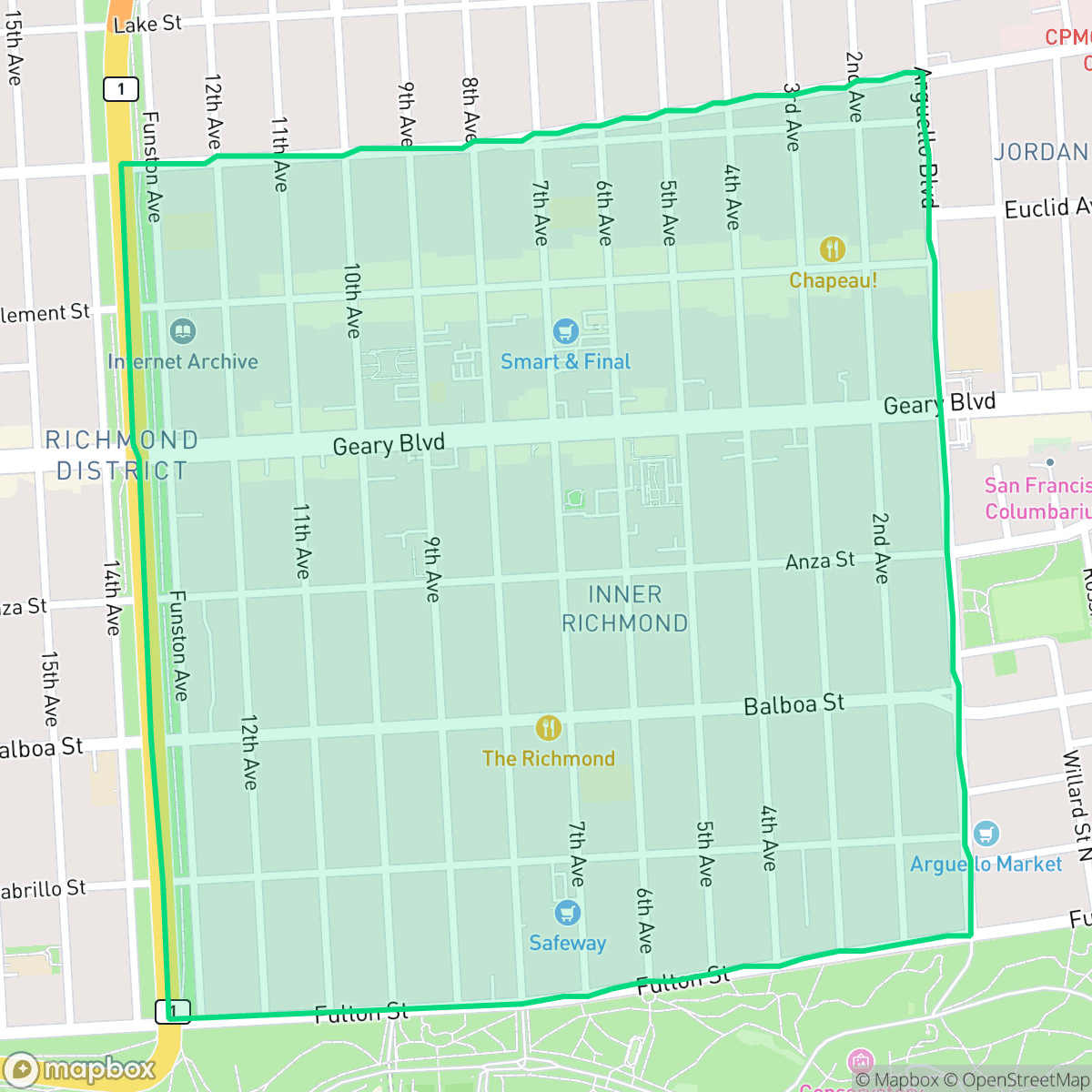
The Inner Richmond is a vibrant, high-density neighborhood defined by its exceptional walkability and diverse culinary landscape along Clement Street. Residents enjoy close proximity to Golden Gate Park and a lively urban atmosphere, though they should expect tightly packed housing with limited privacy and notable road traffic noise.
Key Highlights
About Inner Richmond
Historically part of San Francisco's windswept "Outside Lands," the Inner Richmond began its transformation when George Turner Marsh built his "Richmond House" at 12th Avenue and Clement Street in 1876, giving the district its name. The neighborhood developed rapidly in the late 19th and early 20th centuries, with spec-built Edwardian flats and Victorian row houses rising to accommodate residents, including refugees from the 1906 earthquake. Located between Golden Gate Park and the Presidio, the area evolved into a rich cultural mosaic. Following the Russian Revolution, a wave of Russian immigrants arrived, later marked by the landmark Holy Virgin Cathedral. By the late 20th century, a major influx of Chinese and other Asian immigrants earned Clement Street the moniker "New Chinatown". Today, this vibrant corridor is celebrated for its diverse culinary scene.
Nestled between the Presidio and Golden Gate Park, the area thrives as a dense, urban residential hub characterized by its consistent grid of Edwardian and Victorian row houses. The neighborhood maintains a high level of activity, supported by a wealth of local businesses that offer everything from international dining to neighborhood staples like the Cinderella Bakery and Cafe. It is a highly walkable environment where daily errands can be completed on foot, and according to iHuus data, the area offers excellent access to recreational green spaces for pet owners.
Those considering a move to the area should be prepared for the realities of dense city living. Privacy is limited due to the close proximity of neighboring homes, and the acoustic environment reflects typical urban road traffic levels. While the San Francisco Unified School District faces broader financial challenges, the neighborhood hosts high-performing local options like George Peabody Elementary. This district is best suited for individuals who prioritize walkability, cultural diversity, and immediate access to city parks over spacious, secluded living.
Neighborhood Scores Across 15 Qualities
Close proximity between buildings and shared walls characterize much of the area. According to iHuus data, this density results in minimal private buffers between structures, which is consistent with the rest of the city.
Continuous sidewalks and frequent crosswalks ensure easy movement on foot; this neighborhood offers superior connectivity compared to the city average.
Streetscapes feature a mix of dense, traditional row houses and larger, architecturally unique homes near major parklands. This visual diversity is slightly higher than the San Francisco average according to iHuus data.
Extensive access to Golden Gate Park and various athletic fields provides significantly more green space and walking trails than the San Francisco average. Residents benefit from immediate proximity to large urban lawns and interconnected trail systems for pet exercise.
Residential streets and green spaces exist in roughly equal measure, creating a landscape that is similar to the broader San Francisco average. The area transitions from a dense grid of multi-story row houses into large parklands and golf course borders.
Frequent access to diverse eateries, cafes, and local landmarks provides a high level of activity that is notably more energetic than the city average. This density of social spots and amenities creates a lively atmosphere throughout much of the district.
Steady hums from local traffic on busier streets define the soundscape here. According to iHuus data, acoustic comfort in this area is notably higher than the San Francisco average.
Air quality remains consistently high with rare instances of elevated readings. According to iHuus data, the air quality in this area is comparable to the San Francisco average.
Industrial activity and warehouses are entirely absent from this area. Residents can expect a landscape composed strictly of residential, recreational, and institutional spaces, which is even more disconnected from heavy industry than the San Francisco average.
Health insurance access is exceptionally high among residents, significantly outperforming the San Francisco average according to iHuus data.
Voting patterns and census indicators align with the broader liberal leaning seen across San Francisco. Residents will find a political landscape that is consistent with the city average.
Demographics show a balanced spread of young adults, families, and older residents. This age distribution is largely consistent with the broader San Francisco area, according to iHuus data.
Flood risk in this area is notably higher than the San Francisco average, though official FEMA studies for the neighborhood remain incomplete. According to iHuus data, the area currently sits in a category of undetermined risk.
Address-Level Insights for Inner Richmond


iHuus Neighborhood Intelligence Insights
Get address-level neighborhood insights for Inner Richmond
- Street-level scores — see how individual blocks compare, not just neighborhood averages
- Micro-zone boundaries — identify quiet pockets, flood boundaries, and walkable clusters before you visit
- 15 dimensions in full — walkability, noise, air quality, school quality, insurance coverage, population age profile, urban/rural index, and more
- Boundary risk alerts — know if your address sits near a block boundary where scores drop, the kind of detail no listing will ever mention
- School insights — individual school ratings and insights, not just district-level data
- Compare before you commit — side-by-side data across neighborhoods, down to block precision
No credit card required
Compare with Any Neighborhood
| Dimension | Inner Richmond | Alamo Square |
|---|---|---|
| 🚶 Walkabilityavg 9.91 | ||
| 🔊 Acoustic Comfortavg 3.4 | ||
| 🤫 Privacy Indexavg 2.14 | ||
| 🎨 Visual Appealavg 6.26 | ||
| 🐕 Dog Friendlinessavg 6.55 | ||
| 🗺️ Urban-Rural Indexavg 4.07 | ||
| ✨ Neighborhood Vibeavg 6.4 | ||
| 🏥 Health Insurance Coverageavg 7.87 | ||
| 🌿 Air Qualityavg 7.78 | ||
| 🏭 Industrial Proximityavg 9.37 | ||
| 🌊 Flood Safetyavg 1.89 | ||
| 🗳️ Ideological Leanavg 9.92 | ||
| 👥 Population Age Profileavg 5.18 | ||
| 🔥 Fire Safetyavg 0.01 | ||
| 🏫 School Quality |
Inner Richmond Rankings
School Districts Serving Inner Richmond
School Insights for Inner Richmond
Below average outcomes; significant attendance and academic challenges.
School Insights
See what's really behind every school rating near Inner Richmond
- Individual school ratings — each school's own score with outcome context, not just a district average
- Enrollment & class size data — student-to-teacher ratio and how it compares to the state average
- Full demographics breakdown — ethnicity and gender composition for every school in the enrollment zone
- Every school in the district — all schools within the enrollment boundary ranked by rating, not just the closest one
- Grade levels & benchmarks — elementary through high school, with below/above state-average flags
No credit card required