Inner Parkside, San Francisco
Updated · 4,291 residents
Inner Parkside is a densely populated, highly walkable neighborhood characterized by its uniform grid of row houses and proximity to urban amenities. While it offers excellent access to public transit and local green spaces, residents face significant road traffic noise and limited privacy due to the close proximity of neighboring homes.
Key Highlights
About Inner Parkside
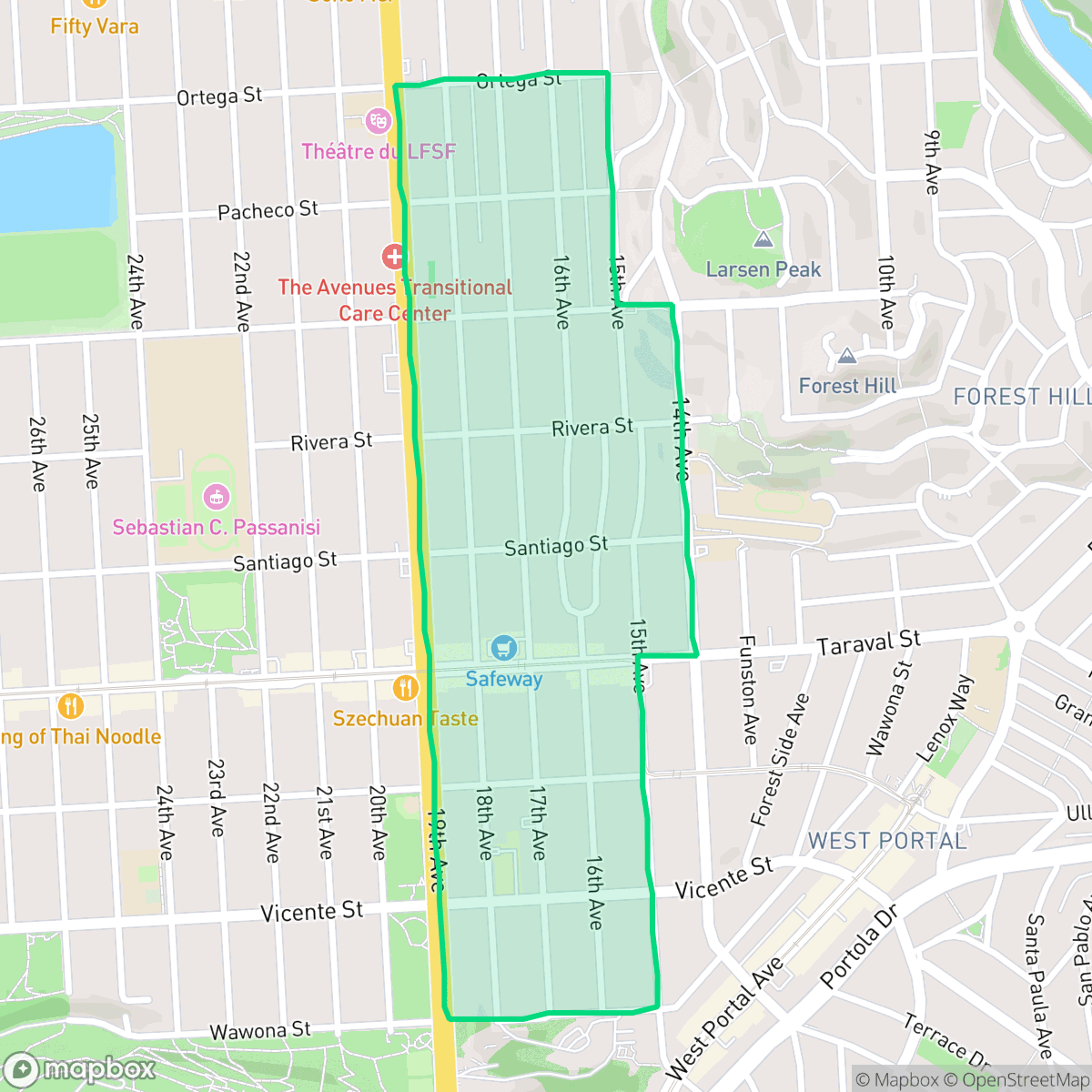
Inner Parkside, situated in southwestern San Francisco between roughly 15th and 19th Avenues, is historically defined by its eastern diagonal border abutting the former Mexican land grant, Rancho San Miguel. Originally a windswept expanse of sand dunes in the city’s "Outside Lands", the area’s transformation began in 1905 when William Crocker’s Parkside Realty Company acquired the tract. Developed largely in the 1920s and 1930s, the neighborhood is architecturally distinguished from the wider Sunset District by its larger, detached lots featuring elegant Mediterranean Revival and Craftsman-style homes, many constructed by prominent merchant-builder Henry Doelger. On its southern edge lies the historic Sigmund Stern Grove, home to the 1890s Trocadero Roadhouse and the renowned, long-running Stern Grove Festival.
The neighborhood functions as a classic San Francisco residential district, defined by its high-density urban grid and consistent street layout. It maintains a strong sense of community with local dining options along Taraval Street and recreational access to nearby parks like McCoppin Playground. According to iHuus data, the area is exceptionally walkable, allowing residents to navigate the district easily on foot despite the high density of its residential blocks. The environment is notably free from industrial activity, contributing to high air quality ratings that distinguish it from more commercialized parts of the city.
Living here involves specific trade-offs, particularly regarding acoustic comfort and housing configuration. The prevalence of wall-to-wall row houses results in limited individual privacy, and the proximity to major thoroughfares like 19th Avenue contributes to a high ambient noise level of 66 decibels. Prospective residents should also consider that the local school district is currently facing significant financial and operational challenges. The neighborhood is best suited for those who prioritize walkability and proximity to public transit over quietude or expansive private outdoor space.
Neighborhood Scores Across 15 Qualities
Housing density is high with houses closely packed and minimal separation between structures. According to iHuus data, this provides more separation than the city average, though many properties still feature narrow gaps or shared walls.
Continuous sidewalks and frequent crosswalks throughout a dense street grid make navigating the area on foot exceptionally easy. This level of pedestrian connectivity is slightly above the San Francisco average according to iHuus data.
Larger, well-maintained homes and mature landscaping provide a visual quality that is slightly above the San Francisco average. According to iHuus data, the area features a mix of spacious lots and custom architecture that enhances the streetscape.
Access to large central parks and tree-lined streets with wide paths makes this area slightly more dog friendly than the San Francisco average. Nearby green spaces like Mount Davidson and Glen Canyon provide ample room for outdoor exercise.
Open land and scattered greenery provide a more spacious environment than the typical San Francisco urban core. According to iHuus data, this neighborhood features more frequent pockets of woodland and fields compared to the city average.
Suburban streets and green spaces characterize this area, offering a more tranquil atmosphere than the city average. While specific blocks feature diverse dining and local cafes, many residential pockets have limited access to businesses within walking distance.
Frequent noise from nearby major freeways and rail lines characterizes the area. This level of acoustic disturbance is notably higher than the San Francisco average, according to iHuus data.
Air quality remains consistently high with rare instances of elevated readings, sitting slightly above the San Francisco average according to iHuus data.
Industrial activity and warehouses are entirely absent from this area. According to iHuus data, the neighborhood is more residential in nature than the San Francisco average.
Health insurance access is exceptionally high among residents, sitting well above the San Francisco average according to iHuus data.
Voting patterns and census indicators show a deeply liberal political leaning that is consistent with the rest of San Francisco. This ideological profile aligns with the city average.
A diverse range of age groups resides here, from young professionals to older adults and families. This demographic spread is slightly more balanced than the typical San Francisco profile, according to iHuus data.
Flood risk is elevated in this area because it sits within a designated floodplain. According to iHuus data, this level of vulnerability is notably higher than the average for San Francisco.
Address-Level Insights for Inner Parkside


iHuus Neighborhood Intelligence Insights
Get address-level neighborhood insights for Inner Parkside
- Street-level scores — see how individual blocks compare, not just neighborhood averages
- Micro-zone boundaries — identify quiet pockets, flood boundaries, and walkable clusters before you visit
- 15 dimensions in full — walkability, noise, air quality, school quality, insurance coverage, population age profile, urban/rural index, and more
- Boundary risk alerts — know if your address sits near a block boundary where scores drop, the kind of detail no listing will ever mention
- School insights — individual school ratings and insights, not just district-level data
- Compare before you commit — side-by-side data across neighborhoods, down to block precision
No credit card required
Compare with Any Neighborhood
| Dimension | Inner Parkside | Alamo Square |
|---|---|---|
| 🚶 Walkabilityavg 9.91 | ||
| 🔊 Acoustic Comfortavg 3.4 | ||
| 🤫 Privacy Indexavg 2.14 | ||
| 🎨 Visual Appealavg 6.26 | ||
| 🐕 Dog Friendlinessavg 6.55 | ||
| 🗺️ Urban-Rural Indexavg 4.07 | ||
| ✨ Neighborhood Vibeavg 6.4 | ||
| 🏥 Health Insurance Coverageavg 7.87 | ||
| 🌿 Air Qualityavg 7.78 | ||
| 🏭 Industrial Proximityavg 9.37 | ||
| 🌊 Flood Safetyavg 1.89 | ||
| 🗳️ Ideological Leanavg 9.92 | ||
| 👥 Population Age Profileavg 5.18 | ||
| 🔥 Fire Safetyavg 0.01 | ||
| 🏫 School Quality |
Inner Parkside Rankings
School Districts Serving Inner Parkside
School Insights for Inner Parkside
Below average outcomes; significant attendance and academic challenges.
School Insights
See what's really behind every school rating near Inner Parkside
- Individual school ratings — each school's own score with outcome context, not just a district average
- Enrollment & class size data — student-to-teacher ratio and how it compares to the state average
- Full demographics breakdown — ethnicity and gender composition for every school in the enrollment zone
- Every school in the district — all schools within the enrollment boundary ranked by rating, not just the closest one
- Grade levels & benchmarks — elementary through high school, with below/above state-average flags
No credit card required