Ingleside Terrace, San Francisco
Updated · 3,265 residents
Ingleside Terraces is defined by its unique oval street layout and distinct architectural heritage, offering a highly walkable residential environment in San Francisco. Residents enjoy excellent air quality and a lack of industrial activity, though the dense housing pattern results in limited privacy for many properties.
Key Highlights
About Ingleside Terrace
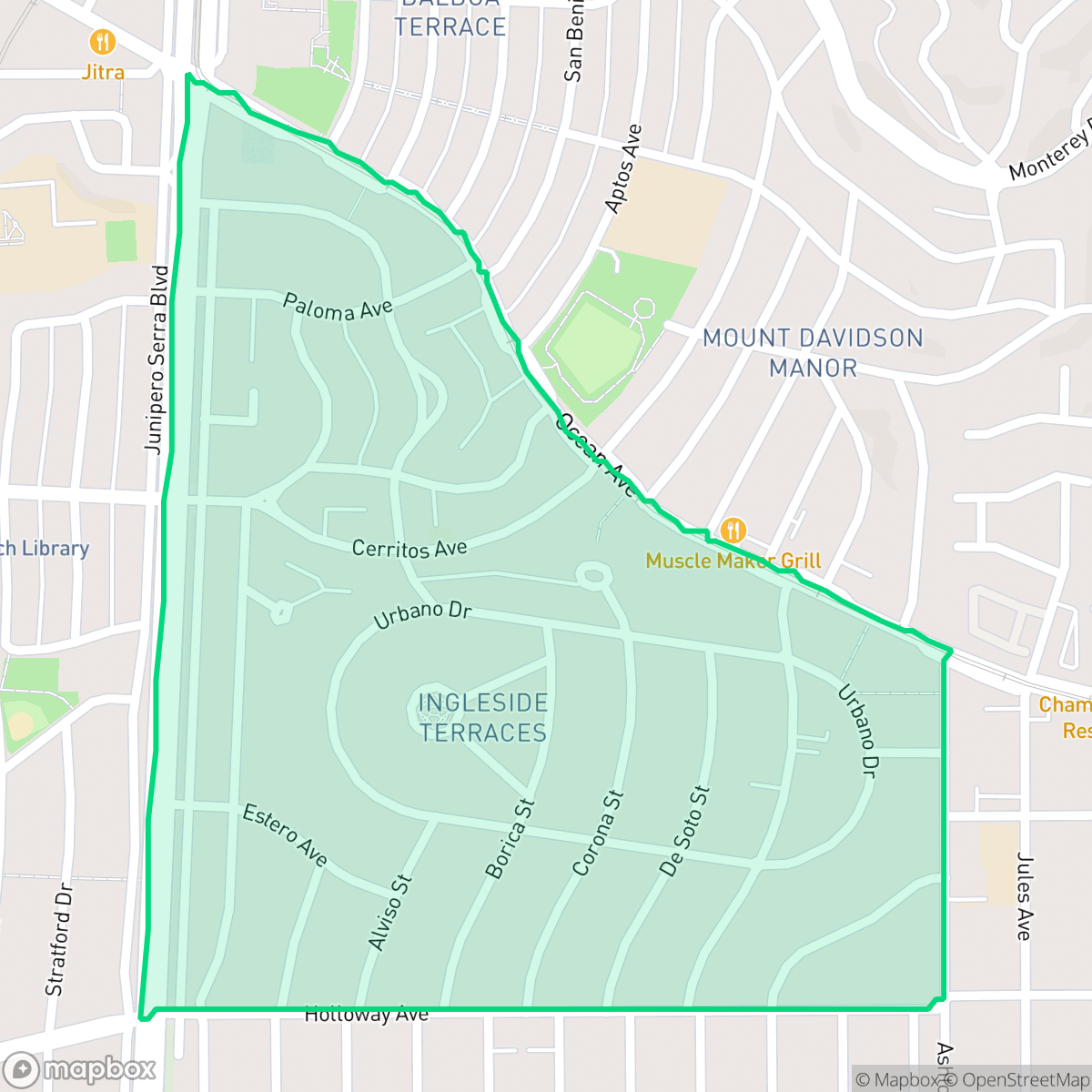
Developed starting in 1912 by architect Joseph Leonard, Ingleside Terraces is a master-planned "residence park" built on the former site of the Ingleside Racetrack. Reflecting this heritage, the neighborhood's main street, Urbano Drive, follows the exact oval path of the historic horse racing track. The neighborhood is characterized by Craftsman and Period Revival homes centered around the Ingleside Terraces Sundial, a massive public monument completed in 1913. Though originally restricted by exclusionary whites-only covenants, the community became a civil rights landmark in 1957 when Cecil F. Poole, a prominent African American attorney and future federal judge, purchased Leonard’s former home on Cedro Avenue, successfully integrating the neighborhood despite facing intense local hostility.
The neighborhood maintains a quiet, residential character centered around its well-preserved street grid and proximity to local commercial corridors. Daily life is supported by a variety of dining options along Ocean Avenue, including Champa Garden, Pho Ha Tien, and Java On Ocean Cafe, which contribute to a vibrant local atmosphere. The area is characterized by a dense residential fabric, featuring tightly packed single-family homes that prioritize neighborhood connectivity over expansive private outdoor space. With consistent sidewalk access throughout the community, it remains a highly accessible area for pedestrians navigating the local streets and nearby green spaces.
Prospective residents should consider that the neighborhood faces some of the broader challenges affecting the San Francisco Unified School District, which is currently navigating significant fiscal and operational constraints. While the area offers a peaceful environment with minimal industrial impact, the high-density nature of the housing means that privacy is relatively low compared to more suburban settings. Noise levels remain moderate, primarily influenced by local road traffic, making it a suitable choice for those who value urban convenience and walkability over secluded living.
Neighborhood Scores Across 15 Qualities
Residential structures are tightly packed with minimal separation between homes. This level of density offers more privacy than the typical San Francisco neighborhood, according to iHuus data.
Continuous sidewalks and clearly marked crosswalks are available on nearly every street, providing a level of walkability that is slightly above the San Francisco average. According to iHuus data, the neighborhood features a complete pedestrian network with ample crossings and infrastructure designed for safe foot traffic.
Mid-century tract housing defines the area with uniform rooflines and small yards. This residential aesthetic is slightly below the San Francisco average for visual variety.
Accessible green spaces and large public park areas provide reliable routes for pet owners. This neighborhood offers slightly more opportunities for outdoor activity with dogs than the San Francisco average.
Residential blocks feature a balanced mix of single-family homes and green space, providing a more suburban character than most of San Francisco. According to iHuus data, the layout offers more open space and detached housing than the dense urban core of the city.
Diverse dining options and established commercial hubs create a lively atmosphere that is notably more active than the San Francisco average. Residents have access to a varied mix of local cafes, eateries, and community landmarks near major transit corridors.
Frequent noise from nearby transit corridors and major roadways is common here. According to iHuus data, acoustic comfort levels are lower than the San Francisco average.
Air quality remains consistently high with infrequent instances of poor air conditions. This level of cleanliness is slightly above the San Francisco average, according to iHuus data.
Industrial activity and warehouses are entirely absent from this area, providing a cleaner environment than much of San Francisco. According to iHuus data, the neighborhood contains only residential and light commercial uses with no detected hazardous facilities.
Health insurance accessibility is exceptionally high in this area, significantly outpacing the San Francisco average according to iHuus data.
Voting patterns and census indicators show a deeply liberal political leaning that is largely consistent with the rest of San Francisco. According to iHuus data, the area aligns closely with the citywide political landscape.
A balanced demographic of young adults, families, and older residents characterizes the area. This distribution is slightly more varied than the typical age profile found across San Francisco, according to iHuus data.
Flood risk in this area is significantly higher than the San Francisco average, though specific risk levels remain undetermined due to incomplete federal studies. According to iHuus data, residents should remain aware of potential vulnerabilities during heavy rain events.
Address-Level Insights for Ingleside Terrace


iHuus Neighborhood Intelligence Insights
Get address-level neighborhood insights for Ingleside Terrace
- Street-level scores — see how individual blocks compare, not just neighborhood averages
- Micro-zone boundaries — identify quiet pockets, flood boundaries, and walkable clusters before you visit
- 15 dimensions in full — walkability, noise, air quality, school quality, insurance coverage, population age profile, urban/rural index, and more
- Boundary risk alerts — know if your address sits near a block boundary where scores drop, the kind of detail no listing will ever mention
- School insights — individual school ratings and insights, not just district-level data
- Compare before you commit — side-by-side data across neighborhoods, down to block precision
No credit card required
Compare with Any Neighborhood
| Dimension | Ingleside Terrace | Alamo Square |
|---|---|---|
| 🚶 Walkabilityavg 9.91 | ||
| 🔊 Acoustic Comfortavg 3.4 | ||
| 🤫 Privacy Indexavg 2.14 | ||
| 🎨 Visual Appealavg 6.26 | ||
| 🐕 Dog Friendlinessavg 6.55 | ||
| 🗺️ Urban-Rural Indexavg 4.07 | ||
| ✨ Neighborhood Vibeavg 6.4 | ||
| 🏥 Health Insurance Coverageavg 7.87 | ||
| 🌿 Air Qualityavg 7.78 | ||
| 🏭 Industrial Proximityavg 9.37 | ||
| 🌊 Flood Safetyavg 1.89 | ||
| 🗳️ Ideological Leanavg 9.92 | ||
| 👥 Population Age Profileavg 5.18 | ||
| 🔥 Fire Safetyavg 0.01 | ||
| 🏫 School Quality |
Ingleside Terrace Rankings
School Districts Serving Ingleside Terrace
School Insights for Ingleside Terrace
Below average outcomes; significant attendance and academic challenges.
School Insights
See what's really behind every school rating near Ingleside Terrace
- Individual school ratings — each school's own score with outcome context, not just a district average
- Enrollment & class size data — student-to-teacher ratio and how it compares to the state average
- Full demographics breakdown — ethnicity and gender composition for every school in the enrollment zone
- Every school in the district — all schools within the enrollment boundary ranked by rating, not just the closest one
- Grade levels & benchmarks — elementary through high school, with below/above state-average flags
No credit card required