Ingleside Heights, San Francisco
Updated · 5,681 residents
Ingleside Heights is a residential neighborhood defined by its dense rows of stucco homes and convenient access to the M Ocean View streetcar line. While the area offers high walkability and proximity to local parks, residents experience significant noise from nearby road traffic. The neighborhood maintains a quiet, suburban atmosphere that appeals to those seeking an established community.
Key Highlights
About Ingleside Heights
Ingleside Heights, located on the southern slopes of San Francisco’s Merced Heights, emerged in the late 19th century following the 1895 opening of the nearby Ingleside Racetrack. The track’s presence drew cottages for racetrack workers to the hillside. After the 1906 earthquake, the shuttered track served as a refugee camp; when it closed, more residents settled on the slopes. By 1912, with the launch of the neighboring Ingleside Terraces residence park, real estate agents and locals adopted the name “Ingleside Heights”. The opening of Muni's M Ocean View streetcar line in 1925, including the Randolph and Arch stop, spurred a 1920s housing boom of stucco, Sunset-style homes. Following World War II, the neighborhood expanded further, becoming a vital hub for middle-class African-American families who established homeownership in the area during the 1950s.
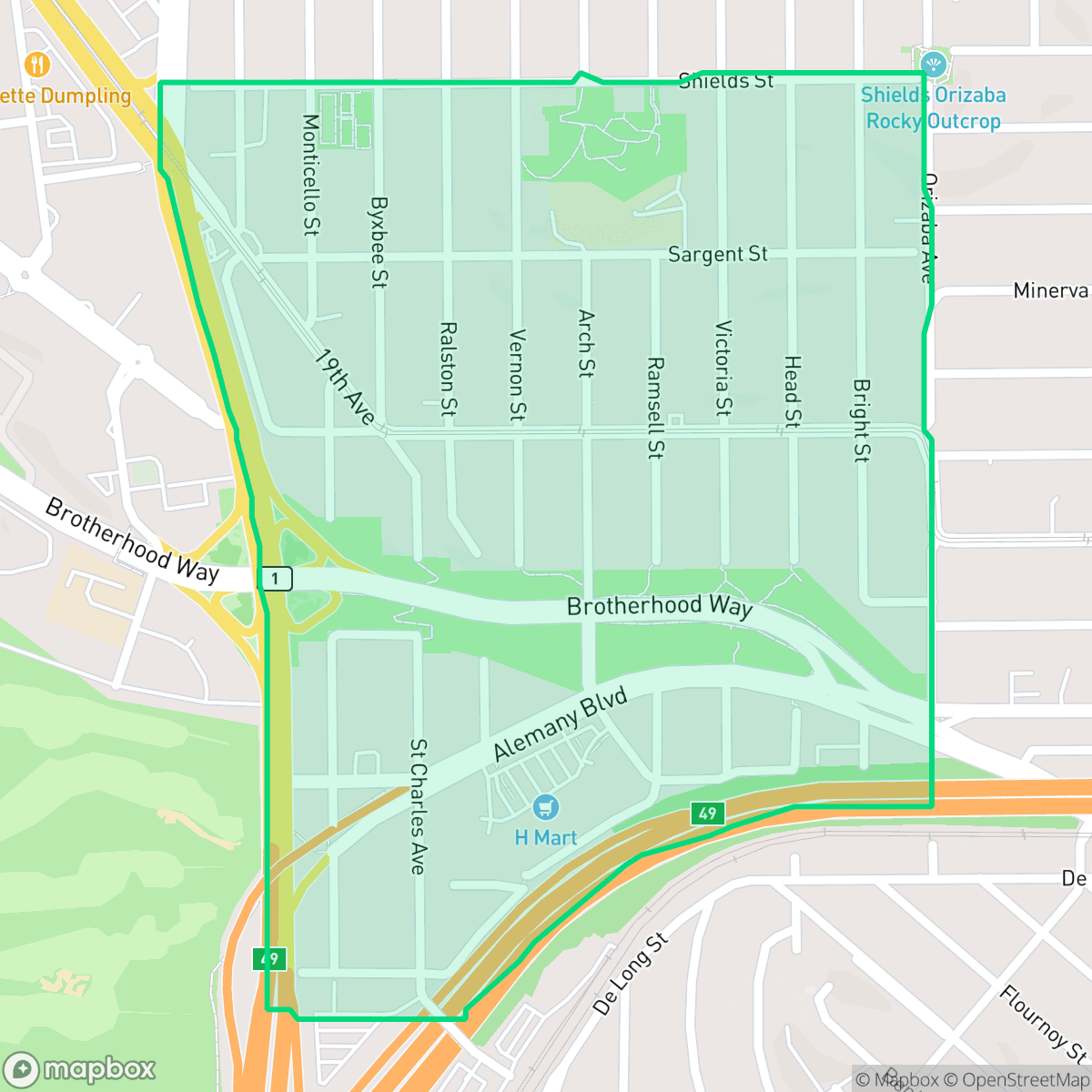
Located on the southern slopes of San Francisco, the area is characterized by a dense grid of residential blocks that prioritize functionality and community access. The neighborhood features a mix of multi-story row houses and light commercial hubs, creating a dense suburban environment. Residents benefit from consistent sidewalk infrastructure and easy access to public transit, which connects the hillside community to the broader city. Local amenities, including neighborhood parks and various eateries, provide essential services within walking distance.
Prospective residents should weigh the benefits of the area against specific livability trade-offs. The neighborhood experiences elevated noise levels primarily due to nearby road traffic, and the high density of row housing results in limited personal privacy between units. While the local school district faces broader systemic challenges, the presence of well-regarded options like Jose Ortega Elementary provides a localized resource for families. The area is best suited for those who prioritize transit connectivity and an established, settled community over absolute quiet or spacious, detached living.
Neighborhood Scores Across 15 Qualities
High residential density and narrow setbacks between homes result in very little personal separation. According to iHuus data, neighbors live in close proximity with many buildings sharing walls or separated by minimal space, which is typical for the broader city area.
Continuous sidewalks and prominent crosswalks facilitate easy movement on foot throughout the neighborhood. While the grid is highly navigable, major highways and transit rail lines can occasionally interrupt the pedestrian path, making walkability slightly lower than the city average.
Dense residential layouts and small yard spaces define the landscape here. This area features a standard level of visual variety that is slightly below the San Francisco average according to iHuus data.
Abundant green belts and large public parks provide ample space for pets. This area offers slightly more accessible walking options than the San Francisco average due to the proximity of the golf course and connected green spaces.
Frequent open land and scattered homes amid greenery provide a more semi-rural character than the dense urban average of San Francisco. Residents may find more pockets of woodland and unbuilt space compared to the typical city grid.
Local activity is characterized by a steady but low-intensity pace, primarily concentrated around small neighborhood hubs and parks. According to iHuus data, the level of social energy and commercial density is lower than the typical San Francisco average.
Significant acoustic disturbances are prevalent throughout the area, resulting in levels that are considerably higher than the San Francisco average. According to iHuus data, residents can expect consistent ambient noise that impacts the overall quietude of the neighborhood.
Air quality is generally excellent with infrequent periods of poor circulation. According to iHuus data, these levels are slightly better than the average found across San Francisco.
Industrial activity is virtually nonexistent here, as the area consists primarily of residential and light commercial uses. While there is no heavy industry or hazardous site nearby, residents should note that a nearby rail yard and transit maintenance facility may introduce some localized noise.
Health insurance access among residents is more widespread here than the city average, according to iHuus data. This indicates a higher proportion of the population possesses medical coverage compared to many other parts of San Francisco.
Voting patterns and census indicators show a predominantly liberal political leaning, which is consistent with the broader San Francisco average according to iHuus data.
Residents live alongside a balanced mix of young adults, families, and older individuals. This age distribution is slightly more varied than the San Francisco average, according to iHuus data.
Address-Level Insights for Ingleside Heights


iHuus Neighborhood Intelligence Insights
Get address-level neighborhood insights for Ingleside Heights
- Street-level scores — see how individual blocks compare, not just neighborhood averages
- Micro-zone boundaries — identify quiet pockets, flood boundaries, and walkable clusters before you visit
- 15 dimensions in full — walkability, noise, air quality, school quality, insurance coverage, population age profile, urban/rural index, and more
- Boundary risk alerts — know if your address sits near a block boundary where scores drop, the kind of detail no listing will ever mention
- School insights — individual school ratings and insights, not just district-level data
- Compare before you commit — side-by-side data across neighborhoods, down to block precision
No credit card required
Compare with Any Neighborhood
| Dimension | Ingleside Heights | Alamo Square |
|---|---|---|
| 🚶 Walkabilityavg 9.91 | ||
| 🔊 Acoustic Comfortavg 3.4 | ||
| 🤫 Privacy Indexavg 2.14 | ||
| 🎨 Visual Appealavg 6.26 | ||
| 🐕 Dog Friendlinessavg 6.55 | ||
| 🗺️ Urban-Rural Indexavg 4.07 | ||
| ✨ Neighborhood Vibeavg 6.4 | ||
| 🏥 Health Insurance Coverageavg 7.87 | ||
| 🌿 Air Qualityavg 7.78 | ||
| 🏭 Industrial Proximityavg 9.37 | ||
| 🌊 Flood Safetyavg 1.89 | ||
| 🗳️ Ideological Leanavg 9.92 | ||
| 👥 Population Age Profileavg 5.18 | ||
| 🔥 Fire Safetyavg 0.01 | ||
| 🏫 School Quality |
Ingleside Heights Rankings
School Districts Serving Ingleside Heights
School Insights for Ingleside Heights
Below average outcomes; significant attendance and academic challenges.
School Insights
See what's really behind every school rating near Ingleside Heights
- Individual school ratings — each school's own score with outcome context, not just a district average
- Enrollment & class size data — student-to-teacher ratio and how it compares to the state average
- Full demographics breakdown — ethnicity and gender composition for every school in the enrollment zone
- Every school in the district — all schools within the enrollment boundary ranked by rating, not just the closest one
- Grade levels & benchmarks — elementary through high school, with below/above state-average flags
No credit card required