Hunters Point, San Francisco
Updated · 5,349 residents
Hunters Point is a quiet, industrial-adjacent neighborhood defined by its expansive shoreline access and high walkability. Residents benefit from good air quality, though the area is characterized by dense housing with limited privacy and a notable lack of local social amenities.
Key Highlights
About Hunters Point
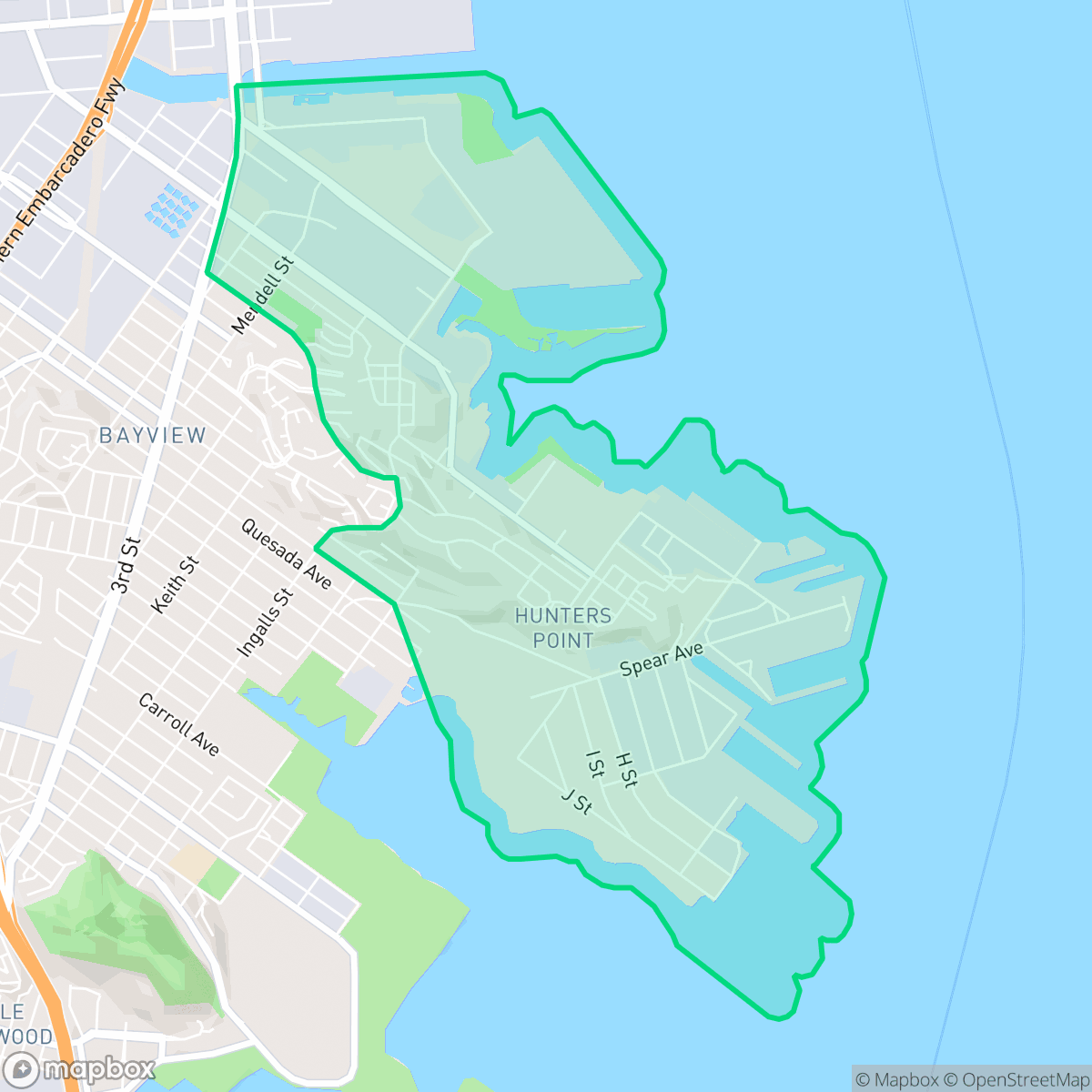
Named for the 19th-century Hunter family, San Francisco’s Hunters Point peninsula was originally inhabited by the Ramaytush Ohlone before hosting a thriving Chinese shrimp-fishing community and the Pacific Coast’s first permanent dry dock in 1867. The neighborhood underwent a dramatic transformation in 1939 when the U.S. Navy acquired the land to establish the Hunters Point Naval Shipyard. This wartime industrial boom drew thousands of African American workers to the area, establishing Hunters Point as a vital hub of Black culture and civil rights activism. Following the shipyard's decommissioning in 1974, the site evolved once more; in 1983, neglected naval buildings were converted into affordable workspaces, blossoming into one of the largest artist colonies in the United States.
This neighborhood functions as a distinct blend of residential blocks and large-scale maritime infrastructure, offering a serene environment that contrasts with the busier parts of San Francisco. The area is highly walkable, featuring a reliable network of paths that connect housing to the waterfront. While it maintains a relatively quiet atmosphere, the landscape is heavily influenced by its industrial history, including the presence of an EPA Superfund site that necessitates awareness regarding local environmental conditions. According to iHuus data, the visual character is largely defined by standard multi-unit housing and apartment complexes rather than traditional suburban aesthetics.
Living in this area involves specific trade-offs, particularly regarding social life and public infrastructure. Residents may find a limited selection of local leisure spots, making it a better fit for those who prioritize a low-key lifestyle over a vibrant nightlife. Prospective families should note that the local school district is currently experiencing significant financial and operational distress. Additionally, the area faces high risks related to flood and fire safety, which are important considerations for long-term residents. Despite these challenges, the neighborhood offers a unique, functional space for those seeking proximity to the bay and a highly accessible pedestrian environment.
Neighborhood Scores Across 15 Qualities
Residential structures feature narrow gaps and shared walls, providing more visual separation than the city average. According to iHuus data, high density housing and townhomes create a closely packed living environment.
Extensive sidewalk networks and dedicated crosswalks connect residential areas to local amenities. While this level of accessibility is slightly below the city average, the dense grid ensures most daily trips are easily completed on foot.
Residential views consist of uniform rooflines, dense multi-family housing, and industrial warehouses. This visual landscape is slightly below the San Francisco average for aesthetic variety.
Access to large shoreline parks and integrated greenbelts provides ample space for pets. According to iHuus data, these connected walking paths make the area slightly more dog friendly than the San Francisco average.
Open land and significant maritime infrastructure provide a more spacious feel than most of San Francisco. According to iHuus data, the area features a unique combination of expansive wetlands and large-scale warehouse zones that are much less dense than the city average.
Primarily composed of industrial zones and suburban-style blocks, this area offers a much more subdued atmosphere than the San Francisco average. Residents will find a tranquil setting with limited social activity and a reliance on vehicles to access dining and services outside of a few local spots.
Steady traffic sounds from nearby busy streets are noticeable, though the acoustic environment remains quieter than the average San Francisco neighborhood according to iHuus data.
Air quality remains consistently high with rare instances of elevated readings, performing slightly above the San Francisco average according to iHuus data.
Large scale logistics hubs, rail yards, and a wastewater treatment plant dominate the immediate surroundings. This area has significantly more heavy commercial infrastructure and industrial activity than the San Francisco average, including proximity to an EPA Superfund site.
Health insurance access is exceptionally high among residents, notably surpassing the San Francisco average according to iHuus data.
Voting patterns and census indicators show a deeply liberal political leaning that is consistent with the broader San Francisco area, according to iHuus data.
Residents occupy a broad spectrum of life stages, including young professionals, families, and seniors. This demographic mix is slightly less concentrated with young adults compared to the broader San Francisco average, according to iHuus data.
Frequent flood risk exists due to being located within a designated floodplain, which is notably higher than the San Francisco average. According to iHuus data, residents should anticipate the likely requirement for flood insurance.
Address-Level Insights for Hunters Point


iHuus Neighborhood Intelligence Insights
Get address-level neighborhood insights for Hunters Point
- Street-level scores — see how individual blocks compare, not just neighborhood averages
- Micro-zone boundaries — identify quiet pockets, flood boundaries, and walkable clusters before you visit
- 15 dimensions in full — walkability, noise, air quality, school quality, insurance coverage, population age profile, urban/rural index, and more
- Boundary risk alerts — know if your address sits near a block boundary where scores drop, the kind of detail no listing will ever mention
- School insights — individual school ratings and insights, not just district-level data
- Compare before you commit — side-by-side data across neighborhoods, down to block precision
No credit card required
Compare with Any Neighborhood
| Dimension | Hunters Point | Alamo Square |
|---|---|---|
| 🚶 Walkabilityavg 9.91 | ||
| 🔊 Acoustic Comfortavg 3.4 | ||
| 🤫 Privacy Indexavg 2.14 | ||
| 🎨 Visual Appealavg 6.26 | ||
| 🐕 Dog Friendlinessavg 6.55 | ||
| 🗺️ Urban-Rural Indexavg 4.07 | ||
| ✨ Neighborhood Vibeavg 6.4 | ||
| 🏥 Health Insurance Coverageavg 7.87 | ||
| 🌿 Air Qualityavg 7.78 | ||
| 🏭 Industrial Proximityavg 9.37 | ||
| 🌊 Flood Safetyavg 1.89 | ||
| 🗳️ Ideological Leanavg 9.92 | ||
| 👥 Population Age Profileavg 5.18 | ||
| 🔥 Fire Safetyavg 0.01 | ||
| 🏫 School Quality |
Hunters Point Rankings
School Districts Serving Hunters Point
School Insights for Hunters Point
Below average outcomes; significant attendance and academic challenges.
School Insights
See what's really behind every school rating near Hunters Point
- Individual school ratings — each school's own score with outcome context, not just a district average
- Enrollment & class size data — student-to-teacher ratio and how it compares to the state average
- Full demographics breakdown — ethnicity and gender composition for every school in the enrollment zone
- Every school in the district — all schools within the enrollment boundary ranked by rating, not just the closest one
- Grade levels & benchmarks — elementary through high school, with below/above state-average flags
No credit card required