Hayes Valley, San Francisco
Updated · 11,989 residents
Hayes Valley is a highly walkable, dense urban enclave defined by its vibrant culinary scene and proximity to cultural landmarks. Residents benefit from a lively atmosphere, though the neighborhood is characterized by compact, high-density housing with limited privacy and consistent road traffic noise.
Key Highlights
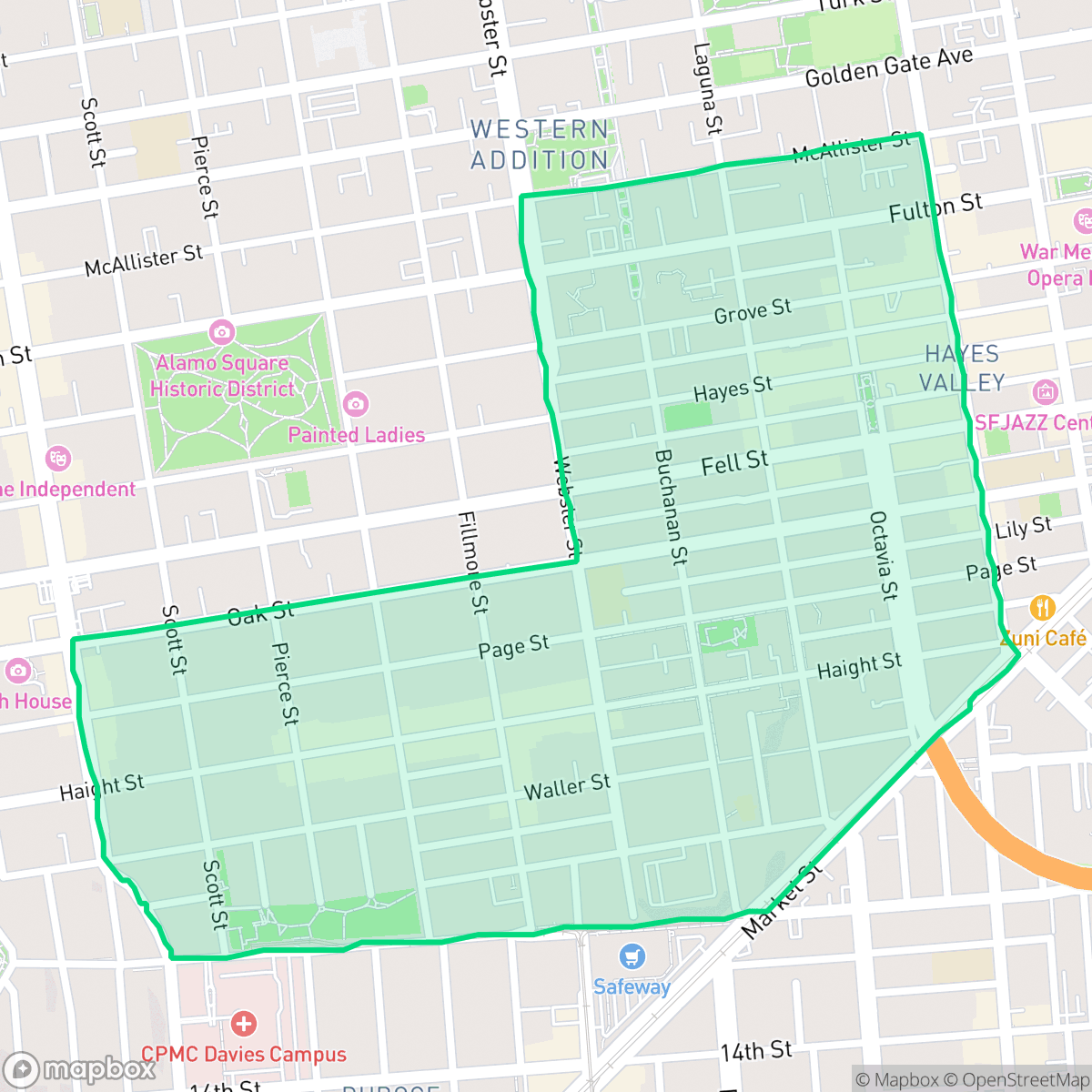
About Hayes Valley
Named for Colonel Thomas Hayes, an Irish immigrant who acquired the land during the Gold Rush, Hayes Valley developed as part of the Western Addition after the Van Ness Ordinance of 1855 cleared land titles. Spared from the fires of the 1906 earthquake, the neighborhood retains some of San Francisco's oldest architectural stock, featuring a rich collection of Victorian, Queen Anne, and Edwardian townhouses. In the mid-20th century, it evolved into a diverse, prominent African American hub. The 1950s construction of the Central Freeway bisected the area, sparking decades of decline, but its post-1989 earthquake demolition catalyzed a dramatic revitalization. Today, the neighborhood's commercial heart along Hayes Street is anchored by the community space Patricia's Green, high-end boutiques, and cultural landmarks like the SFJAZZ Center.
This area functions as a dense urban core where the grid layout supports exceptional pedestrian access to a variety of social hubs, including local cafes and numerous restaurants. According to iHuus data, the neighborhood maintains a high livability score due to its concentration of amenities and lack of industrial hazards, creating a purely residential and commercial environment that feels connected to the pulse of the city. The architectural fabric consists of wall-to-wall row houses and multi-unit complexes, which contributes to a lively streetscape but results in limited privacy for residents.
The trade-offs for this central location include a lack of acoustic comfort, as road traffic contributes to a baseline noise level of 61 decibels. The area is best suited for professionals and urbanites who prioritize immediate access to city life and dining over quiet, spacious living. Prospective residents should also be aware that the local school district is currently navigating significant fiscal and operational challenges, which may impact the stability of nearby educational institutions.
Neighborhood Scores Across 15 Qualities
Dense building configurations with shared walls and narrow gaps between structures create minimal separation from neighbors. This level of density is roughly consistent with the broader San Francisco area, according to iHuus data.
Wide sidewalks and a dense grid of marked crosswalks make navigating the area on foot easy. This level of pedestrian accessibility is even higher than the city average, according to iHuus data.
Dense, well-maintained row housing and apartment blocks define the local landscape. The area offers a typical urban aesthetic that is slightly below the San Francisco average for visual variety.
Access to green space for pet owners is primarily centered around a large public park with sports fields, though many surrounding blocks consist of a dense concrete environment. According to iHuus data, the availability of walkable green verges is slightly below the San Francisco average.
Multi-story buildings and a tight street grid define this area, which is more built-up than the San Francisco average. While the neighborhood features significant park infrastructure, there is very little unpaved land or open soil available.
Dense concentrations of dining, cafes, and art spaces create a high-energy atmosphere that is significantly more active than the San Francisco average. According to iHuus data, this lively urban landscape offers a wide variety of social destinations and local landmarks.
Proximity to major transit corridors and nearby rail lines creates a level of auditory disturbance that is slightly higher than the San Francisco average. Residents may encounter frequent ambient noise from heavy vehicle traffic and transit operations.
Air quality remains consistently high with rare instances of elevated readings. According to iHuus data, the air in this area is slightly cleaner than the San Francisco average.
Industrial hazards, warehouses, and large-scale manufacturing facilities are entirely absent from this area. This neighborhood maintains a cleaner, purely residential and commercial fabric than the San Francisco average, according to iHuus data.
Health insurance access is exceptionally high among residents, significantly exceeding the San Francisco average according to iHuus data.
Voting patterns and census indicators show a highly progressive political landscape that is consistent with the broader San Francisco area. Residents will find an ideological environment that aligns closely with the city average.
A varied mix of young professionals, families, and older residents characterizes the local demographic. This age distribution is roughly in line with the broader San Francisco average, according to iHuus data.
Flood risk in this area is significantly higher than the San Francisco average, as the neighborhood sits within a coastal high-hazard zone. Residents should anticipate elevated or potentially prohibitive flood insurance costs according to iHuus data.
Address-Level Insights for Hayes Valley


iHuus Neighborhood Intelligence Insights
Get address-level neighborhood insights for Hayes Valley
- Street-level scores — see how individual blocks compare, not just neighborhood averages
- Micro-zone boundaries — identify quiet pockets, flood boundaries, and walkable clusters before you visit
- 15 dimensions in full — walkability, noise, air quality, school quality, insurance coverage, population age profile, urban/rural index, and more
- Boundary risk alerts — know if your address sits near a block boundary where scores drop, the kind of detail no listing will ever mention
- School insights — individual school ratings and insights, not just district-level data
- Compare before you commit — side-by-side data across neighborhoods, down to block precision
No credit card required
Compare with Any Neighborhood
| Dimension | Hayes Valley | Alamo Square |
|---|---|---|
| 🚶 Walkabilityavg 9.91 | ||
| 🔊 Acoustic Comfortavg 3.4 | ||
| 🤫 Privacy Indexavg 2.14 | ||
| 🎨 Visual Appealavg 6.26 | ||
| 🐕 Dog Friendlinessavg 6.55 | ||
| 🗺️ Urban-Rural Indexavg 4.07 | ||
| ✨ Neighborhood Vibeavg 6.4 | ||
| 🏥 Health Insurance Coverageavg 7.87 | ||
| 🌿 Air Qualityavg 7.78 | ||
| 🏭 Industrial Proximityavg 9.37 | ||
| 🌊 Flood Safetyavg 1.89 | ||
| 🗳️ Ideological Leanavg 9.92 | ||
| 👥 Population Age Profileavg 5.18 | ||
| 🔥 Fire Safetyavg 0.01 | ||
| 🏫 School Quality |
Hayes Valley Rankings
School Districts Serving Hayes Valley
School Insights for Hayes Valley
Below average outcomes; significant attendance and academic challenges.
School Insights
See what's really behind every school rating near Hayes Valley
- Individual school ratings — each school's own score with outcome context, not just a district average
- Enrollment & class size data — student-to-teacher ratio and how it compares to the state average
- Full demographics breakdown — ethnicity and gender composition for every school in the enrollment zone
- Every school in the district — all schools within the enrollment boundary ranked by rating, not just the closest one
- Grade levels & benchmarks — elementary through high school, with below/above state-average flags
No credit card required