Haight-Ashbury, San Francisco
Updated · 8,001 residents
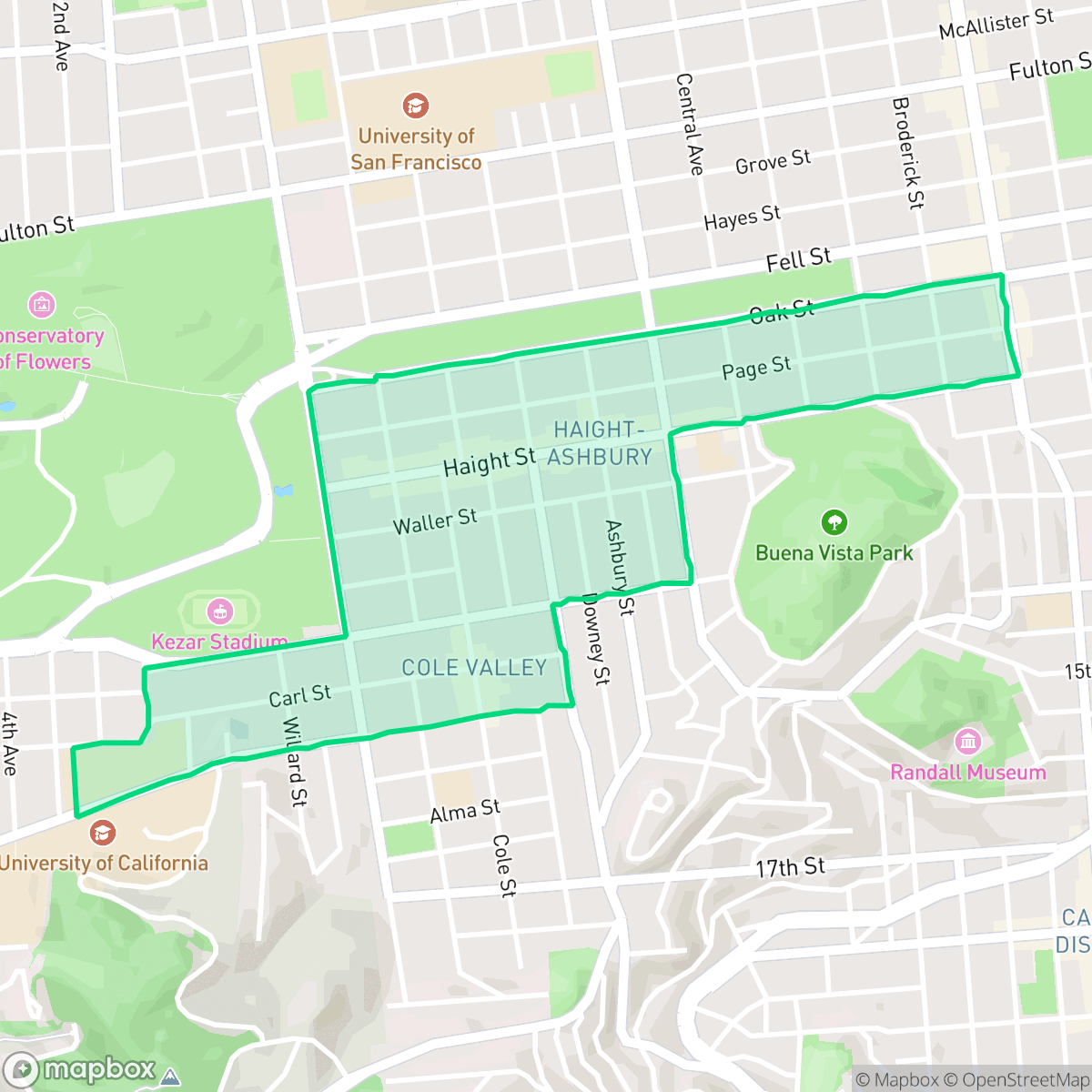
Haight-Ashbury is a highly walkable San Francisco neighborhood defined by its dense, historic Victorian architecture and immediate proximity to Golden Gate Park. The area offers a quiet, residential environment with strong air quality and excellent access to local green spaces.
Key Highlights
About Haight-Ashbury
Once a landscape of sand dunes and isolated farms, San Francisco’s Haight-Ashbury transformed in 1883 with the completion of the Haight Street Cable Railroad. This transit link spurred a building boom of elegant Victorian homes for the middle class. Because the neighborhood was spared from the fires following the 1906 earthquake, it retains one of the city's finest concentrations of intact Victorian architecture. By the mid-20th century, low rents attracted beatniks and later hippies, culminating in the 1967 "Summer of Love" when over 100,000 young people converged on the area. The neighborhood became the epicenter of counterculture, housing legendary musicians like the Grateful Dead (710 Ashbury St.) and Janis Joplin. Today, its bohemian legacy persists through colorful murals, vintage boutiques, and historic landmarks like the Doolan-Larson Building.
The neighborhood features a dense, low-rise urban grid characterized by well-maintained Victorian homes with complex roof geometries. According to iHuus data, the area provides a high quality of life with strong health insurance coverage and a complete absence of industrial activity. Residents benefit from a serene atmosphere that contrasts with the city's busier districts, making it an ideal location for those who value architectural beauty and an established, pedestrian-friendly environment.
Living in this area involves certain trade-offs, particularly regarding privacy, as the high-density layout results in shared walls and minimal space between homes. While the streets are exceptionally walkable, the commercial pace is relatively subdued compared to other parts of the city. Prospective residents should also consider the current state of the local school district, which faces significant financial and operational challenges, though the neighborhood remains a top choice for those prioritizing outdoor access and a cohesive community aesthetic.
Neighborhood Scores Across 15 Qualities
Residential structures are tightly packed with frequent shared walls and very narrow gaps between buildings. This level of density is consistent with the broader San Francisco average.
Continuous sidewalks and frequent crosswalks create an exceptionally easy environment for navigating the area on foot. This level of accessibility and safety for pedestrians is even higher than the San Francisco city average.
Architectural variety and well-maintained residences contribute to a visual environment that is more aesthetically pleasing than the San Francisco average. According to iHuus data, the area features a mix of historic multi-story homes and dense urban housing with notable proximity to major cultural institutions.
Immediate proximity to Golden Gate Park and its extensive trail networks provides significantly more pet-friendly green space than the San Francisco average. Large open fields and forested paths are easily accessible for walking and exercise.
Dense residential blocks and mixed-use buildings are interspersed with significant park infrastructure and forested areas. According to iHuus data, this area offers a more balanced mix of built environment and open space than the typical San Francisco urban landscape.
Diverse dining and social spots create pockets of activity across mid-rise blocks and green spaces. According to iHuus data, the overall level of activity is slightly below the city average.
Continuous traffic noise from nearby busy thoroughfares is a common feature here. According to iHuus data, acoustic levels are slightly higher than the San Francisco average.
Air quality remains consistently high with infrequent periods of poor circulation. According to iHuus data, the atmosphere in this area is slightly cleaner than the city average.
This area is entirely comprised of residential, recreational, and institutional spaces. According to iHuus data, there are no warehouses, heavy machinery, or industrial hazards detected, making the environment cleaner than the San Francisco average.
Health insurance access is exceptionally high among residents, significantly surpassing the San Francisco city average according to iHuus data.
Voting patterns and census indicators show a deeply progressive political landscape that is slightly more liberal than the San Francisco average. According to iHuus data, the area is characterized by very high levels of liberal ideological alignment.
Residents live alongside a varied demographic of young adults, families, and seniors. This age distribution is slightly lower than the San Francisco average, indicating a less concentrated concentration of middle-aged residents compared to much of the city.
Elevated flood hazards and wave action characterize this coastal zone, which presents a significantly higher risk than the San Francisco average. Residents should anticipate potentially high or prohibitive flood insurance costs according to iHuus data.
Address-Level Insights for Haight-Ashbury


iHuus Neighborhood Intelligence Insights
Get address-level neighborhood insights for Haight-Ashbury
- Street-level scores — see how individual blocks compare, not just neighborhood averages
- Micro-zone boundaries — identify quiet pockets, flood boundaries, and walkable clusters before you visit
- 15 dimensions in full — walkability, noise, air quality, school quality, insurance coverage, population age profile, urban/rural index, and more
- Boundary risk alerts — know if your address sits near a block boundary where scores drop, the kind of detail no listing will ever mention
- School insights — individual school ratings and insights, not just district-level data
- Compare before you commit — side-by-side data across neighborhoods, down to block precision
No credit card required
Compare with Any Neighborhood
| Dimension | Haight-Ashbury | Alamo Square |
|---|---|---|
| 🚶 Walkabilityavg 9.91 | ||
| 🔊 Acoustic Comfortavg 3.4 | ||
| 🤫 Privacy Indexavg 2.14 | ||
| 🎨 Visual Appealavg 6.26 | ||
| 🐕 Dog Friendlinessavg 6.55 | ||
| 🗺️ Urban-Rural Indexavg 4.07 | ||
| ✨ Neighborhood Vibeavg 6.4 | ||
| 🏥 Health Insurance Coverageavg 7.87 | ||
| 🌿 Air Qualityavg 7.78 | ||
| 🏭 Industrial Proximityavg 9.37 | ||
| 🌊 Flood Safetyavg 1.89 | ||
| 🗳️ Ideological Leanavg 9.92 | ||
| 👥 Population Age Profileavg 5.18 | ||
| 🔥 Fire Safetyavg 0.01 | ||
| 🏫 School Quality |
Haight-Ashbury Rankings
School Districts Serving Haight-Ashbury
School Insights for Haight-Ashbury
Below average outcomes; significant attendance and academic challenges.
School Insights
See what's really behind every school rating near Haight-Ashbury
- Individual school ratings — each school's own score with outcome context, not just a district average
- Enrollment & class size data — student-to-teacher ratio and how it compares to the state average
- Full demographics breakdown — ethnicity and gender composition for every school in the enrollment zone
- Every school in the district — all schools within the enrollment boundary ranked by rating, not just the closest one
- Grade levels & benchmarks — elementary through high school, with below/above state-average flags
No credit card required