Golden Gate Park, San Francisco
Updated · 14,334 residents
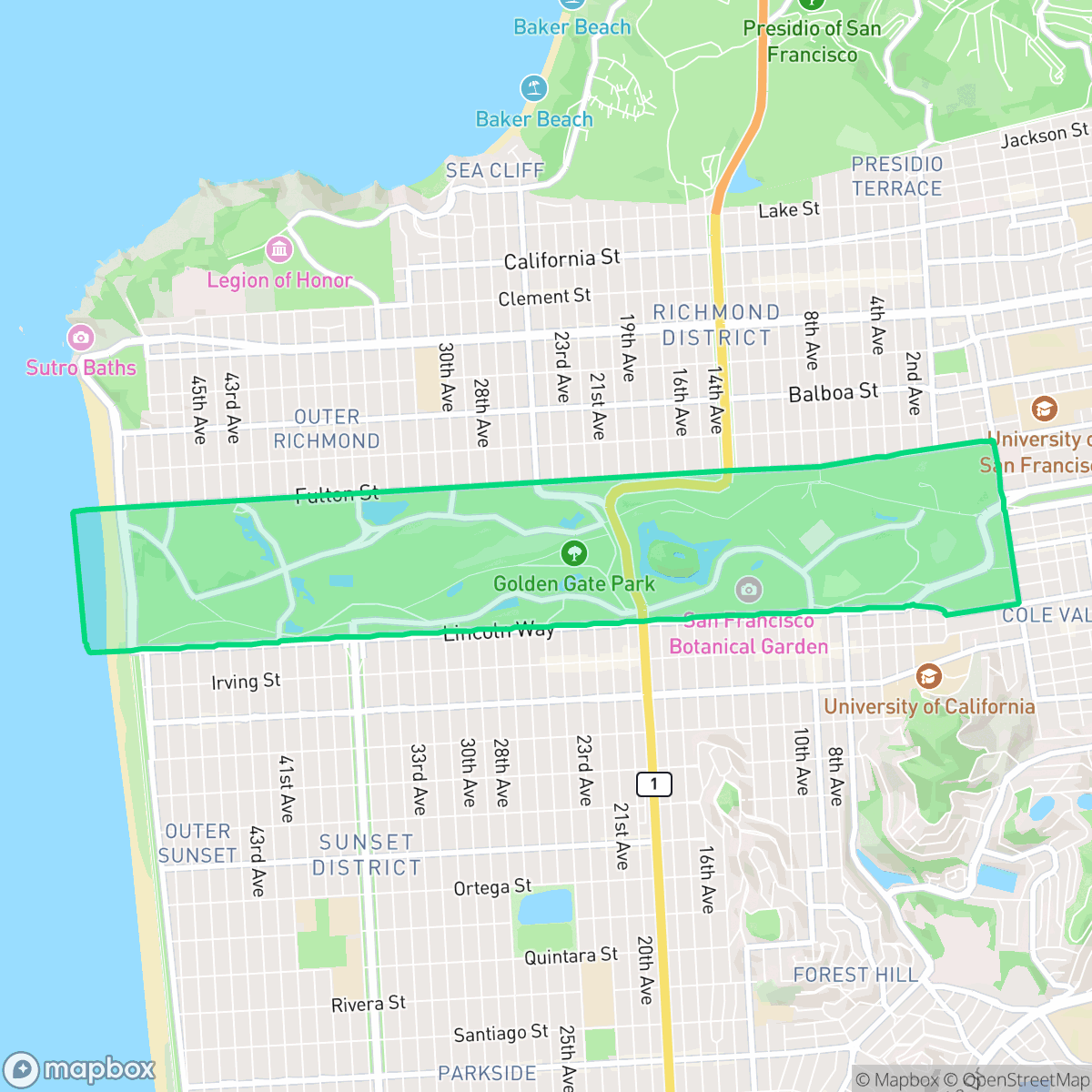
Golden Gate Park is characterized by its immediate access to a world-class urban green space, offering residents an exceptionally walkable environment with extensive recreational trails. The area features a dense grid of residential row houses, though it experiences notable road traffic noise and limited privacy due to the close proximity of neighboring structures. According to iHuus data, this neighborhood provides a highly desirable location for those prioritizing an outdoor lifestyle and proximity to major cultural institutions.
Key Highlights
About Golden Gate Park
Established in 1870, Golden Gate Park was carved out of a vast expanse of windswept sand dunes originally known as the Outside Lands. First superintendent William Hammond Hall and horticulturist John McLaren stabilized the shifting sands using European land reclamation techniques. The park's eastern side features Victorian-era landmarks, including the Conservatory of Flowers (1879)—the oldest wood-and-glass conservatory in North America—and Sharon Quarters (1888), the nation's first public playground. The central Music Concourse and Japanese Tea Garden were developed for the 1894 California Midwinter International Exposition. Following the devastating 1906 earthquake, the park transformed into a vital sanctuary, providing temporary housing and military-run encampments for roughly 200,000 displaced San Franciscans.
The area surrounding Golden Gate Park functions as a dense, highly walkable residential enclave that provides immediate access to over a thousand acres of recreational space. The housing stock consists primarily of traditional San Francisco row houses, which contribute to a uniform architectural aesthetic and a high-density urban feel. Residents benefit from excellent connectivity to the city through a well-maintained grid of streets, making it an ideal location for those who rely on walking or cycling for daily errands. The neighborhood maintains a strong sense of community, supported by high levels of health insurance coverage and a shared commitment to local cultural and educational institutions.
Prospective residents should consider the trade-offs associated with this high-density environment, including limited residential privacy and elevated noise levels from surrounding road traffic. While the proximity to nature is unparalleled, the area faces significant environmental risks, including flood and fire hazards that require careful consideration. Additionally, while the neighborhood is well-positioned for lifestyle amenities, families should be aware that local schools within the San Francisco Unified School District are currently experiencing significant operational and financial challenges. Despite these factors, the area remains a premier destination for those seeking an active, dog-friendly lifestyle in the heart of the city.
Neighborhood Scores Across 15 Qualities
High-density residential rows and row houses feature shared walls or very narrow gaps between structures. According to iHuus data, this lack of separation is consistent with the city average for privacy levels.
Extensive sidewalk networks and pedestrian-priority paths throughout the park area provide exceptional connectivity. This level of accessibility for pedestrians and strollers is slightly above the city average.
The area features a mix of affluent, well-maintained estates and dense, traditional San Francisco row houses. According to iHuus data, the visual landscape is slightly more upscale than the city average due to the presence of larger homes and significant cultural institutions.
Immediate access to Golden Gate Park provides vast lawns and wooded trails for pets. This abundance of large green spaces and open trails makes the area significantly more dog-friendly than the San Francisco average.
A mix of dense residential street grids and expansive parkland provides a suburban feel that is more balanced between built environments and open space than the San Francisco average. According to iHuus data, the area transitions directly from multi-story residential blocks into significant metropolitan park systems.
Active pockets of social hubs and diverse dining options create a more energetic atmosphere than the San Francisco average. Residents can find a variety of local eateries and community landmarks, though the density of businesses varies significantly between the more quiet, suburban streets and the busier, high-energy districts.
Consistent noise from nearby thoroughfares is present; however, acoustic levels are notably more tranquil than the typical experience found elsewhere in San Francisco.
Air quality is generally good with rare instances of elevated readings; however, it stays slightly below the San Francisco average according to iHuus data.
Industrial activity and hazardous facilities are entirely absent from this area. According to iHuus data, the neighborhood contains only residential, recreational, and institutional land uses, which is even lower in industrial density than the San Francisco average.
Health insurance accessibility is exceptionally high among residents, significantly outpacing the San Francisco average according to iHuus data.
Voting patterns and census indicators show a deeply liberal political landscape that is consistent with the rest of San Francisco. According to iHuus data, the area reflects the same predominant ideological lean found across the city.
A balanced mix of young adults, families, and older residents characterizes the area. According to iHuus data, this demographic spread is roughly in line with the city average.
Significant flood risk exists within this area as it sits within a designated floodplain. According to iHuus data, this risk level is notably higher than the San Francisco average and may necessitate flood insurance.
Address-Level Insights for Golden Gate Park


iHuus Neighborhood Intelligence Insights
Get address-level neighborhood insights for Golden Gate Park
- Street-level scores — see how individual blocks compare, not just neighborhood averages
- Micro-zone boundaries — identify quiet pockets, flood boundaries, and walkable clusters before you visit
- 15 dimensions in full — walkability, noise, air quality, school quality, insurance coverage, population age profile, urban/rural index, and more
- Boundary risk alerts — know if your address sits near a block boundary where scores drop, the kind of detail no listing will ever mention
- School insights — individual school ratings and insights, not just district-level data
- Compare before you commit — side-by-side data across neighborhoods, down to block precision
No credit card required
Compare with Any Neighborhood
| Dimension | Golden Gate Park | Alamo Square |
|---|---|---|
| 🚶 Walkabilityavg 9.91 | ||
| 🔊 Acoustic Comfortavg 3.4 | ||
| 🤫 Privacy Indexavg 2.14 | ||
| 🎨 Visual Appealavg 6.26 | ||
| 🐕 Dog Friendlinessavg 6.55 | ||
| 🗺️ Urban-Rural Indexavg 4.07 | ||
| ✨ Neighborhood Vibeavg 6.4 | ||
| 🏥 Health Insurance Coverageavg 7.87 | ||
| 🌿 Air Qualityavg 7.78 | ||
| 🏭 Industrial Proximityavg 9.37 | ||
| 🌊 Flood Safetyavg 1.89 | ||
| 🗳️ Ideological Leanavg 9.92 | ||
| 👥 Population Age Profileavg 5.18 | ||
| 🔥 Fire Safetyavg 0.01 | ||
| 🏫 School Quality |
Golden Gate Park Rankings
School Districts Serving Golden Gate Park
School Insights for Golden Gate Park
Below average outcomes; significant attendance and academic challenges.
School Insights
See what's really behind every school rating near Golden Gate Park
- Individual school ratings — each school's own score with outcome context, not just a district average
- Enrollment & class size data — student-to-teacher ratio and how it compares to the state average
- Full demographics breakdown — ethnicity and gender composition for every school in the enrollment zone
- Every school in the district — all schools within the enrollment boundary ranked by rating, not just the closest one
- Grade levels & benchmarks — elementary through high school, with below/above state-average flags
No credit card required