Golden Gate Heights, San Francisco
Updated · 2,960 residents
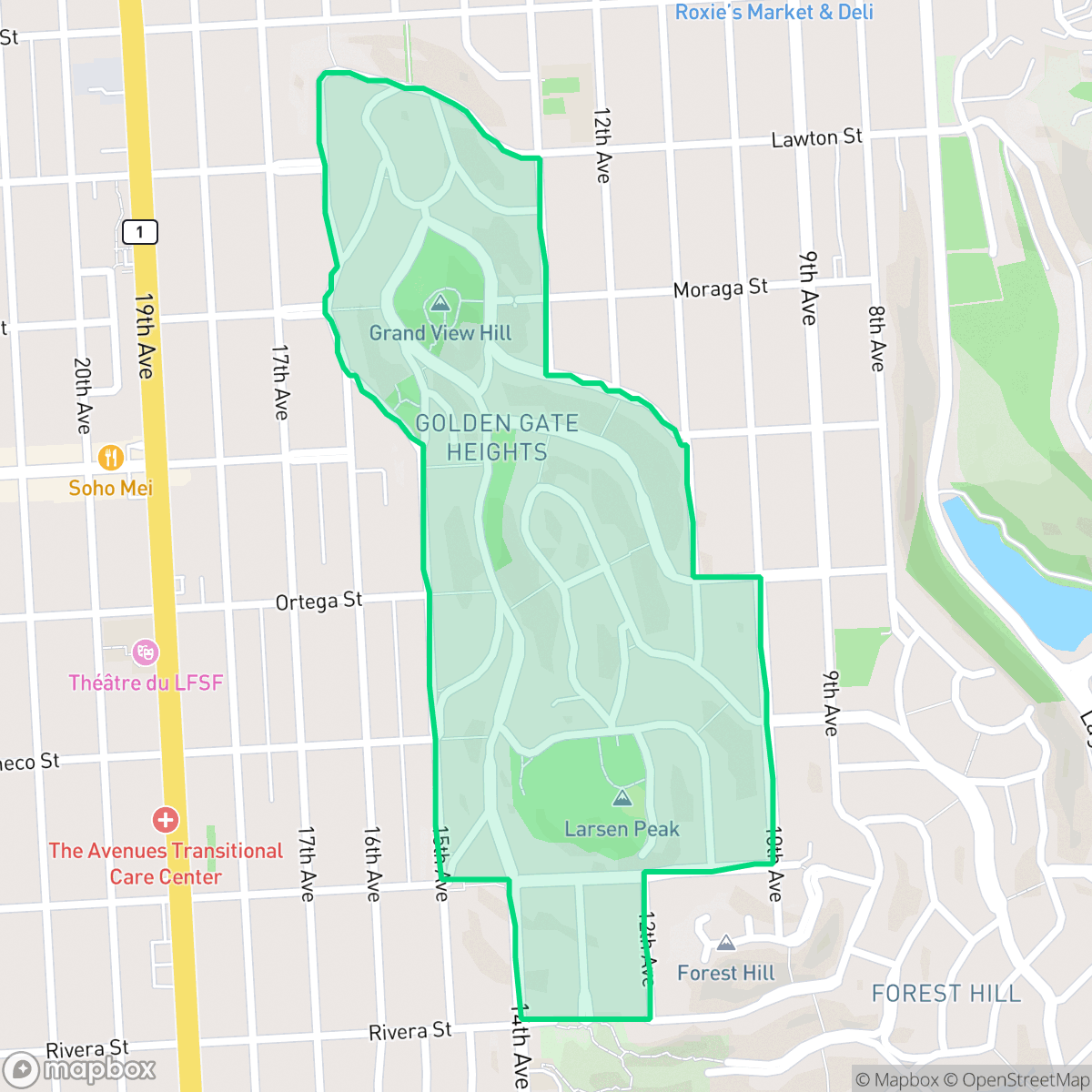
Golden Gate Heights is a hillside neighborhood in San Francisco defined by its exceptional walkability and panoramic vistas. Residents experience a dense, urban environment with closely packed housing and notable ambient noise levels from nearby road traffic.
Key Highlights
About Golden Gate Heights
Once part of San Francisco’s windswept "Outside Lands" sand dunes, Golden Gate Heights began its transformation in 1924 when Danish immigrant Carl Larsen donated the hilltop land that became Golden Gate Heights Park. Planners laid out the neighborhood’s streets in 1927, designing winding, terraced roads that hug the steep ridge of 140-million-year-old Franciscan chert, intentionally breaking the Sunset District's rigid grid. While some homes arose in the 1930s, the bulk of residential construction occurred during the 1940s and 1950s. Today, this quiet, hillside neighborhood is celebrated for its dramatic panoramic views, Grandview Park, and community-driven public art landmarks, most notably the 163-step mosaic of the 16th Avenue Tiled Steps and the nearby Hidden Garden Steps.
The neighborhood is characterized by its steep, winding streets that offer expansive views of the city and the Pacific Ocean. It maintains a high level of walkability, allowing residents to easily access local businesses and dining options along its established grid. While the atmosphere is vibrant, the dense, low-rise residential fabric means that homes are situated closely together, which results in limited privacy for many households according to iHuus data. Prospective residents should be aware that the area experiences high levels of noise from road traffic, which is a significant factor in the daily environment. Additionally, while the area is well-connected, it sits within the San Francisco Unified School District, which currently faces financial and operational challenges. The neighborhood is best suited for those who prioritize pedestrian access and a central location over quietude or expansive private outdoor space.
Neighborhood Scores Across 15 Qualities
Residential structures are positioned closely together with minimal separation between property lines. This density of housing is slightly higher than the San Francisco average, according to iHuus data.
A dense and well-connected street grid with consistent sidewalks on both sides of the road makes navigating the area on foot very easy. According to iHuus data, the neighborhood offers superior pedestrian infrastructure and frequent crossings compared to the rest of San Francisco.
Streetscapes feature a mix of dense urban row houses and well-maintained larger homes on sloped lots with mature landscaping. This level of visual variety is consistent with the city average.
Proximity to large forested areas and significant green corridors provides excellent access to walking paths for pets. This level of accessibility to parks is slightly higher than the San Francisco average, according to iHuus data.
Residential streets and green spaces are balanced here, mirroring the general density found across San Francisco. According to iHuus data, the area features a mix of dense low-rise housing and pockets of open ground.
Local dining options and social hubs provide more activity than the typical San Francisco district. While some pockets offer a quiet suburban feel, much of the area features a high concentration of diverse eateries and accessible green spaces according to iHuus data.
Local traffic from nearby thoroughfares creates a consistent level of background noise. This acoustic environment is more active than the average for San Francisco.
Air quality remains consistently high with rare instances of elevated readings. This level of cleanliness is slightly above the San Francisco average according to iHuus data.
Industrial activity and large warehouses are entirely absent from this area. According to iHuus data, the neighborhood contains only residential and light commercial structures, making it even more free of industrial signatures than the city average.
Health insurance access is exceptionally high among residents, significantly outpacing the San Francisco average according to iHuus data.
Voting patterns and census indicators reflect a deeply progressive political climate that aligns with the broader San Francisco average.
Residents live alongside a balanced mix of young professionals, families, and seniors. This age distribution is consistent with the broader San Francisco area.
Flood risk in this area is higher than the San Francisco average, though the specific level of danger remains undetermined due to incomplete local studies. Residents should note that according to iHuus data, the neighborhood sits in a category with more uncertainty than most parts of the city.
Address-Level Insights for Golden Gate Heights


iHuus Neighborhood Intelligence Insights
Get address-level neighborhood insights for Golden Gate Heights
- Street-level scores — see how individual blocks compare, not just neighborhood averages
- Micro-zone boundaries — identify quiet pockets, flood boundaries, and walkable clusters before you visit
- 15 dimensions in full — walkability, noise, air quality, school quality, insurance coverage, population age profile, urban/rural index, and more
- Boundary risk alerts — know if your address sits near a block boundary where scores drop, the kind of detail no listing will ever mention
- School insights — individual school ratings and insights, not just district-level data
- Compare before you commit — side-by-side data across neighborhoods, down to block precision
No credit card required
Compare with Any Neighborhood
| Dimension | Golden Gate Heights | Alamo Square |
|---|---|---|
| 🚶 Walkabilityavg 9.91 | ||
| 🔊 Acoustic Comfortavg 3.4 | ||
| 🤫 Privacy Indexavg 2.14 | ||
| 🎨 Visual Appealavg 6.26 | ||
| 🐕 Dog Friendlinessavg 6.55 | ||
| 🗺️ Urban-Rural Indexavg 4.07 | ||
| ✨ Neighborhood Vibeavg 6.4 | ||
| 🏥 Health Insurance Coverageavg 7.87 | ||
| 🌿 Air Qualityavg 7.78 | ||
| 🏭 Industrial Proximityavg 9.37 | ||
| 🌊 Flood Safetyavg 1.89 | ||
| 🗳️ Ideological Leanavg 9.92 | ||
| 👥 Population Age Profileavg 5.18 | ||
| 🔥 Fire Safetyavg 0.01 | ||
| 🏫 School Quality |
Golden Gate Heights Rankings
School Districts Serving Golden Gate Heights
School Insights for Golden Gate Heights
Below average outcomes; significant attendance and academic challenges.
School Insights
See what's really behind every school rating near Golden Gate Heights
- Individual school ratings — each school's own score with outcome context, not just a district average
- Enrollment & class size data — student-to-teacher ratio and how it compares to the state average
- Full demographics breakdown — ethnicity and gender composition for every school in the enrollment zone
- Every school in the district — all schools within the enrollment boundary ranked by rating, not just the closest one
- Grade levels & benchmarks — elementary through high school, with below/above state-average flags
No credit card required