Forest Knolls, San Francisco
Updated · 4,158 residents
Forest Knolls is a residential enclave defined by its immediate access to the expansive green trails of Mount Sutro. The neighborhood offers high walkability and excellent dog-friendly amenities, though residents experience significant road traffic noise and limited privacy due to its dense housing layout.
Key Highlights
About Forest Knolls
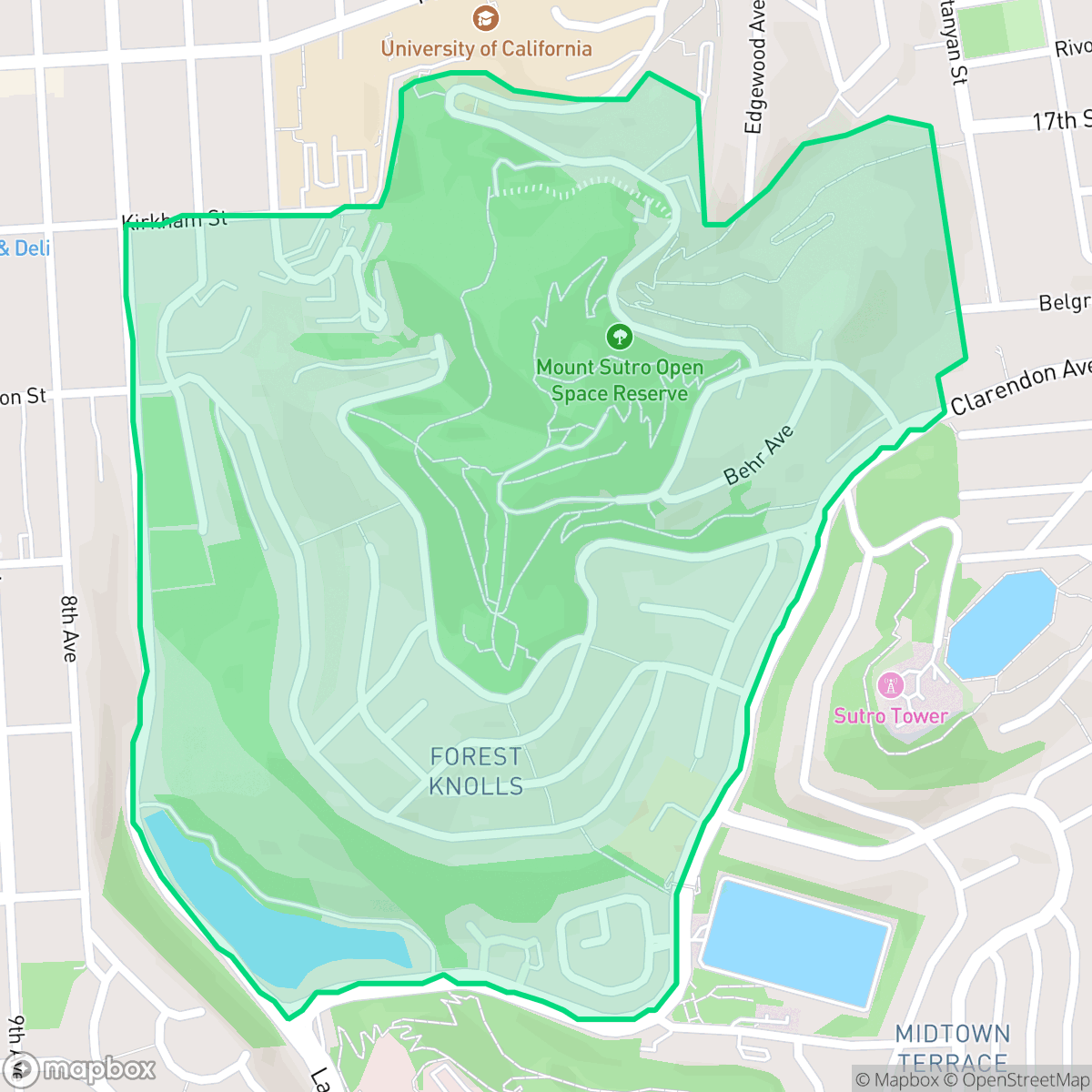
Situated on the southwestern slope of Mount Sutro, San Francisco’s Forest Knolls neighborhood was originally part of Rancho San Miguel before becoming part of an 1,100-acre eucalyptus forest planted by former mayor Adolph Sutro. Developed between 1959 and 1963 by the Gellert Brothers’ Standard Building Company, the neighborhood features detached mid-century homes and townhomes on winding, hilly streets. In the early 1960s, Forest Knolls became a major battleground for the local civil rights movement. Activists, including a young Willie Brown (later San Francisco’s first Black mayor), organized sit-ins and picket lines to protest the developer’s discriminatory housing practices after Brown's wife was refused service by neighborhood realtors in 1961. Today, the quiet residential enclave remains defined by its close proximity to Mount Sutro's open space and panoramic views.
The neighborhood is characterized by its hilly, winding streets and a distinct transition from a dense residential grid to the forested slopes of Mount Sutro. It maintains a strong connection to nature, providing residents with immediate access to extensive trail networks that make it a premier location for outdoor enthusiasts. According to iHuus data, the area is exceptionally walkable, allowing for easy navigation throughout its quiet, tree-lined corridors.
Prospective residents should weigh the benefits of its natural surroundings against certain livability trade-offs. The area is notably loud due to persistent road traffic and offers limited privacy because of its high-density residential structure. While the local Clarendon Alternative Elementary school is highly regarded, the broader San Francisco Unified School District currently faces significant fiscal and operational challenges. The area is best suited for those who prioritize proximity to open space and a pedestrian-friendly lifestyle over absolute quiet or expansive, detached living.
Neighborhood Scores Across 15 Qualities
Residential structures are tightly packed with minimal separation between homes. This level of density is higher than the San Francisco average, as many houses feature very narrow gaps or small setbacks.
Continuous sidewalks and integrated forest trail systems provide exceptional ease of movement for pedestrians. This level of connectivity and safety is slightly higher than the city average, according to iHuus data.
Spacious driveways and well-maintained, large homes provide a more polished aesthetic than the city average. Many properties near Twin Peaks feature complex architectural details and high-value residential characteristics, according to iHuus data.
Extensive forest trails and large public green spaces like Mount Sutro Open Space provide exceptional walking options for dogs. According to iHuus data, the access to these natural corridors is significantly higher than the San Francisco average.
Significant forested canopy and large regional parklands provide a semi-rural feel that is notably more open than the dense urban landscape found in much of San Francisco. Residents can expect a landscape characterized by scattered homes and substantial green spaces according to iHuus data.
A blend of serene green spaces and suburban streets offers a moderate level of activity. While the area features a walkable selection of local bistros and cafes, the overall liveliness sits slightly below the city average.
Frequent noise from nearby transit corridors and major roadways characterizes the area. According to iHuus data, acoustic comfort in Forest Knolls is slightly below the city average.
Air quality remains consistently high with rare instances of elevated readings. According to iHuus data, the air is slightly cleaner than the typical San Francisco average.
Industrial presence is non-existent in this area, which consists entirely of residential, parkland, and institutional uses. This lack of warehouses or heavy industry makes the neighborhood even more secluded from industrial hazards than the San Francisco average.
Health insurance enrollment is nearly universal among residents, representing a significantly higher rate of coverage than the San Francisco average according to iHuus data.
Voting patterns and census indicators show a predominantly liberal political leaning, which is very much in line with the broader San Francisco average according to iHuus data.
A balanced demographic of young adults, families, and seniors characterizes this area. This age distribution is largely consistent with the broader San Francisco population, according to iHuus data.
Flood risk in this area is notably higher than the San Francisco average, though specific risk levels remain undetermined because federal agencies have not yet completed detailed studies for this zone.
Address-Level Insights for Forest Knolls


iHuus Neighborhood Intelligence Insights
Get address-level neighborhood insights for Forest Knolls
- Street-level scores — see how individual blocks compare, not just neighborhood averages
- Micro-zone boundaries — identify quiet pockets, flood boundaries, and walkable clusters before you visit
- 15 dimensions in full — walkability, noise, air quality, school quality, insurance coverage, population age profile, urban/rural index, and more
- Boundary risk alerts — know if your address sits near a block boundary where scores drop, the kind of detail no listing will ever mention
- School insights — individual school ratings and insights, not just district-level data
- Compare before you commit — side-by-side data across neighborhoods, down to block precision
No credit card required
Compare with Any Neighborhood
| Dimension | Forest Knolls | Alamo Square |
|---|---|---|
| 🚶 Walkabilityavg 9.91 | ||
| 🔊 Acoustic Comfortavg 3.4 | ||
| 🤫 Privacy Indexavg 2.14 | ||
| 🎨 Visual Appealavg 6.26 | ||
| 🐕 Dog Friendlinessavg 6.55 | ||
| 🗺️ Urban-Rural Indexavg 4.07 | ||
| ✨ Neighborhood Vibeavg 6.4 | ||
| 🏥 Health Insurance Coverageavg 7.87 | ||
| 🌿 Air Qualityavg 7.78 | ||
| 🏭 Industrial Proximityavg 9.37 | ||
| 🌊 Flood Safetyavg 1.89 | ||
| 🗳️ Ideological Leanavg 9.92 | ||
| 👥 Population Age Profileavg 5.18 | ||
| 🔥 Fire Safetyavg 0.01 | ||
| 🏫 School Quality |
Forest Knolls Rankings
School Districts Serving Forest Knolls
School Insights for Forest Knolls
Below average outcomes; significant attendance and academic challenges.
School Insights
See what's really behind every school rating near Forest Knolls
- Individual school ratings — each school's own score with outcome context, not just a district average
- Enrollment & class size data — student-to-teacher ratio and how it compares to the state average
- Full demographics breakdown — ethnicity and gender composition for every school in the enrollment zone
- Every school in the district — all schools within the enrollment boundary ranked by rating, not just the closest one
- Grade levels & benchmarks — elementary through high school, with below/above state-average flags
No credit card required