Forest Hill, San Francisco
Updated · 3,031 residents
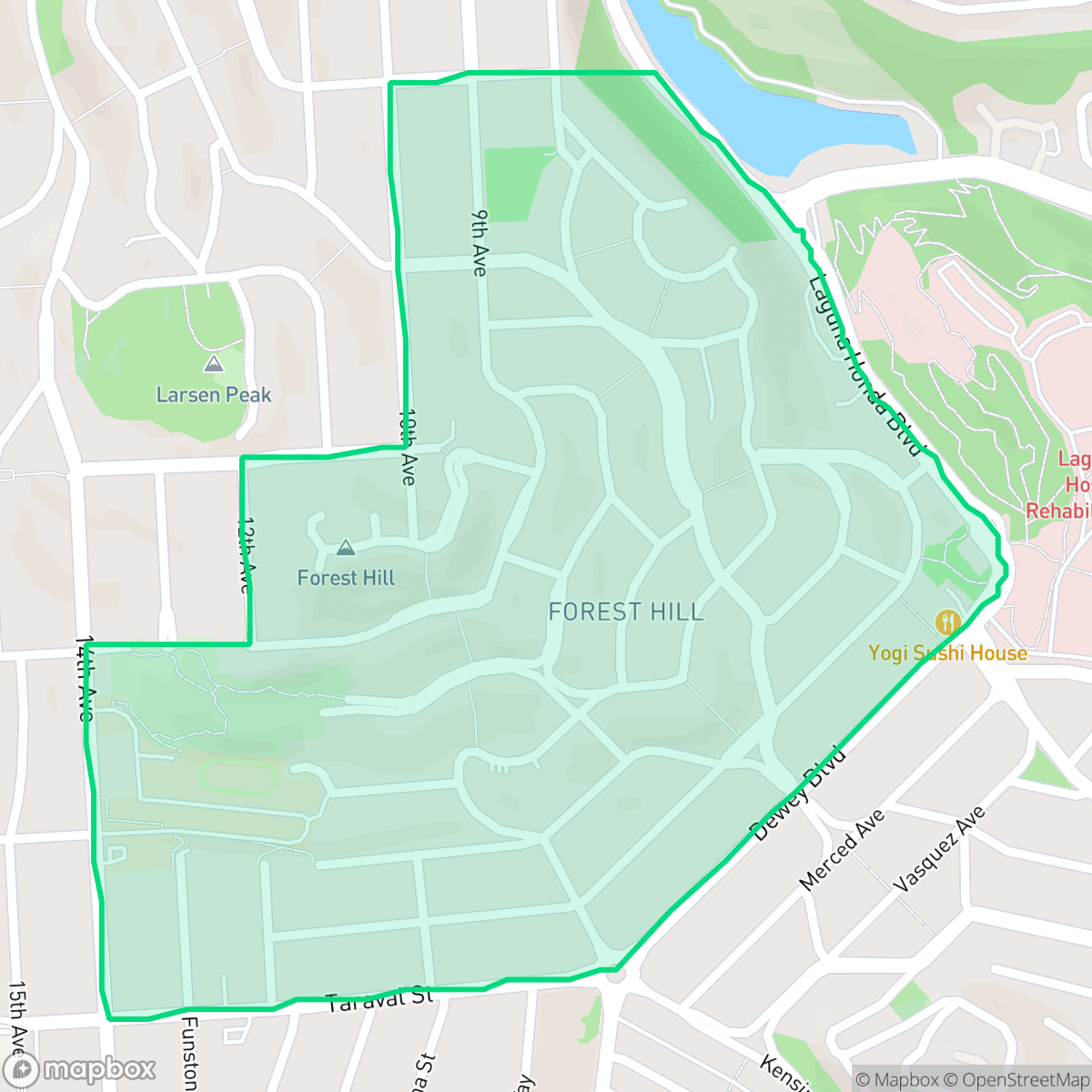
Forest Hill is a quiet, residential enclave in central San Francisco defined by its winding streets and distinctive detached architecture. The area features high walkability and excellent air quality, though residents should expect limited privacy due to closely packed homes.
Key Highlights
About Forest Hill
Established in 1912 as one of San Francisco’s premier master-planned "residence parks," Forest Hill was developed by the Newell-Murdoch Company on land purchased from the estate of Adolph Sutro. Designed by landscape architect Mark Daniels, it was the city's first subdivision with winding streets following the natural contours of the hillside. The neighborhood is characterized by detached homes in various architectural styles, ornate public staircases decorated by Sarsi Studios, and the historic, storybook-style Forest Hill Clubhouse designed by famed architect Bernard Maybeck in 1919. While early deed restrictions originally enforced racial exclusion, the neighborhood integrated in the 1960s when prominent figures like baseball legend Willie Mays and civil rights leader Terry Francois moved in. Today, Forest Hill remains a tranquil, leafy enclave in the geographic center of the city.
This neighborhood serves as a peaceful retreat in the heart of the city, characterized by a dense residential fabric and a complete absence of industrial activity. According to iHuus data, the area maintains a high standard for health insurance coverage and air quality, contributing to its reputation as a stable, long-term living destination. The terrain is hilly, and the lack of through-traffic helps maintain a calm, suburban-like atmosphere despite the central location.
For those considering a move, the trade-off for this tranquility is a limited local commercial presence. While the streets are highly walkable, residents typically travel to adjacent areas like West Portal for daily shopping and dining needs. It is best suited for individuals or families seeking a quiet, community-oriented environment who prioritize access to nearby green spaces and a low-noise residential setting over immediate proximity to urban nightlife.
Neighborhood Scores Across 15 Qualities
Residential structures are situated in close proximity with minimal separation between homes. According to iHuus data, this level of density is higher than the San Francisco average, characterized by narrow gaps and tightly packed lots.
Continuous sidewalks and well-defined crosswalks throughout the dense residential street network ensure high pedestrian safety. This level of connectivity and accessibility is slightly above the San Francisco average, according to iHuus data.
Large, well-maintained homes with mature landscaping and custom architecture provide a more scenic environment than the city average. Many properties feature spacious lots and premium amenities, according to iHuus data.
Abundant forest trails and proximity to large parks like Mount Davidson provide superior walking options for pets. According to iHuus data, the neighborhood offers much greater access to green corridors and safe, tree-lined paths than the San Francisco average.
Residential pockets feature more open land and wooded areas than the typical San Francisco urban grid. According to iHuus data, the landscape offers a more suburban feel with frequent greenery compared to the city average.
Suburban streets and green spaces create a serene atmosphere with a lower level of activity than the San Francisco average. While some lively blocks offer localized dining and social hubs, most essential businesses are not within walking distance.
Local traffic from nearby busy streets creates a steady hum throughout the area. This level of acoustic activity is slightly higher than the average for San Francisco.
Air quality remains consistently high with infrequent instances of poor readings, performing slightly better than the San Francisco average according to iHuus data.
Industrial activity and warehouse facilities are entirely absent from this area. According to iHuus data, the neighborhood maintains a higher level of separation from heavy industry and hazardous sites than the San Francisco average.
Health insurance access is widespread among residents, significantly higher than the San Francisco average according to iHuus data.
Voting patterns and census indicators reflect a deeply liberal political identity that aligns with the broader San Francisco average, according to iHuus data.
Residents live alongside a balanced mix of young professionals, families, and seniors. This demographic spread is slightly more varied than the average found across San Francisco, according to iHuus data.
Flood risk is notably higher than the San Francisco average due to portions of the area falling within the 100-year floodplain. According to iHuus data, residents in these zones may find flood insurance typically required for properties.
Address-Level Insights for Forest Hill


iHuus Neighborhood Intelligence Insights
Get address-level neighborhood insights for Forest Hill
- Street-level scores — see how individual blocks compare, not just neighborhood averages
- Micro-zone boundaries — identify quiet pockets, flood boundaries, and walkable clusters before you visit
- 15 dimensions in full — walkability, noise, air quality, school quality, insurance coverage, population age profile, urban/rural index, and more
- Boundary risk alerts — know if your address sits near a block boundary where scores drop, the kind of detail no listing will ever mention
- School insights — individual school ratings and insights, not just district-level data
- Compare before you commit — side-by-side data across neighborhoods, down to block precision
No credit card required
Compare with Any Neighborhood
| Dimension | Forest Hill | Alamo Square |
|---|---|---|
| 🚶 Walkabilityavg 9.91 | ||
| 🔊 Acoustic Comfortavg 3.4 | ||
| 🤫 Privacy Indexavg 2.14 | ||
| 🎨 Visual Appealavg 6.26 | ||
| 🐕 Dog Friendlinessavg 6.55 | ||
| 🗺️ Urban-Rural Indexavg 4.07 | ||
| ✨ Neighborhood Vibeavg 6.4 | ||
| 🏥 Health Insurance Coverageavg 7.87 | ||
| 🌿 Air Qualityavg 7.78 | ||
| 🏭 Industrial Proximityavg 9.37 | ||
| 🌊 Flood Safetyavg 1.89 | ||
| 🗳️ Ideological Leanavg 9.92 | ||
| 👥 Population Age Profileavg 5.18 | ||
| 🔥 Fire Safetyavg 0.01 | ||
| 🏫 School Quality |
Forest Hill Rankings
School Districts Serving Forest Hill
School Insights for Forest Hill
Below average outcomes; significant attendance and academic challenges.
School Insights
See what's really behind every school rating near Forest Hill
- Individual school ratings — each school's own score with outcome context, not just a district average
- Enrollment & class size data — student-to-teacher ratio and how it compares to the state average
- Full demographics breakdown — ethnicity and gender composition for every school in the enrollment zone
- Every school in the district — all schools within the enrollment boundary ranked by rating, not just the closest one
- Grade levels & benchmarks — elementary through high school, with below/above state-average flags
No credit card required