Financial District, San Francisco
Updated · 3,952 residents
The Financial District is a high-density urban core defined by its towering skyscrapers and exceptional walkability. Residents and workers experience a fast-paced environment with limited privacy and significant street-level noise, yet benefit from proximity to major commercial hubs and transit connections.
Key Highlights
About Financial District
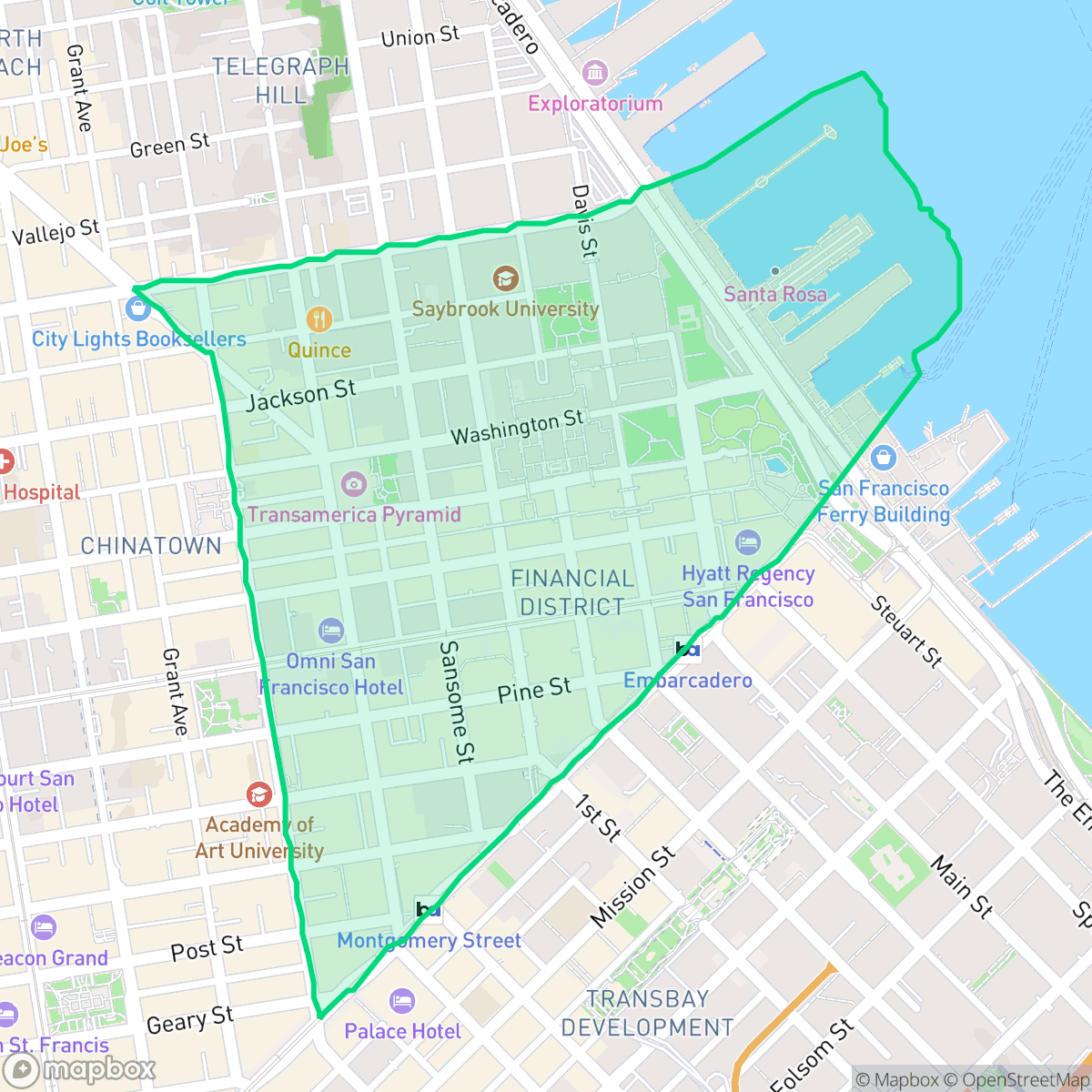
San Francisco’s Financial District, or "FiDi," sits on a unique foundation of maritime history. During the 1849 Gold Rush, Yerba Buena Cove became a "forest of masts" as hundreds of ships were abandoned by crews seeking gold. To claim land, opportunists deliberately scuttled these vessels, filling the cove with earth and rubble. Today, dozens of these historic ships remain buried beneath the district's streets and skyscrapers. Evolving into one of the oldest and largest financial centers in the Western United States, the neighborhood features a striking mix of architectural landmarks. These include the iconic 850-foot Transamerica Pyramid, the Art Deco Shell Building, and the historic Hallidie Building, which is celebrated as the world’s first glass curtain-wall structure.
This neighborhood functions as the primary business center of the city, characterized by an ultra-dense grid of high-rise commercial and residential structures. The area is defined by its intense urban character, where the concentration of activity creates a continuous, high-energy atmosphere throughout the work week. With a perfect walkability score, the district offers seamless access to a wide array of dining options, ranging from upscale establishments like Bix to casual eateries. The streetscape is dominated by glass and steel, reflecting a modern aesthetic that contrasts with the historic infrastructure buried beneath the surface.
Living here involves significant trade-offs regarding privacy and acoustic comfort. The dense, wall-to-wall building configuration results in limited personal space, and the constant road traffic generates a baseline noise level of 62 decibels. Green space is minimal, and the concrete-heavy environment presents challenges for pet owners, with small park areas restricted to the northeastern corner. This neighborhood is best suited for professionals and individuals who prioritize immediate access to the city's commercial core and transit networks over traditional suburban amenities or quiet, secluded living environments.
Neighborhood Scores Across 15 Qualities
Dense, wall-to-wall architecture and narrow alleys create a sense of extreme proximity to neighbors. According to iHuus data, separation between buildings is minimal and comparable to the city average.
Pedestrian navigation is exceptionally easy due to a complete sidewalk grid, high-visibility crosswalks, and a wide harbor-front promenade. This infrastructure provides a level of walkability that is even higher than the San Francisco average, according to iHuus data.
The landscape is characterized by large-scale commercial structures and high-density residential towers. According to iHuus data, the visual environment is largely consistent with the city average, featuring a mix of luxury waterfront real estate and dense urban architecture.
Dense concrete surfaces and minimal street level greenery make finding open areas for pets difficult. While waterfront promenades and small plazas offer some relief, the overall accessibility to parks is below the city average, according to iHuus data.
High-rise skyscrapers and continuous pavement dominate the landscape, providing significantly less greenery and open soil than the San Francisco average. According to iHuus data, the area is characterized by intense building density and minimal natural ground cover.
Dense high-rise blocks and waterfront piers provide a steady concentration of social hubs and diverse dining options. This level of activity is slightly above the city average, according to iHuus data.
Constant sounds from heavy traffic and nearby transit corridors characterize this area. According to iHuus data, acoustic levels are slightly higher than the city average.
Air quality remains mostly clean with rare instances of elevated readings. According to iHuus data, the air quality in this area is slightly better than the San Francisco average.
Industrial activity and heavy manufacturing sites are absent from this area, which consists primarily of high-rise commercial and residential structures. While proximity to maritime infrastructure is noted, the neighborhood remains slightly cleaner of industrial hazards than the San Francisco average according to iHuus data.
Voting patterns and census indicators reflect a deeply liberal political leaning, which aligns with the broader San Francisco average according to iHuus data.
Residents live alongside a balanced mix of young professionals, families, and older adults. According to iHuus data, this age distribution is more varied than the typical profile found across San Francisco.
Frequent flood risk exists due to being located within a designated floodplain; this level of vulnerability is higher than the city average, according to iHuus data.
Address-Level Insights for Financial District


iHuus Neighborhood Intelligence Insights
Get address-level neighborhood insights for Financial District
- Street-level scores — see how individual blocks compare, not just neighborhood averages
- Micro-zone boundaries — identify quiet pockets, flood boundaries, and walkable clusters before you visit
- 15 dimensions in full — walkability, noise, air quality, school quality, insurance coverage, population age profile, urban/rural index, and more
- Boundary risk alerts — know if your address sits near a block boundary where scores drop, the kind of detail no listing will ever mention
- School insights — individual school ratings and insights, not just district-level data
- Compare before you commit — side-by-side data across neighborhoods, down to block precision
No credit card required
Compare with Any Neighborhood
| Dimension | Financial District | Alamo Square |
|---|---|---|
| 🚶 Walkabilityavg 9.91 | ||
| 🔊 Acoustic Comfortavg 3.4 | ||
| 🤫 Privacy Indexavg 2.14 | ||
| 🎨 Visual Appealavg 6.26 | ||
| 🐕 Dog Friendlinessavg 6.55 | ||
| 🗺️ Urban-Rural Indexavg 4.07 | ||
| ✨ Neighborhood Vibeavg 6.4 | ||
| 🏥 Health Insurance Coverageavg 7.87 | ||
| 🌿 Air Qualityavg 7.78 | ||
| 🏭 Industrial Proximityavg 9.37 | ||
| 🌊 Flood Safetyavg 1.89 | ||
| 🗳️ Ideological Leanavg 9.92 | ||
| 👥 Population Age Profileavg 5.18 | ||
| 🔥 Fire Safetyavg 0.01 | ||
| 🏫 School Quality |
Financial District Rankings
School Districts Serving Financial District
School Insights for Financial District
Below average outcomes; significant attendance and academic challenges.
School Insights
See what's really behind every school rating near Financial District
- Individual school ratings — each school's own score with outcome context, not just a district average
- Enrollment & class size data — student-to-teacher ratio and how it compares to the state average
- Full demographics breakdown — ethnicity and gender composition for every school in the enrollment zone
- Every school in the district — all schools within the enrollment boundary ranked by rating, not just the closest one
- Grade levels & benchmarks — elementary through high school, with below/above state-average flags
No credit card required