Excelsior, San Francisco
Updated · 22,705 residents
Excelsior is a highly walkable San Francisco neighborhood characterized by a dense grid of residential row houses and a vibrant, diverse local culture. Residents benefit from excellent air quality and convenient access to local services, though the area features limited privacy due to its tightly packed housing and moderate noise levels from road traffic.
Key Highlights
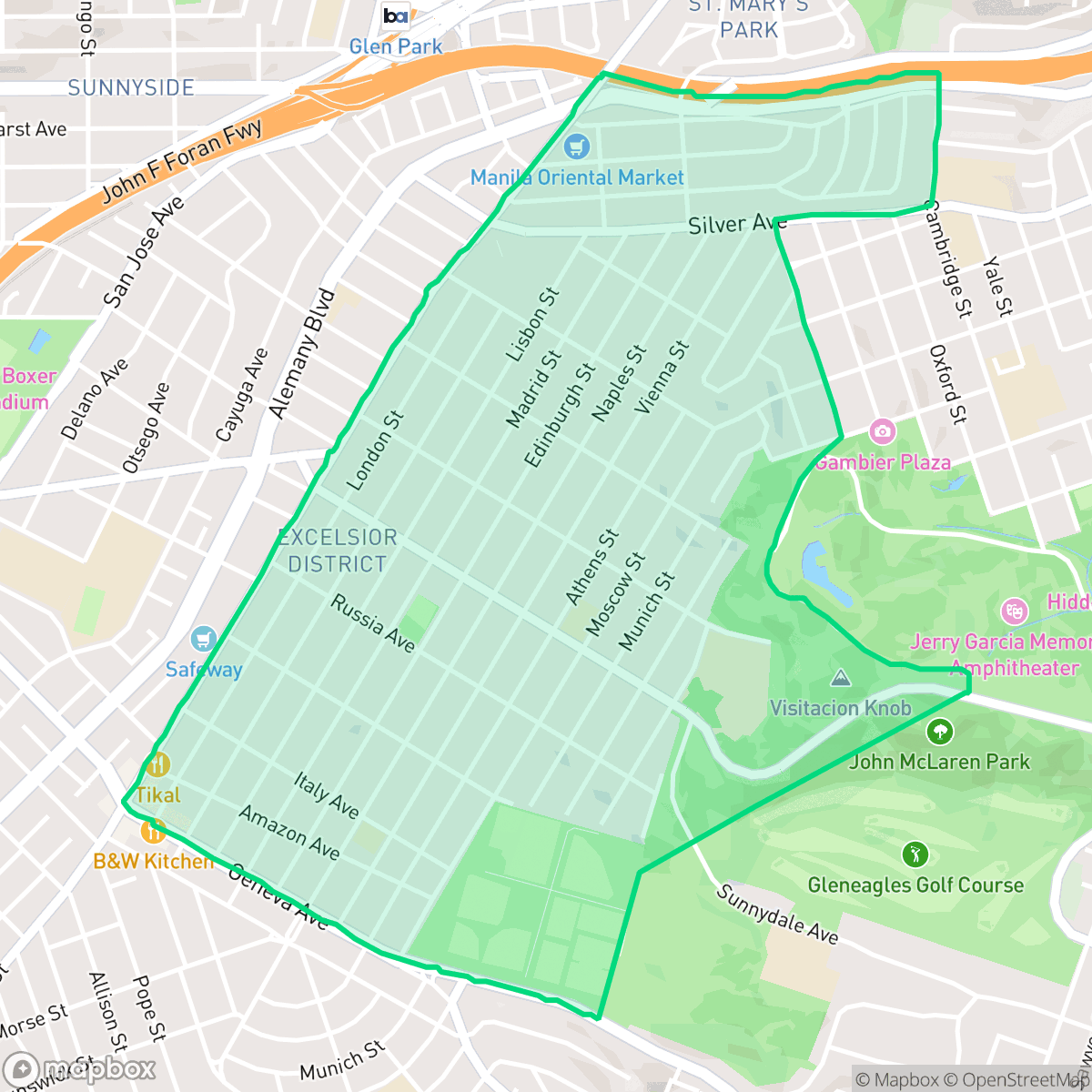
About Excelsior
First filed as a homestead in 1869, San Francisco’s Excelsior neighborhood originally developed as an agricultural suburb populated by Irish, German, and Italian immigrant farmers. The district is famously defined by its "around the world" street grid, where avenues named after countries (like France and Brazil) are crossed by streets named after global capitals (such as Lisbon and Athens). Following the 1906 earthquake, displaced residents migrated to the area, prompting the construction of Victorian row houses and, later, Art Deco and Modernist commercial structures. Over the decades, the working-class neighborhood evolved into one of the city's most ethnically diverse districts, shaped by significant Latino, Filipino, and Chinese communities. Notable local landmarks include the historic 1901 Geneva Car Barn and the childhood home of Grateful Dead frontman Jerry Garcia on Amazon Avenue.
The neighborhood functions as a dense, low-rise residential enclave that maintains a strong sense of community through its consistent street grid and proximity to daily essentials. With a high level of walkability, the area encourages pedestrian activity, connecting residents to a variety of local eateries and social spots. It is notably free from industrial hazards, providing a purely residential environment that is well-supported by high rates of health insurance coverage among its population.
Prospective residents should note that the neighborhood prioritizes density over seclusion, with homes situated close together and minimal separation between properties. While the streets are lively and well-connected, the acoustic environment is influenced by consistent road traffic. The area is particularly well-suited for those who value urban connectivity and a diverse, established community atmosphere over the seclusion of more suburban settings.
Neighborhood Scores Across 15 Qualities
Residential structures are characterized by narrow lots and shared walls, resulting in a level of privacy that is consistent with the city average. According to iHuus data, many homes are row-style developments with minimal separation between neighbors.
Continuous sidewalks and clear pedestrian crossings connect residential blocks to nearby park amenities. This level of accessibility is roughly equal to the city average, according to iHuus data.
Standard tract housing features boxy rooflines and small, tidy yards. This level of visual variety is slightly below the San Francisco average according to iHuus data.
Access to large public parks and green corridors provides reliable opportunities for exercise and walking. This level of greenery and trail connectivity is slightly above the city average according to iHuus data.
Frequent open land and large public parks provide a more spacious feel than the dense urban core of San Francisco. According to iHuus data, the area features a higher concentration of greenery and less-dense housing patterns than the city average.
Diverse dining and social spots create a spirited atmosphere that is more active than the San Francisco average. Residents can find a steady rhythm of life through a variety of local cafes, eateries, and community spaces scattered throughout the neighborhood.
Frequent noise from nearby transit corridors and major roadways is a notable characteristic of this area. According to iHuus data, acoustic comfort levels in the Excelsior are lower than the city average.
Air quality remains mostly clean with rare instances of elevated readings. According to iHuus data, the air quality in this area is slightly better than the San Francisco average.
Industrial activity and warehouses are absent from this area, making it even more residential than the typical San Francisco neighborhood. Residents can expect a landscape composed primarily of homes, parks, and light commercial use without proximity to heavy industrial hazards.
Health insurance accessibility remains relatively high for residents, though coverage levels are slightly below the San Francisco average according to iHuus data.
Voting patterns and census indicators show a deeply liberal political landscape, mirroring the broader trend seen across San Francisco.
Residents live in a community with a diverse age spread ranging from young adults to older generations. This demographic mix is largely consistent with the broader San Francisco average, according to iHuus data.
Flood risk in this area is notably higher than the San Francisco average due to its location in a coastal high-hazard zone. Residents should expect potential exposure to wave action and significantly elevated insurance costs, according to iHuus data.
Address-Level Insights for Excelsior


iHuus Neighborhood Intelligence Insights
Get address-level neighborhood insights for Excelsior
- Street-level scores — see how individual blocks compare, not just neighborhood averages
- Micro-zone boundaries — identify quiet pockets, flood boundaries, and walkable clusters before you visit
- 15 dimensions in full — walkability, noise, air quality, school quality, insurance coverage, population age profile, urban/rural index, and more
- Boundary risk alerts — know if your address sits near a block boundary where scores drop, the kind of detail no listing will ever mention
- School insights — individual school ratings and insights, not just district-level data
- Compare before you commit — side-by-side data across neighborhoods, down to block precision
No credit card required
Compare with Any Neighborhood
| Dimension | Excelsior | Alamo Square |
|---|---|---|
| 🚶 Walkabilityavg 9.91 | ||
| 🔊 Acoustic Comfortavg 3.4 | ||
| 🤫 Privacy Indexavg 2.14 | ||
| 🎨 Visual Appealavg 6.26 | ||
| 🐕 Dog Friendlinessavg 6.55 | ||
| 🗺️ Urban-Rural Indexavg 4.07 | ||
| ✨ Neighborhood Vibeavg 6.4 | ||
| 🏥 Health Insurance Coverageavg 7.87 | ||
| 🌿 Air Qualityavg 7.78 | ||
| 🏭 Industrial Proximityavg 9.37 | ||
| 🌊 Flood Safetyavg 1.89 | ||
| 🗳️ Ideological Leanavg 9.92 | ||
| 👥 Population Age Profileavg 5.18 | ||
| 🔥 Fire Safetyavg 0.01 | ||
| 🏫 School Quality |
Excelsior Rankings
School Districts Serving Excelsior
School Insights for Excelsior
Below average outcomes; significant attendance and academic challenges.
School Insights
See what's really behind every school rating near Excelsior
- Individual school ratings — each school's own score with outcome context, not just a district average
- Enrollment & class size data — student-to-teacher ratio and how it compares to the state average
- Full demographics breakdown — ethnicity and gender composition for every school in the enrollment zone
- Every school in the district — all schools within the enrollment boundary ranked by rating, not just the closest one
- Grade levels & benchmarks — elementary through high school, with below/above state-average flags
No credit card required