Eureka Valley - Dolores Heights - Castro, San Francisco
Updated · 14,713 residents
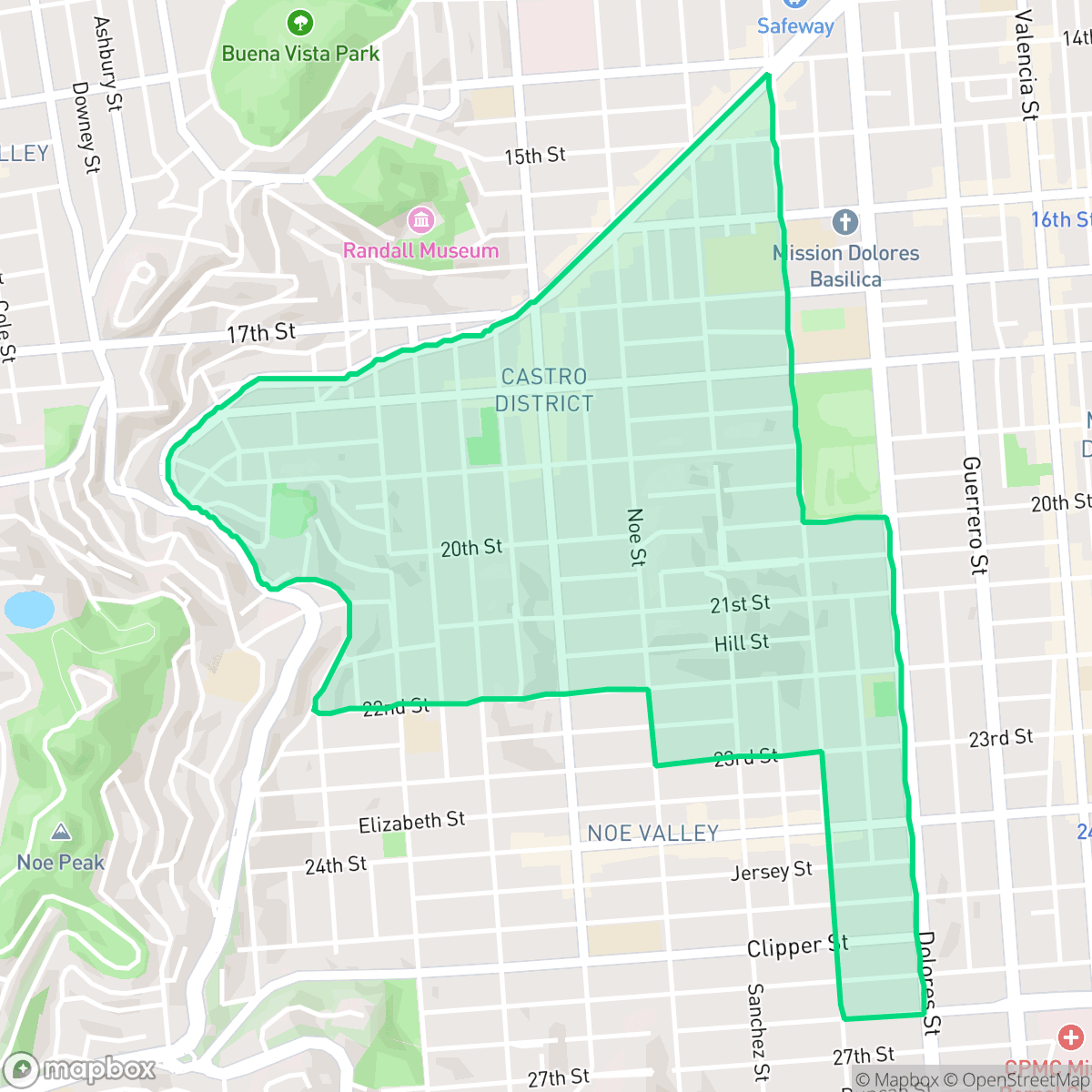
The Eureka Valley, Dolores Heights, and Castro neighborhood is a highly walkable urban district defined by its dense collection of Victorian row houses and hilly terrain. Residents enjoy immediate access to local parks and a vibrant street life, though the area is characterized by tightly packed housing with minimal privacy. According to iHuus data, the neighborhood offers an exceptionally pedestrian-friendly environment in the heart of San Francisco.
Key Highlights
About Eureka Valley - Dolores Heights - Castro
Originally part of the 1845 Mexican land grant Rancho San Miguel, the Eureka Valley, Dolores Heights, and Castro area transitioned from rural farmland into a bustling streetcar suburb following the 1886 opening of the Market & Castro Street Cable Car line. Spared from the 1906 earthquake's fires—aided by the historic golden fire hydrant at Dolores Park—the neighborhood retained its dense stock of Victorian architecture, including Queen Anne row houses on Hartford Street. Initially a working-class enclave for Irish, German, and Scandinavian immigrants, who built landmarks like the 1907 Swedish American Hall, the area underwent a dramatic cultural shift in the 1960s and 1970s. It evolved into the global epicenter of LGBTQ+ activism, famously championed by Supervisor Harvey Milk and anchored by the iconic 1922 Timothy Pflueger-designed Castro Theatre.
This neighborhood serves as a dense, transit-oriented hub where traditional architecture meets a modern urban lifestyle. The area is defined by its steep, grid-based streets that provide excellent walkability and immediate access to major green spaces like Dolores Park. The local environment is strictly residential and light commercial, free from industrial hazards, and features a high degree of health insurance coverage among its residents. The visual appeal remains high due to well-maintained historic homes and consistent property upkeep. Prospective residents should be aware of the trade-offs inherent in such a dense urban setting. The prevalence of wall-to-wall row houses means that privacy is limited, and road traffic contributes to a moderate noise level. While the area is highly desirable for its culture and convenience, families should note that the local school district currently faces significant financial and operational challenges. According to iHuus, the neighborhood is best suited for those who prioritize walkability and proximity to city amenities over expansive private outdoor space.
Neighborhood Scores Across 15 Qualities
Residential structures consist largely of high-density row houses and multi-unit buildings with shared walls or very narrow gaps. This level of density is typical for the area and aligns closely with the city average.
Extremely easy to navigate on foot due to a dense street grid, wide sidewalks, and frequent marked crosswalks. This level of pedestrian accessibility is slightly above the San Francisco average according to iHuus data.
Well-maintained historic architecture and tiered landscaping create a more visually pleasing environment than the San Francisco average. Residents benefit from prominent hillside homes and proximity to manicured urban parks.
Frequent access to major hubs like Dolores Park and Duboce Park provides more open green space for pets than the city average. While many residential blocks feature a dense urban grid, the neighborhood offers several large public parks with visible walking trails and wide sidewalks.
Residential streets and hilly open spaces are distributed in roughly equal measure here. This density of low-rise buildings and mixed-use blocks is slightly more suburban than the San Francisco average.
Frequent social activity and a dense concentration of eateries and parks create an energy that is slightly higher than the San Francisco average. While some residential blocks remain quiet, much of the area features accessible local hubs and diverse dining options according to iHuus data.
Steady traffic sounds from busy local thoroughfares are present, though the acoustic environment remains more tranquil than the average San Francisco neighborhood according to iHuus data.
Air quality remains mostly clean with only rare instances of elevated readings. This level of air quality is slightly below the San Francisco city average according to iHuus data.
Residential and light commercial uses define this area, with no warehouses, heavy industry, or hazardous facilities detected. This neighborhood maintains a cleaner profile than the San Francisco average according to iHuus data.
Health insurance access is exceptionally high for residents in this area, significantly surpassing the San Francisco average according to iHuus data.
Voting patterns and census indicators show a deeply liberal political leaning that is slightly more pronounced than the city average, according to iHuus data.
Residents live alongside a balanced blend of young professionals, families, and long-term older inhabitants. This demographic spread is closely aligned with the typical age distribution found across San Francisco.
Address-Level Insights for Eureka Valley - Dolores Heights - Castro


iHuus Neighborhood Intelligence Insights
Get address-level neighborhood insights for Eureka Valley - Dolores Heights - Castro
- Street-level scores — see how individual blocks compare, not just neighborhood averages
- Micro-zone boundaries — identify quiet pockets, flood boundaries, and walkable clusters before you visit
- 15 dimensions in full — walkability, noise, air quality, school quality, insurance coverage, population age profile, urban/rural index, and more
- Boundary risk alerts — know if your address sits near a block boundary where scores drop, the kind of detail no listing will ever mention
- School insights — individual school ratings and insights, not just district-level data
- Compare before you commit — side-by-side data across neighborhoods, down to block precision
No credit card required
Compare with Any Neighborhood
| Dimension | Eureka Valley - Dolores Heights - Castro | Alamo Square |
|---|---|---|
| 🚶 Walkabilityavg 9.91 | ||
| 🔊 Acoustic Comfortavg 3.4 | ||
| 🤫 Privacy Indexavg 2.14 | ||
| 🎨 Visual Appealavg 6.26 | ||
| 🐕 Dog Friendlinessavg 6.55 | ||
| 🗺️ Urban-Rural Indexavg 4.07 | ||
| ✨ Neighborhood Vibeavg 6.4 | ||
| 🏥 Health Insurance Coverageavg 7.87 | ||
| 🌿 Air Qualityavg 7.78 | ||
| 🏭 Industrial Proximityavg 9.37 | ||
| 🌊 Flood Safetyavg 1.89 | ||
| 🗳️ Ideological Leanavg 9.92 | ||
| 👥 Population Age Profileavg 5.18 | ||
| 🔥 Fire Safetyavg 0.01 | ||
| 🏫 School Quality |
Eureka Valley - Dolores Heights - Castro Rankings
School Districts Serving Eureka Valley - Dolores Heights - Castro
School Insights for Eureka Valley - Dolores Heights - Castro
Below average outcomes; significant attendance and academic challenges.
School Insights
See what's really behind every school rating near Eureka Valley - Dolores Heights - Castro
- Individual school ratings — each school's own score with outcome context, not just a district average
- Enrollment & class size data — student-to-teacher ratio and how it compares to the state average
- Full demographics breakdown — ethnicity and gender composition for every school in the enrollment zone
- Every school in the district — all schools within the enrollment boundary ranked by rating, not just the closest one
- Grade levels & benchmarks — elementary through high school, with below/above state-average flags
No credit card required