Downtown, San Francisco
Updated · 19,194 residents
Downtown San Francisco is the city's high-energy commercial heart, defined by its exceptional walkability and dense urban landscape. While the area offers unparalleled access to dining and cultural landmarks, residents face high noise levels and limited private outdoor space.
Key Highlights
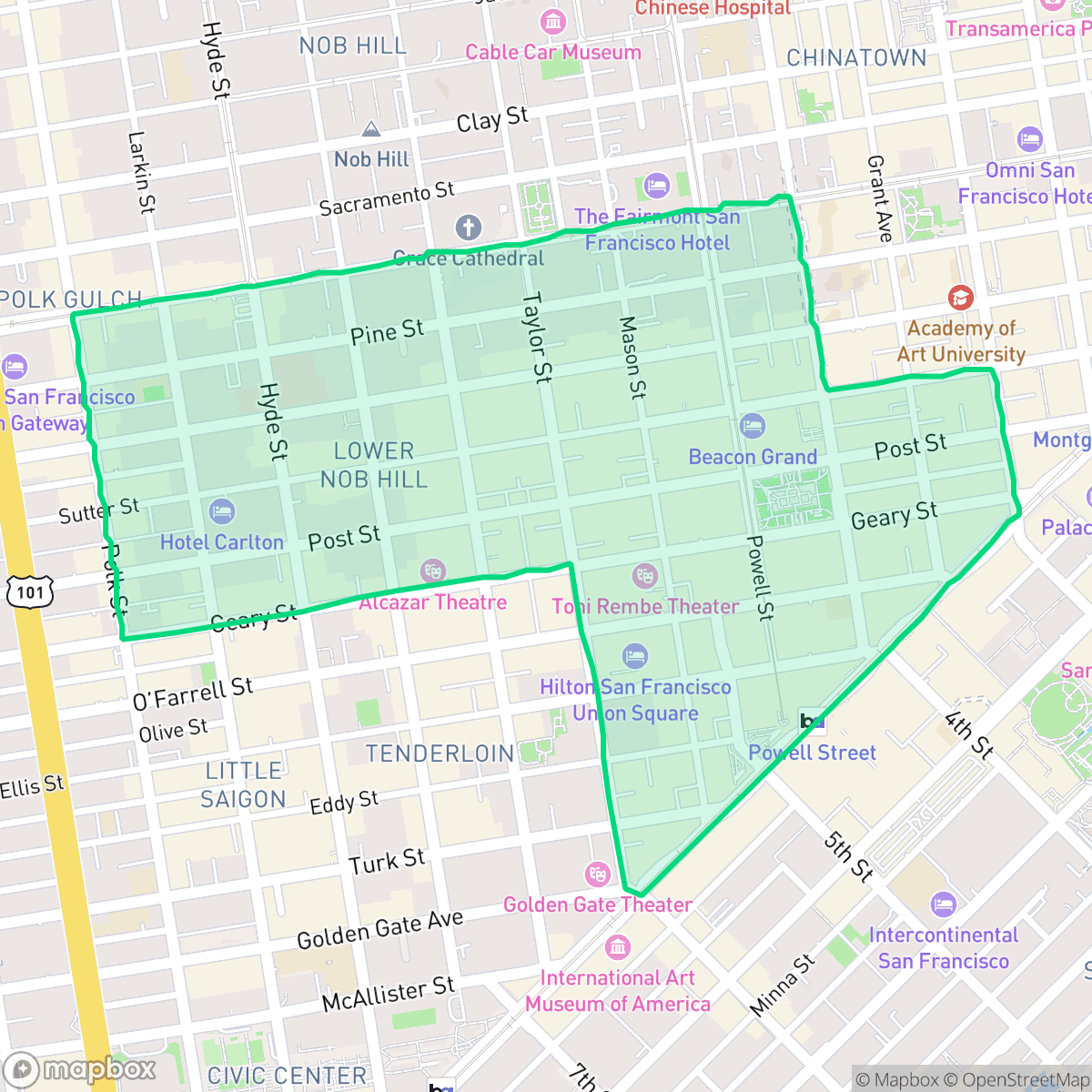
About Downtown
Downtown San Francisco, anchored by the Financial District and Union Square, originated as a settlement near Yerba Buena Cove, which was later filled to expand the city's commercial core following the 1849 Gold Rush. The neighborhood served as the primary business hub of the American West, though it was largely devastated by the 1906 earthquake and fire. Reconstruction efforts defined its architectural character, blending Beaux-Arts and Art Deco styles with historic Gold Rush-era brick structures in areas like Jackson Square. Landmarks such as Lotta’s Fountain, which served as a central meeting point during the 1906 disaster, and the modern Transamerica Pyramid reflect the district's evolution. Historically, the area shifted from maritime trade and the infamous Barbary Coast vice district into a global center for finance, law, and commerce, solidified by mid-20th-century urban development.
Downtown San Francisco functions as a dense urban core where high-rise residential and commercial buildings dominate the skyline. The area serves as a central social and professional hub, featuring a high concentration of restaurants and cultural attractions that keep the streets active throughout the day. Pedestrian infrastructure is highly developed, allowing residents to navigate the grid with ease and efficiency.
Living here requires balancing the benefits of a central location against the realities of a high-density environment. Privacy is limited due to the proximity of neighboring units, and the lack of street-level greenery results in a concrete-heavy aesthetic. Prospective residents should note that the area is subject to significant traffic noise and carries elevated flood risks. Despite these challenges, the neighborhood remains a primary destination for those prioritizing proximity to the city's core over quiet residential seclusion.
Neighborhood Scores Across 15 Qualities
High density and wall-to-wall construction result in minimal separation between buildings. According to iHuus data, privacy levels here are slightly below the city average due to the prevalence of shared walls and narrow alleys.
Pedestrian infrastructure is exceptionally well-developed, featuring wide sidewalks and high-visibility crosswalks throughout the grid. This level of accessibility is slightly above the San Francisco city average, according to iHuus data.
Characterized by high-density commercial and residential structures, this area features a mix of institutional architecture and flat-roofed apartments. The visual landscape is slightly below the city average for aesthetic variety due to a lack of private green spaces and luxury amenities.
Dense concrete surroundings and a lack of street-level greenery make pet outings difficult. While small areas like Yerba Buena Gardens offer some relief, overall access to open parks is significantly below the city average according to iHuus data.
High-rise buildings and continuous pavement dominate the landscape, providing far less greenery than the San Francisco average. According to iHuus data, this area is characterized by an intense urban density with very little unbuilt ground space or natural cover.
High concentrations of diverse dining and cultural landmarks create a high-energy atmosphere that is more active than the city average. According to iHuus data, the area serves as a dense social center with a wide variety of restaurants and notable attractions.
Frequent traffic and transit noise from nearby major thoroughfares and rail lines characterize the area. According to iHuus data, acoustic comfort is notably lower than the San Francisco average.
Air quality remains consistently good with rare instances of elevated readings. According to iHuus data, levels in this area are slightly higher than the San Francisco average.
The area consists entirely of commercial and residential high-rises with no detectable warehouses or heavy manufacturing. This lack of industrial activity is even more pronounced here than in the rest of San Francisco, according to iHuus data.
Health insurance coverage among residents is significantly lower than the San Francisco average. According to iHuus data, a small minority of the local population possesses medical coverage.
Voting patterns and census indicators reflect a deeply liberal political landscape that is consistent with the rest of San Francisco. According to iHuus data, this area shares the same predominant ideological lean as the city average.
Residents live among a balanced distribution of young professionals, families, and older adults. This age profile is largely consistent with the broader San Francisco area, according to iHuus data.
Significant flood risk exists due to the area being within a coastal high-hazard zone. Residents should anticipate much higher insurance costs than the city average according to iHuus data.
Address-Level Insights for Downtown


iHuus Neighborhood Intelligence Insights
Get address-level neighborhood insights for Downtown
- Street-level scores — see how individual blocks compare, not just neighborhood averages
- Micro-zone boundaries — identify quiet pockets, flood boundaries, and walkable clusters before you visit
- 15 dimensions in full — walkability, noise, air quality, school quality, insurance coverage, population age profile, urban/rural index, and more
- Boundary risk alerts — know if your address sits near a block boundary where scores drop, the kind of detail no listing will ever mention
- School insights — individual school ratings and insights, not just district-level data
- Compare before you commit — side-by-side data across neighborhoods, down to block precision
No credit card required
Compare with Any Neighborhood
| Dimension | Downtown | Alamo Square |
|---|---|---|
| 🚶 Walkabilityavg 9.91 | ||
| 🔊 Acoustic Comfortavg 3.4 | ||
| 🤫 Privacy Indexavg 2.14 | ||
| 🎨 Visual Appealavg 6.26 | ||
| 🐕 Dog Friendlinessavg 6.55 | ||
| 🗺️ Urban-Rural Indexavg 4.07 | ||
| ✨ Neighborhood Vibeavg 6.4 | ||
| 🏥 Health Insurance Coverageavg 7.87 | ||
| 🌿 Air Qualityavg 7.78 | ||
| 🏭 Industrial Proximityavg 9.37 | ||
| 🌊 Flood Safetyavg 1.89 | ||
| 🗳️ Ideological Leanavg 9.92 | ||
| 👥 Population Age Profileavg 5.18 | ||
| 🔥 Fire Safetyavg 0.01 | ||
| 🏫 School Quality |
Downtown Rankings
School Districts Serving Downtown
School Insights for Downtown
Below average outcomes; significant attendance and academic challenges.
School Insights
See what's really behind every school rating near Downtown
- Individual school ratings — each school's own score with outcome context, not just a district average
- Enrollment & class size data — student-to-teacher ratio and how it compares to the state average
- Full demographics breakdown — ethnicity and gender composition for every school in the enrollment zone
- Every school in the district — all schools within the enrollment boundary ranked by rating, not just the closest one
- Grade levels & benchmarks — elementary through high school, with below/above state-average flags
No credit card required