Diamond Heights, San Francisco
Updated · 4,780 residents
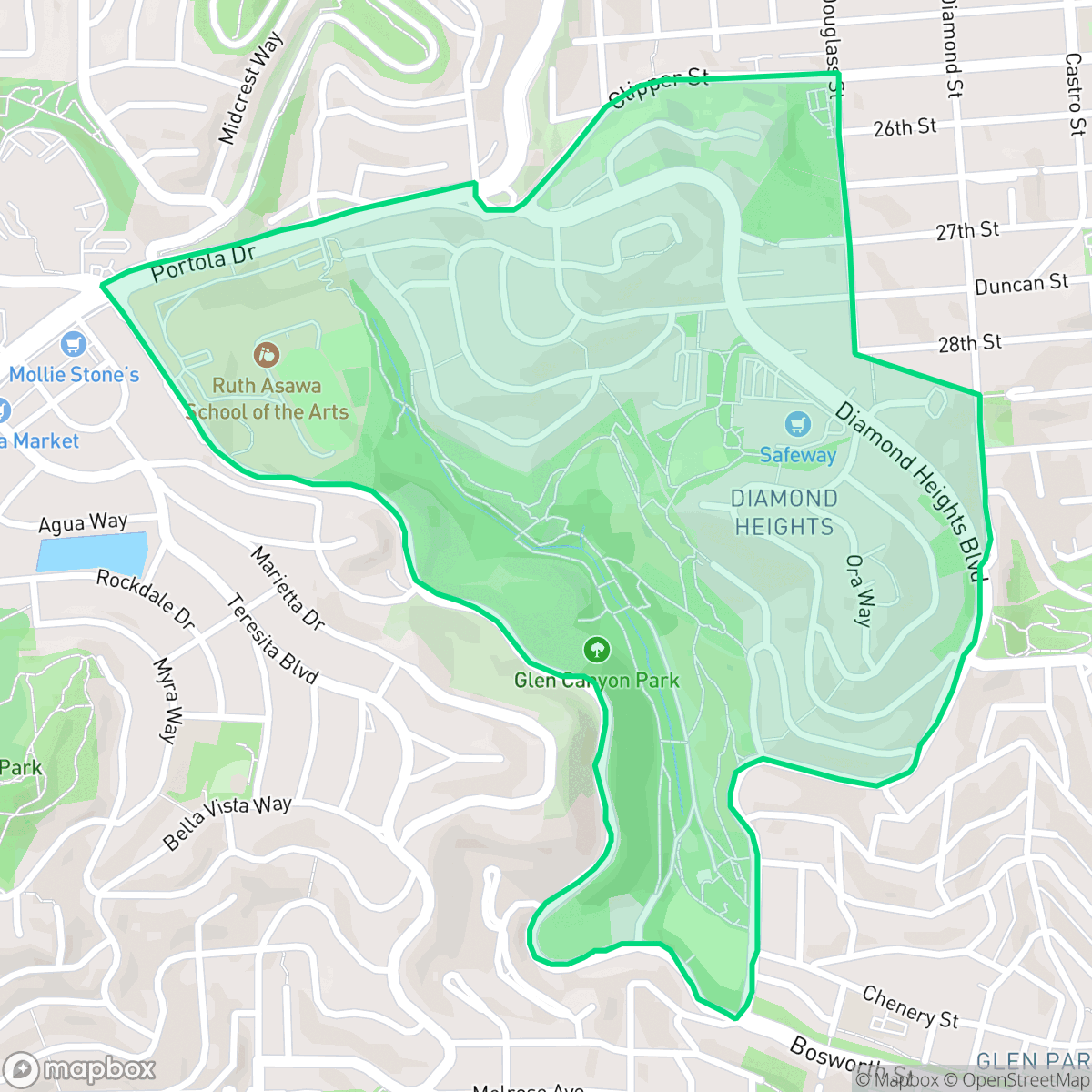
Diamond Heights is a hilly, architecturally distinct enclave known for its Mid-Century Modern homes and sweeping views of San Francisco. The area offers exceptional walkability and extensive green space, making it a premier destination for dog owners and those seeking a quiet, suburban atmosphere within the city.
Key Highlights
About Diamond Heights
Until the mid-20th century, the rugged hills of Diamond Heights—including Red Rock Hill and Gold Mine Hill—were largely undeveloped, used primarily for cattle grazing and rock quarrying. In 1950, the San Francisco Redevelopment Agency designated the 332-acre site as its first major urban renewal project. Architect Vernon DeMars drafted a 1951 master plan to build a cohesive, modern "neighborhood unit" that worked with the steep topography rather than against it. Developed between 1961 and 1978, Diamond Heights became a showcase for Mid-Century Modernism and regional Bay Area architectural traditions, featuring designs by prominent figures like Joseph Eichler, Beverly Willis, and Skidmore, Owings & Merrill. The neighborhood was planned as a self-contained community, integrating diverse housing, public parks like the George Christopher Playground, and the Diamond Heights Shopping Center.
The neighborhood is defined by its intentional, master-planned layout that emphasizes integration with the steep, rugged terrain. Residents benefit from a highly walkable environment featuring dedicated pedestrian pathways and proximity to significant natural areas, including large forest parks. The area maintains a high standard of visual appeal, characterized by well-maintained, multi-story homes and a lack of industrial activity, which contributes to a clean and purely residential atmosphere.
While the area provides a peaceful, community-focused lifestyle, prospective residents should note the trade-offs associated with its high-density design. The closely spaced row-house configurations limit individual privacy, and road traffic noise remains a consistent factor throughout the neighborhood. It is best suited for individuals or families who prioritize outdoor access and a stable, residential environment over the high-energy, commercial activity found in other parts of the city.
Neighborhood Scores Across 15 Qualities
Residential structures are closely spaced with minimal separation between homes, which is slightly higher than the San Francisco average. Many properties feature a row-house configuration with very narrow gaps between adjacent buildings according to iHuus data.
Continuous sidewalks and dedicated park paths make navigating the neighborhood easy on foot, though the street grid is slightly less dense than the San Francisco average. According to iHuus data, the area features a reliable network of wide sidewalks and ample crossings for residents.
Large, well-maintained homes and high-quality amenities provide a more visually pleasing environment than the city average. According to iHuus data, the area features notable architectural variety and manicured landscapes positioned near scenic hills.
Extensive wooded trails and large public parks with athletic fields provide abundant space for pet recreation. According to iHuus data, these connected green spaces offer much higher accessibility for dogs than the typical San Francisco neighborhood.
Residential streets and green spaces are distributed in roughly equal measure, providing a more suburban feel than the city average. According to iHuus data, the area features a blend of multi-story housing and significant natural buffers.
Local dining hubs and community landmarks provide a noticeable level of activity that sits slightly above the city average. While some residential streets remain calm and suburban, certain pockets offer a steady movement of people near various social spots.
Steady noise from nearby busy streets is present, though the acoustic environment remains notably quieter than the San Francisco average according to iHuus data.
Air quality remains consistently high with rare instances of elevated readings, performing slightly better than the San Francisco average according to iHuus data.
Industrial activity and large warehouses are absent from this area, which consists entirely of residential, educational, and recreational zones. This lack of industrial presence is more pronounced here than in most other parts of San Francisco.
Health insurance access is exceptionally high among residents, significantly outpacing the San Francisco average according to iHuus data.
Voting patterns and census indicators reflect a deeply liberal political leaning that is consistent with the broader San Francisco area. This political landscape is a defining characteristic of the community according to iHuus data.
Residents experience a balanced mix of young adults, families, and older populations. According to iHuus data, this demographic spread is slightly more varied than the average found across San Francisco.
Flood risk in this area is notably higher than the San Francisco average. According to iHuus data, the lack of a detailed federal flood study leaves the precise level of risk undetermined.
Address-Level Insights for Diamond Heights


iHuus Neighborhood Intelligence Insights
Get address-level neighborhood insights for Diamond Heights
- Street-level scores — see how individual blocks compare, not just neighborhood averages
- Micro-zone boundaries — identify quiet pockets, flood boundaries, and walkable clusters before you visit
- 15 dimensions in full — walkability, noise, air quality, school quality, insurance coverage, population age profile, urban/rural index, and more
- Boundary risk alerts — know if your address sits near a block boundary where scores drop, the kind of detail no listing will ever mention
- School insights — individual school ratings and insights, not just district-level data
- Compare before you commit — side-by-side data across neighborhoods, down to block precision
No credit card required
Compare with Any Neighborhood
| Dimension | Diamond Heights | Alamo Square |
|---|---|---|
| 🚶 Walkabilityavg 9.91 | ||
| 🔊 Acoustic Comfortavg 3.4 | ||
| 🤫 Privacy Indexavg 2.14 | ||
| 🎨 Visual Appealavg 6.26 | ||
| 🐕 Dog Friendlinessavg 6.55 | ||
| 🗺️ Urban-Rural Indexavg 4.07 | ||
| ✨ Neighborhood Vibeavg 6.4 | ||
| 🏥 Health Insurance Coverageavg 7.87 | ||
| 🌿 Air Qualityavg 7.78 | ||
| 🏭 Industrial Proximityavg 9.37 | ||
| 🌊 Flood Safetyavg 1.89 | ||
| 🗳️ Ideological Leanavg 9.92 | ||
| 👥 Population Age Profileavg 5.18 | ||
| 🔥 Fire Safetyavg 0.01 | ||
| 🏫 School Quality |
Diamond Heights Rankings
School Districts Serving Diamond Heights
School Insights for Diamond Heights
Below average outcomes; significant attendance and academic challenges.
School Insights
See what's really behind every school rating near Diamond Heights
- Individual school ratings — each school's own score with outcome context, not just a district average
- Enrollment & class size data — student-to-teacher ratio and how it compares to the state average
- Full demographics breakdown — ethnicity and gender composition for every school in the enrollment zone
- Every school in the district — all schools within the enrollment boundary ranked by rating, not just the closest one
- Grade levels & benchmarks — elementary through high school, with below/above state-average flags
No credit card required