Crocker Amazon, San Francisco
Updated · 10,647 residents
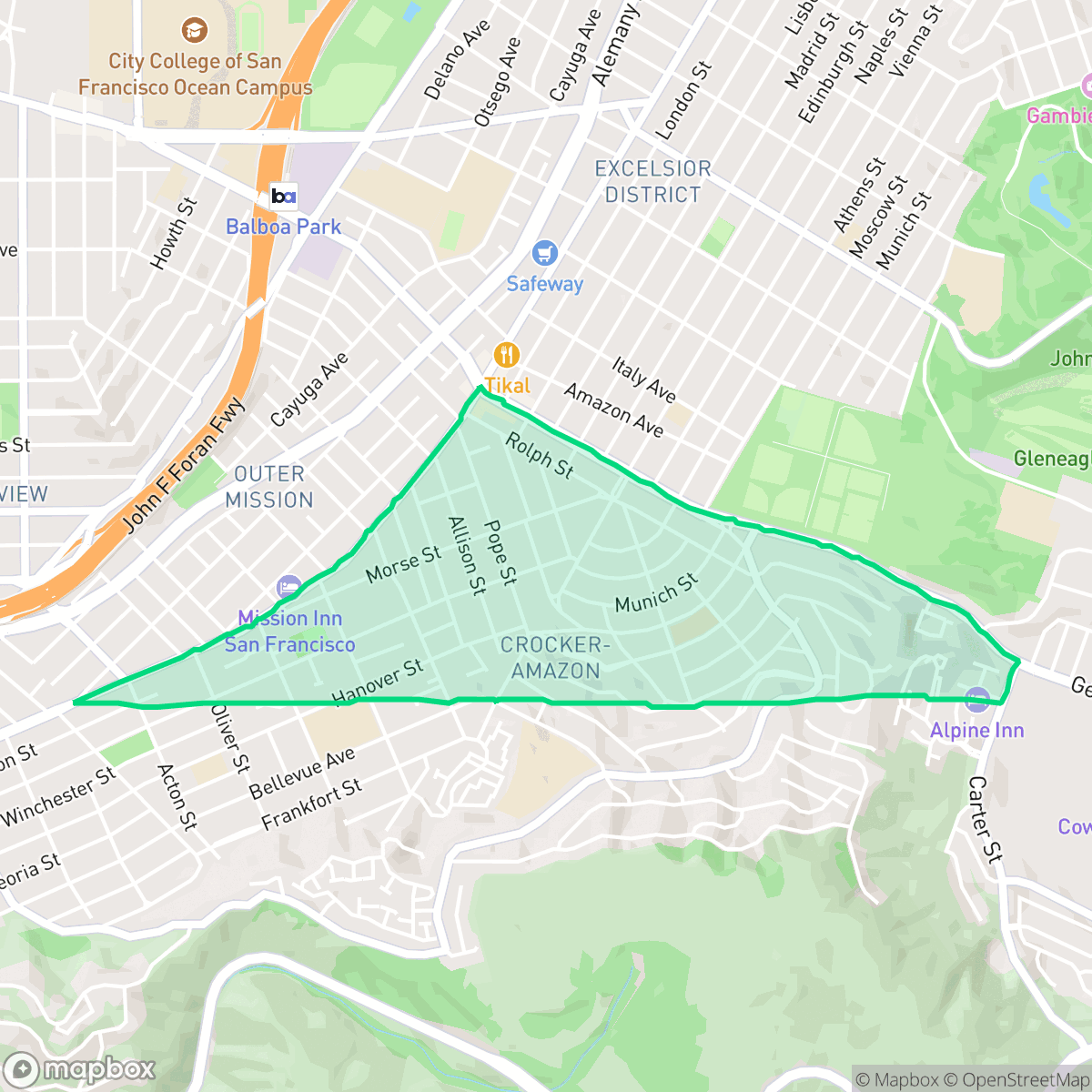
Crocker Amazon is a dense residential neighborhood at San Francisco's southern edge, known for its multicultural character and proximity to expansive public green space. The area offers exceptional walkability with continuous sidewalks and easy access to recreational fields, though residents experience high density and notable noise levels from nearby road traffic.
Key Highlights
About Crocker Amazon
Situated at San Francisco’s southern border, Crocker Amazon developed on land holdings once owned by railroad magnate Charles Crocker, with its name drawing from his estate and nearby Amazon Avenue. Initially established as a quiet, working-class enclave dominated by Irish and Italian families, the neighborhood featured diverse architectural styles, including Edwardian, Craftsman, and mid-century Sunstream homes. Its commercial hub along Geneva Avenue and Mission Street was historically anchored by local landmarks like the Amazon Theatre (later the Apollo). By the late 1970s and 1980s, Crocker Amazon underwent a significant cultural transformation, evolving into a vibrant, diverse community with a large Filipino, Latino, and Samoan presence. Today, the neighborhood is defined by its multicultural eateries and the expansive Crocker-Amazon Park, which features active sports fields adjacent to McLaren Park.
The area functions as a quiet, residential enclave defined by its tight grid of row-houses and consistent street-level activity. It benefits from a complete lack of industrial activity, maintaining a purely residential and recreational atmosphere. Residents enjoy direct access to large parks and green corridors, which according to iHuus data, makes the neighborhood particularly well-suited for dog owners and those who prioritize outdoor recreation. Living here involves navigating the realities of high-density urban design, where homes are positioned closely together with limited privacy. While the neighborhood boasts perfect walkability scores, potential residents should be aware of the consistent road traffic noise that permeates the area. It is an ideal location for those seeking a multicultural community and a stable, neighborhood-focused lifestyle, provided they are comfortable with the acoustic environment and the density of a traditional San Francisco residential block.
Neighborhood Scores Across 15 Qualities
Residential density is high, with many row houses and apartment blocks featuring shared walls or very narrow gaps between structures. This lack of separation between buildings is consistent with the overall privacy levels found across San Francisco.
Continuous sidewalks and clear pedestrian crossings throughout the residential grid make navigating the area on foot very easy. This level of pedestrian connectivity is slightly above the San Francisco average according to iHuus data.
Residential landscapes consist primarily of standard tract housing with uniform rooflines and small yards. This visual profile is slightly below the San Francisco average for aesthetic variety.
Extensive parklands and greenbelt trails provide excellent opportunities for pet owners. According to iHuus data, access to large trails and open fields is slightly above the city average.
Residential blocks offer a consistent mix of dense row houses and significant public park space. This landscape provides a more suburban balance of greenery and street grid than the typical San Francisco urban core, according to iHuus data.
Suburban streets and green spaces define much of the area, offering a steady rhythm of life with occasional pockets of vibrant dining and social spots. While some blocks feature diverse eateries, the overall level of activity and amenity density is lower than the San Francisco average.
Frequent noise from nearby transit corridors and major roadways makes this area louder than the San Francisco average. Residents should expect consistent auditory disturbances from heavy vehicle and rail traffic according to iHuus data.
Air quality in this area is consistently good, remaining slightly above the San Francisco average according to iHuus data.
Industrial activity is virtually non-existent in this area, as the landscape is composed of residential and light commercial zones. According to iHuus data, there are no detectable warehouses, heavy manufacturing facilities, or hazardous industrial sites within the neighborhood, making it very similar to the broader San Francisco average.
Health insurance access among residents is high, though slightly below the San Francisco average according to iHuus data.
Political leanings in this area align closely with the broader San Francisco trend. Census indicators and voting patterns according to iHuus data reflect a community with deeply established liberal values.
Residents live alongside a balanced demographic of young professionals, families, and seniors. According to iHuus data, this age distribution is largely in line with the broader San Francisco area.
Located in a coastal high-hazard zone with potential wave action, this area faces significantly higher flood risks than the San Francisco average. Residents should prepare for elevated or prohibitive flood insurance costs according to iHuus data.
Fire hazards in this area are exceptionally high, representing a significant risk level that is even greater than the San Francisco average. Residents should remain vigilant about local fire safety protocols and maximum protection measures.
Address-Level Insights for Crocker Amazon


iHuus Neighborhood Intelligence Insights
Get address-level neighborhood insights for Crocker Amazon
- Street-level scores — see how individual blocks compare, not just neighborhood averages
- Micro-zone boundaries — identify quiet pockets, flood boundaries, and walkable clusters before you visit
- 15 dimensions in full — walkability, noise, air quality, school quality, insurance coverage, population age profile, urban/rural index, and more
- Boundary risk alerts — know if your address sits near a block boundary where scores drop, the kind of detail no listing will ever mention
- School insights — individual school ratings and insights, not just district-level data
- Compare before you commit — side-by-side data across neighborhoods, down to block precision
No credit card required
Compare with Any Neighborhood
| Dimension | Crocker Amazon | Alamo Square |
|---|---|---|
| 🚶 Walkabilityavg 9.91 | ||
| 🔊 Acoustic Comfortavg 3.4 | ||
| 🤫 Privacy Indexavg 2.14 | ||
| 🎨 Visual Appealavg 6.26 | ||
| 🐕 Dog Friendlinessavg 6.55 | ||
| 🗺️ Urban-Rural Indexavg 4.07 | ||
| ✨ Neighborhood Vibeavg 6.4 | ||
| 🏥 Health Insurance Coverageavg 7.87 | ||
| 🌿 Air Qualityavg 7.78 | ||
| 🏭 Industrial Proximityavg 9.37 | ||
| 🌊 Flood Safetyavg 1.89 | ||
| 🗳️ Ideological Leanavg 9.92 | ||
| 👥 Population Age Profileavg 5.18 | ||
| 🔥 Fire Safetyavg 0.01 | ||
| 🏫 School Quality |
Crocker Amazon Rankings
School Districts Serving Crocker Amazon
School Insights for Crocker Amazon
Below average outcomes; significant attendance and academic challenges.
School Insights
See what's really behind every school rating near Crocker Amazon
- Individual school ratings — each school's own score with outcome context, not just a district average
- Enrollment & class size data — student-to-teacher ratio and how it compares to the state average
- Full demographics breakdown — ethnicity and gender composition for every school in the enrollment zone
- Every school in the district — all schools within the enrollment boundary ranked by rating, not just the closest one
- Grade levels & benchmarks — elementary through high school, with below/above state-average flags
No credit card required