Cow Hollow, San Francisco
Updated · 7,483 residents
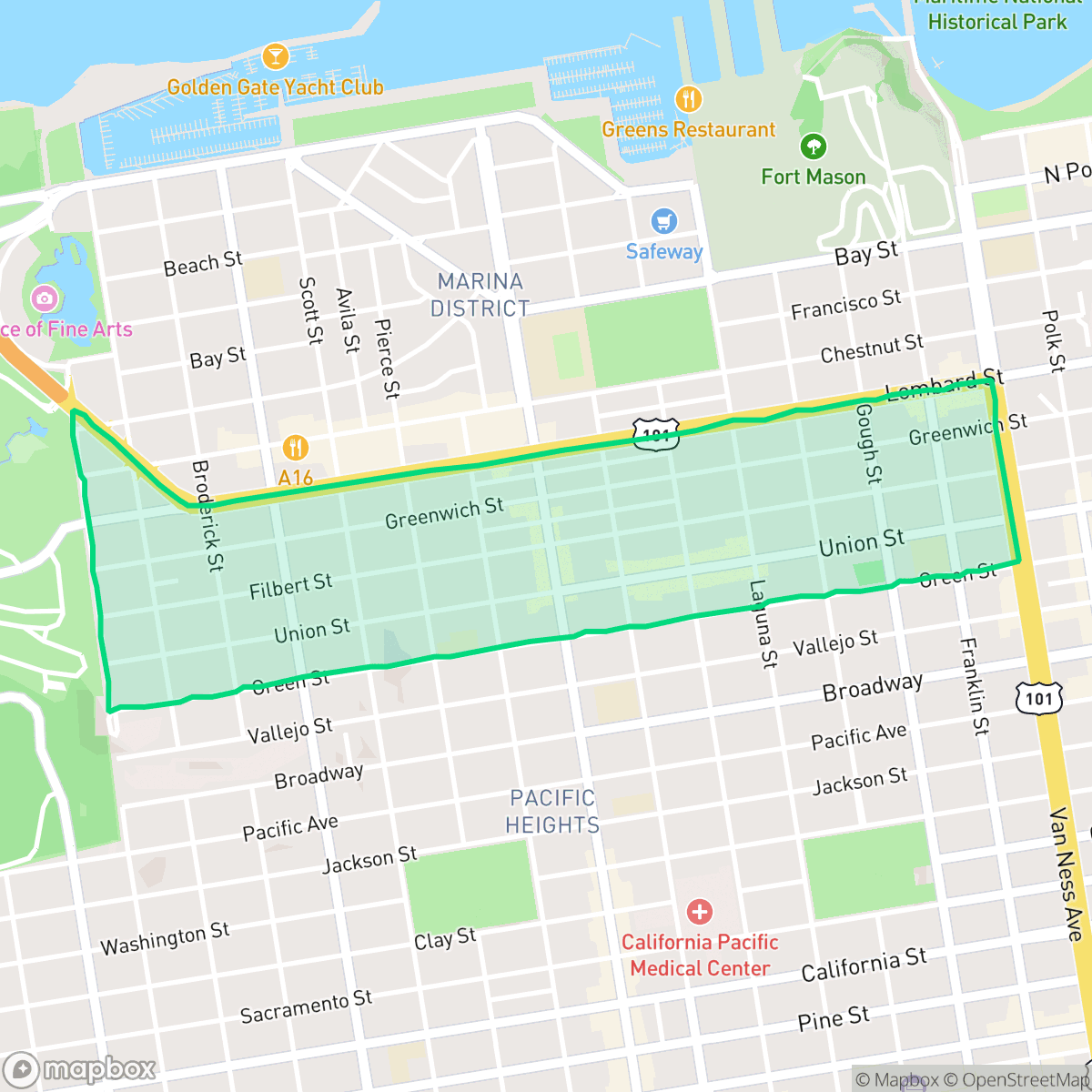
Cow Hollow is a high-energy, exceptionally walkable neighborhood defined by its vibrant commercial corridor on Union Street and dense, historic residential streets. While it offers excellent air quality and convenient access to local amenities, residents should expect limited privacy due to closely spaced housing and elevated noise levels from road traffic.
Key Highlights
About Cow Hollow
Originally known as Spring Valley, San Francisco’s Cow Hollow neighborhood began in the mid-1800s as a rural agricultural hub centered around Washerwoman’s Lagoon. The area earned its name from the dozens of dairies and hundreds of cattle that grazed its pastures. In 1891, the city banned livestock and filled in the lagoon to accommodate rapid residential growth. Because the neighborhood largely escaped damage during the 1906 earthquake and fire, it retains an exceptionally well-preserved collection of Victorian and Edwardian architecture. Notable local landmarks include the 1861 McElroy Octagon House, the Italianate Casebolt House, and the 1905 Vedanta Temple, the oldest Hindu temple in the Western world. Today, Union Street serves as the neighborhood's vibrant commercial heart, lined with historic carriage houses and Victorian storefronts.
The area acts as a bustling urban hub, characterized by a lively atmosphere that blends historic charm with modern convenience. The commercial spine along Union Street features a high density of dining and retail options, ranging from popular casual eateries to established local landmarks. According to iHuus data, the neighborhood benefits from a perfect walkability score, ensuring that daily errands and social outings are easily accessible on foot. The built environment remains compact, with mid-rise structures that prioritize density over expansive private outdoor space, creating a social and active streetscape. Prospective residents should consider the trade-offs inherent in this dense, urban setting. The acoustic environment is influenced by consistent road traffic, resulting in a moderate noise profile for those living near major thoroughfares. Privacy is also limited by the tight proximity of buildings, which are often separated by less than two meters. Despite these factors, the neighborhood maintains high standards for health insurance coverage and industrial safety, making it a stable choice for those who prioritize proximity to city amenities and a high-energy lifestyle over seclusion or quietude.
Neighborhood Scores Across 15 Qualities
Buildings are often positioned in a high-density, row-house configuration with shared walls or minimal separation. This density is largely consistent with the typical urban density found across San Francisco.
Pedestrian navigation is effortless due to a dense grid of continuous sidewalks and frequent marked crosswalks. This level of accessibility is slightly above the San Francisco average, making the area exceptionally easy to traverse on foot according to iHuus data.
Well-maintained multi-story homes and proximity to manicured parks create a visual environment that is more aesthetically pleasing than the San Francisco average. According to iHuus data, the area features prominent architectural upkeep and frequent upscale amenities.
Lafayette Park provides essential access to public green space and walking paths, though overall access to grassy verges is below the city average according to iHuus data.
Multi-story buildings and a continuous street grid define this area, which features significantly more built-up density than the San Francisco average. While the landscape is dominated by urban fabric, occasional patches of green space are interspersed throughout the residential blocks according to iHuus data.
High concentrations of diverse dining and retail destinations create an energy level significantly higher than the San Francisco average. Residents benefit from a dense landscape of social spots and cafes, although proximity to major highways impacts the pedestrian experience in certain sections.
Frequent noise from nearby major transit corridors and flight paths makes this area louder than the typical San Francisco neighborhood. According to iHuus data, residents can expect more consistent acoustic disturbances than the city average.
Air quality is consistently high with rare instances of elevated readings. According to iHuus data, the atmosphere in Cow Hollow is slightly cleaner than the San Francisco average.
Industrial hazards and large warehouses are entirely absent from this area. According to iHuus data, the neighborhood maintains a purely residential and light commercial landscape that is more free of heavy industry than the San Francisco average.
Health insurance access is exceptionally high among Cow Hollow residents, significantly surpassing the San Francisco average according to iHuus data.
Political patterns in Cow Hollow align closely with the broader San Francisco landscape. According to iHuus data, the area exhibits a high level of liberal voting trends consistent with the city average.
Residents live alongside a balanced mix of young professionals, families, and seniors. This demographic variety is roughly in line with the broader San Francisco population according to iHuus data.
Properties are situated within a designated flood zone, which may necessitate flood insurance according to iHuus data. This level of risk is higher than the typical level found throughout San Francisco.
Address-Level Insights for Cow Hollow


iHuus Neighborhood Intelligence Insights
Get address-level neighborhood insights for Cow Hollow
- Street-level scores — see how individual blocks compare, not just neighborhood averages
- Micro-zone boundaries — identify quiet pockets, flood boundaries, and walkable clusters before you visit
- 15 dimensions in full — walkability, noise, air quality, school quality, insurance coverage, population age profile, urban/rural index, and more
- Boundary risk alerts — know if your address sits near a block boundary where scores drop, the kind of detail no listing will ever mention
- School insights — individual school ratings and insights, not just district-level data
- Compare before you commit — side-by-side data across neighborhoods, down to block precision
No credit card required
Compare with Any Neighborhood
| Dimension | Cow Hollow | Alamo Square |
|---|---|---|
| 🚶 Walkabilityavg 9.91 | ||
| 🔊 Acoustic Comfortavg 3.4 | ||
| 🤫 Privacy Indexavg 2.14 | ||
| 🎨 Visual Appealavg 6.26 | ||
| 🐕 Dog Friendlinessavg 6.55 | ||
| 🗺️ Urban-Rural Indexavg 4.07 | ||
| ✨ Neighborhood Vibeavg 6.4 | ||
| 🏥 Health Insurance Coverageavg 7.87 | ||
| 🌿 Air Qualityavg 7.78 | ||
| 🏭 Industrial Proximityavg 9.37 | ||
| 🌊 Flood Safetyavg 1.89 | ||
| 🗳️ Ideological Leanavg 9.92 | ||
| 👥 Population Age Profileavg 5.18 | ||
| 🔥 Fire Safetyavg 0.01 | ||
| 🏫 School Quality |
Cow Hollow Rankings
School Districts Serving Cow Hollow
School Insights for Cow Hollow
Below average outcomes; significant attendance and academic challenges.
School Insights
See what's really behind every school rating near Cow Hollow
- Individual school ratings — each school's own score with outcome context, not just a district average
- Enrollment & class size data — student-to-teacher ratio and how it compares to the state average
- Full demographics breakdown — ethnicity and gender composition for every school in the enrollment zone
- Every school in the district — all schools within the enrollment boundary ranked by rating, not just the closest one
- Grade levels & benchmarks — elementary through high school, with below/above state-average flags
No credit card required