Corona Heights, San Francisco
Updated · 4,054 residents
Corona Heights is a quiet, highly walkable residential enclave known for its dramatic hillside architecture and proximity to scenic public trails. While the area offers a serene atmosphere with excellent air quality, residents should expect high-density living and moderate noise levels from local road traffic.
Key Highlights
About Corona Heights
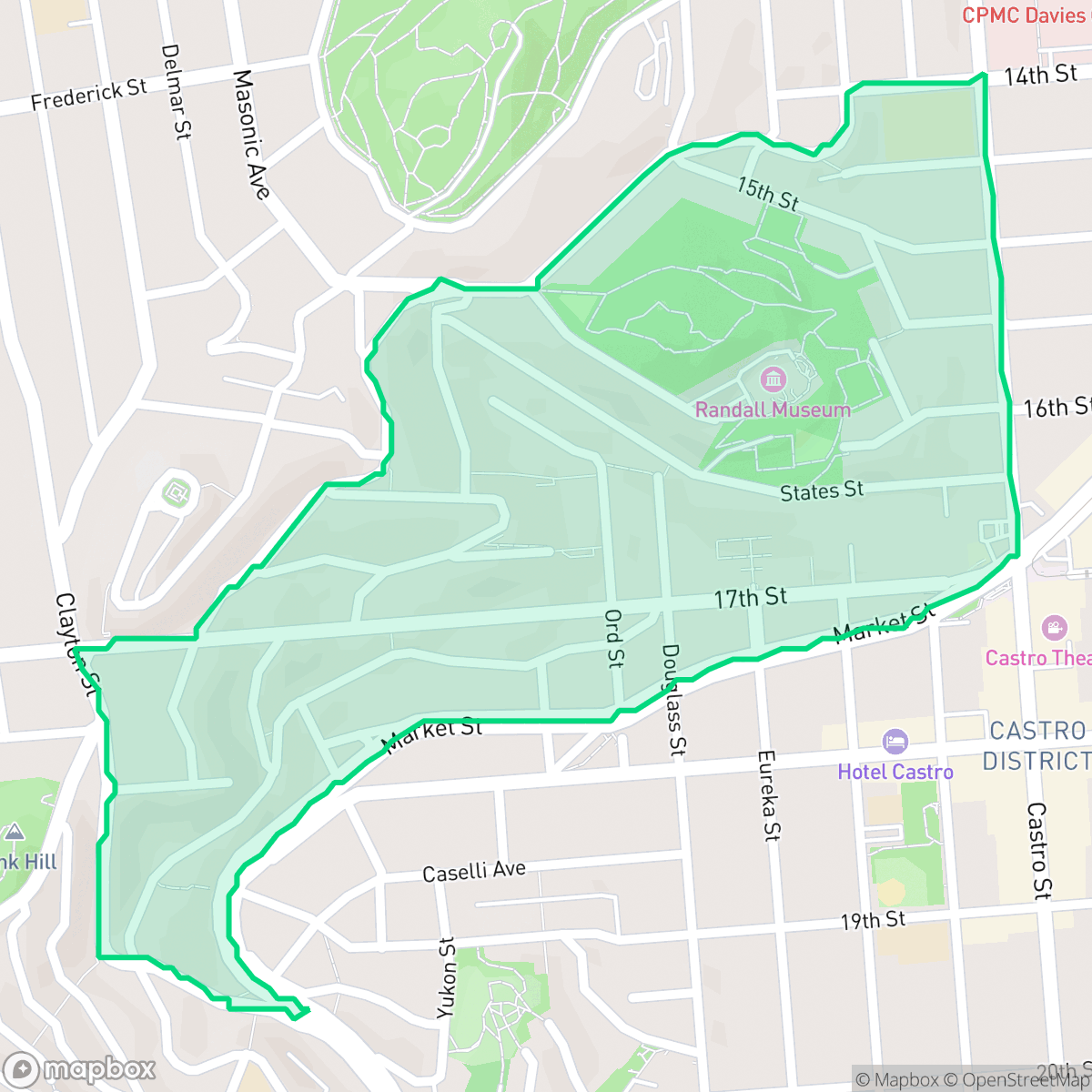
Corona Heights developed around the former Gray Brothers Quarry and brick factory established in 1899. Originally known as "Rocky Hill," the neighborhood's steep, narrow streets were carved directly into the Franciscan chert bedrock to transport quarried stone used for San Francisco's cable car beds and post-earthquake reconstruction. After the quarry closed following the owner's murder in 1915, these carved-out roads became prime real estate for hillside homes, which today range from classic Victorians to modern architectural designs. In 1941, the city purchased the quarry site to establish Corona Heights Park. Today, the neighborhood is defined by its dramatic 360-degree views, the family-friendly Randall Museum (opened in 1951), and historic public stairways like the Vulcan Stairs and Saturn Street Steps.
This neighborhood is characterized by a dense collection of well-maintained, high-value homes that take advantage of the steep terrain to offer expansive views of the city. It remains a purely residential and recreational environment, completely free of industrial activity or heavy commercial development. The area maintains a consistent, pedestrian-friendly infrastructure, ensuring that residents can easily navigate the hilly streets to reach nearby green spaces and local amenities. Its quiet nature and strong sense of community appeal to those who prioritize a peaceful living environment over the high-energy atmosphere found in adjacent districts.
Prospective residents should consider the trade-offs of the area, which include limited privacy due to the high-density nature of the housing and the prevalence of shared walls. While the neighborhood is peaceful, it is not silent, as road traffic contributes to a moderate ambient noise level. Families often look to the local McKinley Elementary School, which maintains a high rating, though it is important to note the broader challenges facing the San Francisco Unified School District. The area is best suited for individuals or families who value architectural character, access to outdoor trails, and a stable, established community feel.
Neighborhood Scores Across 15 Qualities
Buildings are situated in close quarters with minimal separation between structures. This density of housing is roughly in line with the city average, according to iHuus data.
Pedestrian infrastructure is exceptional, featuring consistent sidewalks on both sides of every street and well-marked crossings. This level of walkability is slightly above the San Francisco average, according to iHuus data.
Large, well-maintained multi-story homes and historic architecture create a scenic streetscape that is more visually appealing than the San Francisco average. According to iHuus data, the area features complex roof geometries and significant property values throughout many residential blocks.
Direct access to Duboce and Dolores Parks provides abundant green space and trails for pets. According to iHuus data, the availability of large, open areas and safe walking paths is significantly higher than the city average.
Residential streets and park infrastructure are distributed in roughly equal measure. This area offers a more suburban feel compared to the denser urban core of San Francisco, according to iHuus data.
Local social hubs and diverse dining options provide a steady level of activity, though the neighborhood is slightly less lively than the San Francisco average. Some residential blocks offer a quieter, suburban feel, while other areas feature concentrated pockets of commerce and greenery.
Steady traffic sounds from nearby thoroughfares are noticeable, though the level of acoustic disturbance is slightly more tranquil than the San Francisco average, according to iHuus data.
Air quality is consistently good with rare instances of elevated readings. According to iHuus data, the atmosphere in Corona Heights is slightly cleaner than the San Francisco average.
Industrial presence is nonexistent in this area, as the neighborhood contains no warehouses, factories, or heavy machinery. According to iHuus data, this lack of industrial activity is even more pronounced here than in the rest of San Francisco.
Health insurance access is exceptionally high among residents, significantly surpassing the San Francisco average according to iHuus data.
Voting patterns and census indicators show a highly liberal political leaning that is slightly more pronounced than the San Francisco average. According to iHuus data, this area maintains very consistent progressive alignment.
Residents live alongside a diverse range of age groups, including young professionals, families, and seniors. This demographic distribution is roughly in line with the broader San Francisco area, according to iHuus data.
Address-Level Insights for Corona Heights


iHuus Neighborhood Intelligence Insights
Get address-level neighborhood insights for Corona Heights
- Street-level scores — see how individual blocks compare, not just neighborhood averages
- Micro-zone boundaries — identify quiet pockets, flood boundaries, and walkable clusters before you visit
- 15 dimensions in full — walkability, noise, air quality, school quality, insurance coverage, population age profile, urban/rural index, and more
- Boundary risk alerts — know if your address sits near a block boundary where scores drop, the kind of detail no listing will ever mention
- School insights — individual school ratings and insights, not just district-level data
- Compare before you commit — side-by-side data across neighborhoods, down to block precision
No credit card required
Compare with Any Neighborhood
| Dimension | Corona Heights | Alamo Square |
|---|---|---|
| 🚶 Walkabilityavg 9.91 | ||
| 🔊 Acoustic Comfortavg 3.4 | ||
| 🤫 Privacy Indexavg 2.14 | ||
| 🎨 Visual Appealavg 6.26 | ||
| 🐕 Dog Friendlinessavg 6.55 | ||
| 🗺️ Urban-Rural Indexavg 4.07 | ||
| ✨ Neighborhood Vibeavg 6.4 | ||
| 🏥 Health Insurance Coverageavg 7.87 | ||
| 🌿 Air Qualityavg 7.78 | ||
| 🏭 Industrial Proximityavg 9.37 | ||
| 🌊 Flood Safetyavg 1.89 | ||
| 🗳️ Ideological Leanavg 9.92 | ||
| 👥 Population Age Profileavg 5.18 | ||
| 🔥 Fire Safetyavg 0.01 | ||
| 🏫 School Quality |
Corona Heights Rankings
School Districts Serving Corona Heights
School Insights for Corona Heights
Below average outcomes; significant attendance and academic challenges.
School Insights
See what's really behind every school rating near Corona Heights
- Individual school ratings — each school's own score with outcome context, not just a district average
- Enrollment & class size data — student-to-teacher ratio and how it compares to the state average
- Full demographics breakdown — ethnicity and gender composition for every school in the enrollment zone
- Every school in the district — all schools within the enrollment boundary ranked by rating, not just the closest one
- Grade levels & benchmarks — elementary through high school, with below/above state-average flags
No credit card required