Clarendon Heights, San Francisco
Updated · 848 residents
Clarendon Heights is a quiet, hilly neighborhood in San Francisco known for its panoramic views and eclectic mid-century architecture. According to iHuus data, the area offers exceptional walkability and is highly dog-friendly, featuring extensive access to the Mount Sutro Open Space. Residents enjoy a peaceful, residential atmosphere that feels removed from the city's industrial zones.
Key Highlights
About Clarendon Heights
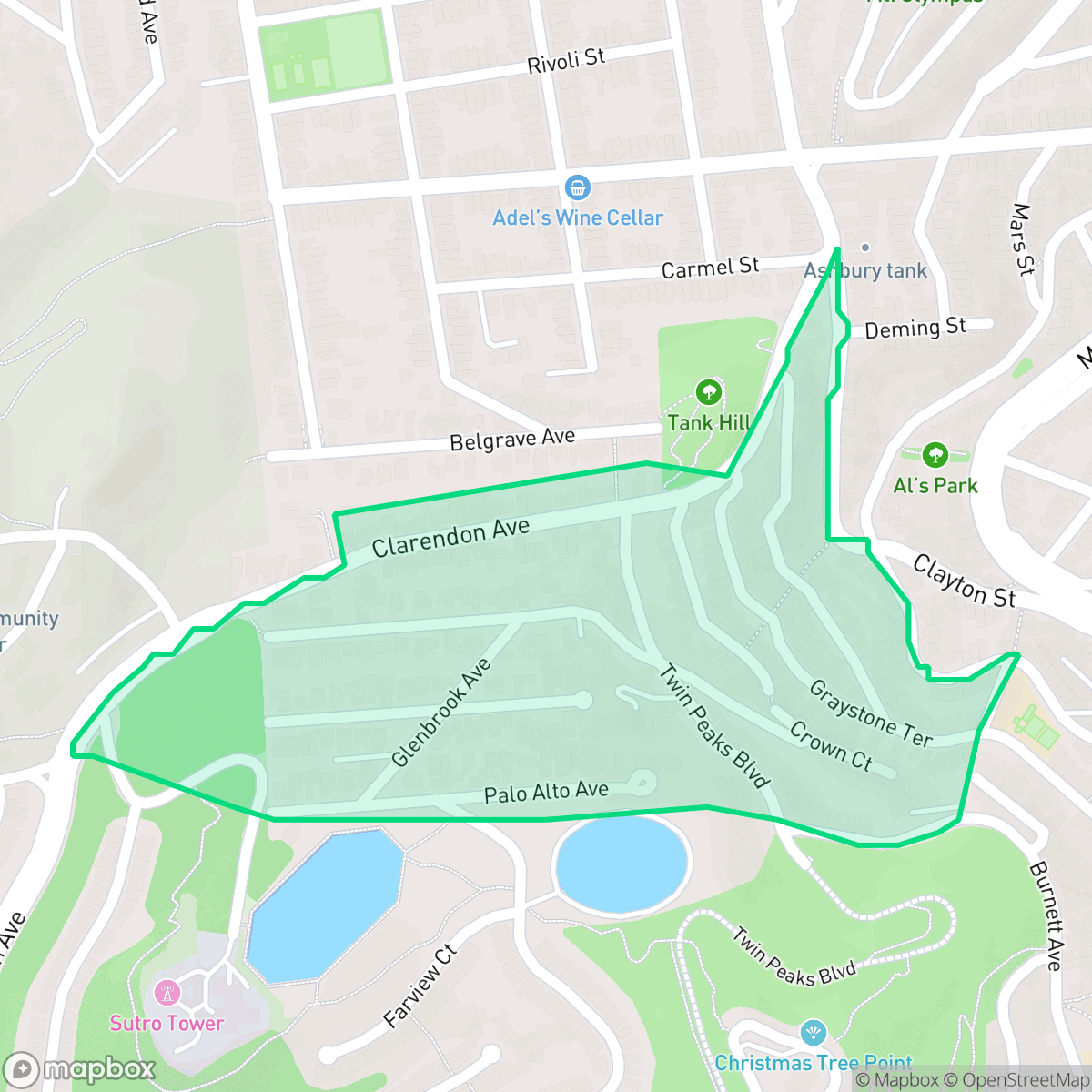
Clarendon Heights, a hilltop neighborhood in central San Francisco situated north of Twin Peaks, originated as part of the historic Rancho San Miguel land grant. The terrain was later acquired by Adolph Sutro, who famously forested the area with eucalyptus trees. Due to the neighborhood's vertiginous topography, early development remained sparse. A post-World War II housing boom transformed the slopes as architects embraced the challenging terrain to maximize panoramic views. Today, the neighborhood features an eclectic mix of mid-century modern homes, contemporary designs, and older estates, including the 1959 "Duncan House" designed by Warren Callister. Looming beneath the iconic Sutro Tower, Clarendon Heights is defined by quiet cul-de-sacs and historic public stairways, such as the Pemberton Steps and the Iron Alley Stairway, which provide the sole access to several secluded hillside homes.
The area is characterized by its steep, winding streets and a significant forested canopy that creates a unique urban-rural aesthetic. With a large portion of the land dedicated to green space, the neighborhood provides a tranquil environment that remains free from industrial hazards. The architectural landscape is defined by well-maintained, high-value homes that take advantage of the challenging topography to offer expansive vistas of the city and bay. While the neighborhood excels in accessibility and outdoor recreation, it maintains a low-key social vibe, making it a quiet retreat from the more bustling parts of San Francisco.
Prospective residents should consider the trade-offs regarding privacy and local infrastructure. Homes are often situated in close proximity to one another, which can limit the sense of seclusion on some blocks. Additionally, the local school district currently faces significant financial and operational challenges, which may be a factor for families. Overall, the area is best suited for those who prioritize proximity to nature, quiet residential living, and scenic beauty over access to high-density commercial or nightlife hubs.
Neighborhood Scores Across 15 Qualities
Close proximity between homes and narrow setbacks between structures create a dense living environment. This level of density is slightly higher than the San Francisco average, according to iHuus data.
Pedestrian movement is seamless across the area due to continuous sidewalks on both sides of every street and integrated trail systems. According to iHuus data, the connectivity and availability of clear crossings are slightly above the San Francisco average.
Tiered landscaping and large, well-maintained homes with complex architectural geometries provide a highly attractive streetscape. According to iHuus data, the visual quality of the built environment in this area is notably higher than the San Francisco average.
Extensive forest trails and large green spaces within Mount Sutro provide significantly more outdoor recreation area than the typical San Francisco neighborhood. Residents have direct access to numerous public parks and walking paths for pet exercise.
Significant forested canopy and hilly open spaces provide a much more natural feel than the typical dense urban environment of San Francisco. This mix of dense residential blocks and greenery offers more landscape variety than the city average, according to iHuus data.
Low levels of commercial activity create a subdued atmosphere that is notably more tranquil than the San Francisco average. While some social spots and leisure businesses are accessible on foot, much of the neighborhood consists of quiet, suburban-style blocks near green spaces.
Audible noise from nearby major transit corridors and rail lines is a common feature of the area. According to iHuus data, acoustic levels are slightly higher than the city average.
Air quality remains consistently high with rare instances of elevated readings, performing slightly better than the San Francisco average according to iHuus data.
Industrial activity is absent from this area, as there are no warehouses, factories, or heavy industrial facilities present. This neighborhood maintains a higher level of residential purity than the San Francisco average according to iHuus data.
Health insurance enrollment among residents is exceptionally high, significantly surpassing the San Francisco average according to iHuus data.
Voting patterns and census indicators show a deeply liberal political leaning that is slightly more pronounced than the San Francisco average.
Residents live alongside a balanced mix of young professionals, families, and older adults. This age distribution is consistent with the broader San Francisco area, according to iHuus data.
Property within the 100-year floodplain is subject to elevated flooding risks, which is more significant here than the San Francisco average. According to iHuus data, residents should be aware that flood insurance is typically required for homes in this area.
Address-Level Insights for Clarendon Heights


iHuus Neighborhood Intelligence Insights
Get address-level neighborhood insights for Clarendon Heights
- Street-level scores — see how individual blocks compare, not just neighborhood averages
- Micro-zone boundaries — identify quiet pockets, flood boundaries, and walkable clusters before you visit
- 15 dimensions in full — walkability, noise, air quality, school quality, insurance coverage, population age profile, urban/rural index, and more
- Boundary risk alerts — know if your address sits near a block boundary where scores drop, the kind of detail no listing will ever mention
- School insights — individual school ratings and insights, not just district-level data
- Compare before you commit — side-by-side data across neighborhoods, down to block precision
No credit card required
Compare with Any Neighborhood
| Dimension | Clarendon Heights | Alamo Square |
|---|---|---|
| 🚶 Walkabilityavg 9.91 | ||
| 🔊 Acoustic Comfortavg 3.4 | ||
| 🤫 Privacy Indexavg 2.14 | ||
| 🎨 Visual Appealavg 6.26 | ||
| 🐕 Dog Friendlinessavg 6.55 | ||
| 🗺️ Urban-Rural Indexavg 4.07 | ||
| ✨ Neighborhood Vibeavg 6.4 | ||
| 🏥 Health Insurance Coverageavg 7.87 | ||
| 🌿 Air Qualityavg 7.78 | ||
| 🏭 Industrial Proximityavg 9.37 | ||
| 🌊 Flood Safetyavg 1.89 | ||
| 🗳️ Ideological Leanavg 9.92 | ||
| 👥 Population Age Profileavg 5.18 | ||
| 🔥 Fire Safetyavg 0.01 | ||
| 🏫 School Quality |
Clarendon Heights Rankings
School Districts Serving Clarendon Heights
School Insights for Clarendon Heights
Below average outcomes; significant attendance and academic challenges.
School Insights
See what's really behind every school rating near Clarendon Heights
- Individual school ratings — each school's own score with outcome context, not just a district average
- Enrollment & class size data — student-to-teacher ratio and how it compares to the state average
- Full demographics breakdown — ethnicity and gender composition for every school in the enrollment zone
- Every school in the district — all schools within the enrollment boundary ranked by rating, not just the closest one
- Grade levels & benchmarks — elementary through high school, with below/above state-average flags
No credit card required