Chinatown, San Francisco
Updated · 3,478 residents
Chinatown is a dense urban core defined by its exceptional walkability and vibrant cultural heritage. Residents enjoy a highly pedestrian-friendly environment, though the area is characterized by tight living quarters and noticeable noise from surrounding city traffic.
Key Highlights
About Chinatown
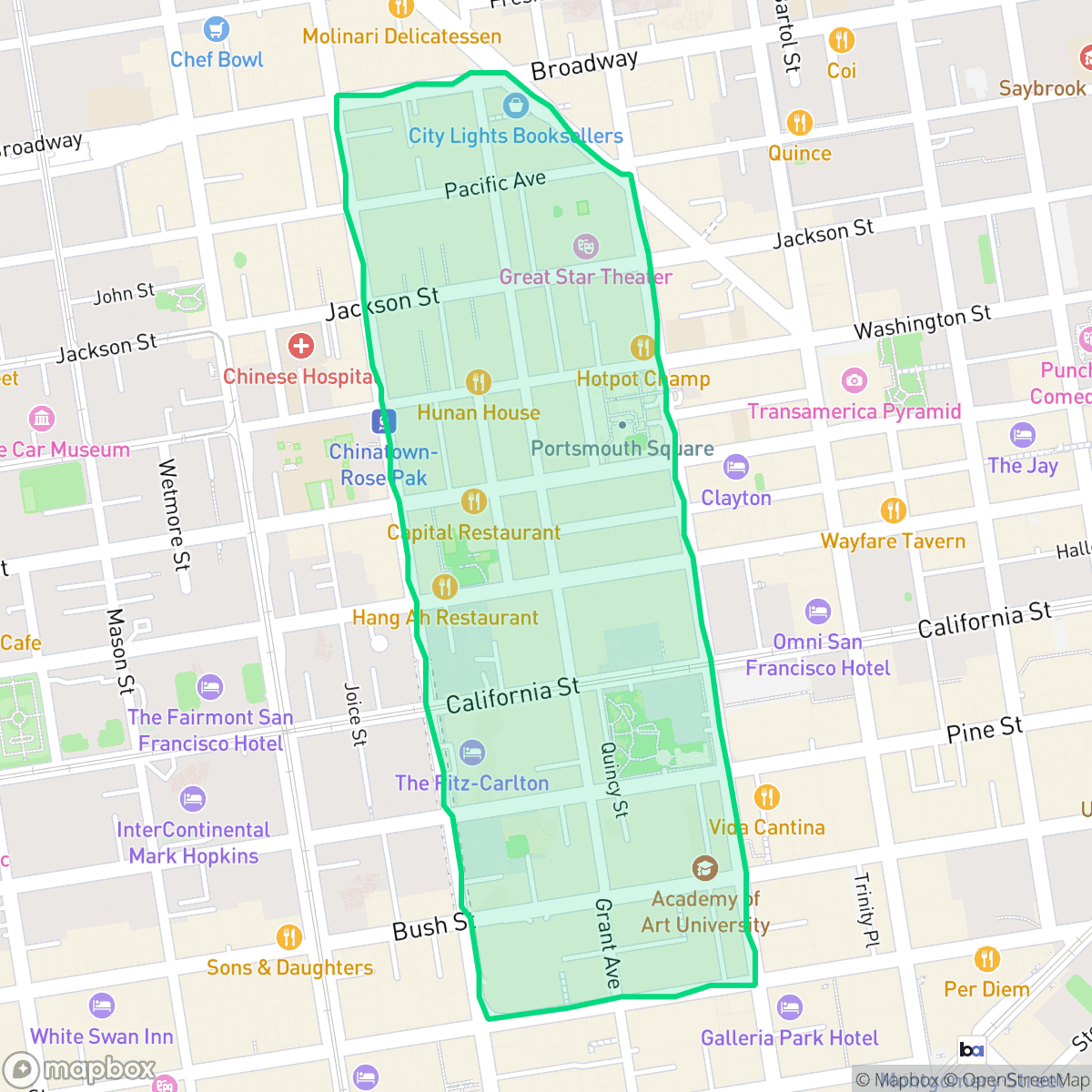
Established in 1848, San Francisco's Chinatown is the oldest in North America. Following the 1906 earthquake and fire, which destroyed the neighborhood, local merchants successfully resisted city-led relocation efforts by rebuilding in a distinctive 'Orientalist' architectural style. Characterized by pagoda-style roofs, ornate balconies, and vibrant red, green, and gold facades, this aesthetic was strategically designed to foster tourism and preserve the community's presence. Centered around Grant Avenue and Stockton Street, the neighborhood features significant landmarks like Portsmouth Square—the city's original public plaza—and the iconic Dragon Gate. Historically shaped by the Gold Rush and the subsequent 'bachelor society' resulting from the Chinese Exclusion Act, the district remains a vital cultural hub defined by its dense residential stock, traditional markets, and deep-rooted history of resilience against systemic discrimination.
The neighborhood functions as a high-energy, dense urban environment where the grid layout and extensive sidewalk networks make daily errands easy to complete on foot. It maintains a diverse age profile, fostering a multi-generational atmosphere that thrives on local dining and community gathering points. Unlike many other city districts, the area remains entirely free of industrial activity, providing a cleaner environment for its residents according to iHuus data.
Livability trade-offs include limited privacy due to high-density building structures and minimal access to private green space for pets. Prospective residents should also be aware of the elevated flood risk associated with the coastal location and the persistent urban noise from nearby transit corridors. While the local schools are part of a larger district currently facing significant financial and operational challenges, the area remains a central hub for those prioritizing convenience and cultural connectivity.
Neighborhood Scores Across 15 Qualities
Residential buildings are characterized by extreme density, often sharing walls or being separated only by narrow alleys. This level of proximity to neighbors is consistent with the broader San Francisco average, according to iHuus data.
Extensive sidewalk networks and numerous high-visibility crosswalks make navigating the area on foot very easy. This grid layout offers superior pedestrian connectivity compared to the San Francisco average, according to iHuus data.
Dense apartment buildings and commercial rooftops define the skyline, providing a functional urban aesthetic that is slightly below the city average. This area lacks private greenery or luxury residential amenities, consisting primarily of shared walls and standard high-density structures according to iHuus data.
Dense concrete surfaces and minimal street-level greenery make finding casual walking paths difficult. While small parks exist in the northeast corner, the availability of open space for pets is significantly lower than the San Francisco average.
High-density buildings and continuous pavement dominate this area, making it significantly more built-up than the San Francisco average. Very little greenery or open soil is present within the neighborhood according to iHuus data.
Active social hubs and diverse dining options provide a consistent level of activity that is roughly in line with the San Francisco average. According to iHuus data, the area features a noticeable concentration of local eateries and community gathering points.
Audible disturbances from nearby transit corridors and heavy traffic are common. This level of acoustic activity is slightly higher than the typical experience found across San Francisco.
Air remains mostly clean with infrequent periods of elevated readings, performing slightly better than the San Francisco average according to iHuus data.
Heavy industrial hazards and manufacturing facilities are entirely absent from this area. Residents experience a purely commercial and residential environment that is notably cleaner of industrial activity than the San Francisco average.
Voting patterns and census indicators show a deeply liberal political landscape that aligns with the city average. According to iHuus data, the area reflects the broader political trends seen throughout San Francisco.
A balanced variety of young adults, families, and seniors resides here, representing a slightly more diverse age distribution than the San Francisco average. According to iHuus data, this demographic spread contributes to a multi-generational community atmosphere.
Significant flood and wave action risks exist here due to its location in a coastal high-hazard zone. According to iHuus data, this vulnerability is much higher than the typical level found across San Francisco.
Address-Level Insights for Chinatown


iHuus Neighborhood Intelligence Insights
Get address-level neighborhood insights for Chinatown
- Street-level scores — see how individual blocks compare, not just neighborhood averages
- Micro-zone boundaries — identify quiet pockets, flood boundaries, and walkable clusters before you visit
- 15 dimensions in full — walkability, noise, air quality, school quality, insurance coverage, population age profile, urban/rural index, and more
- Boundary risk alerts — know if your address sits near a block boundary where scores drop, the kind of detail no listing will ever mention
- School insights — individual school ratings and insights, not just district-level data
- Compare before you commit — side-by-side data across neighborhoods, down to block precision
No credit card required
Compare with Any Neighborhood
| Dimension | Chinatown | Alamo Square |
|---|---|---|
| 🚶 Walkabilityavg 9.91 | ||
| 🔊 Acoustic Comfortavg 3.4 | ||
| 🤫 Privacy Indexavg 2.14 | ||
| 🎨 Visual Appealavg 6.26 | ||
| 🐕 Dog Friendlinessavg 6.55 | ||
| 🗺️ Urban-Rural Indexavg 4.07 | ||
| ✨ Neighborhood Vibeavg 6.4 | ||
| 🏥 Health Insurance Coverageavg 7.87 | ||
| 🌿 Air Qualityavg 7.78 | ||
| 🏭 Industrial Proximityavg 9.37 | ||
| 🌊 Flood Safetyavg 1.89 | ||
| 🗳️ Ideological Leanavg 9.92 | ||
| 👥 Population Age Profileavg 5.18 | ||
| 🔥 Fire Safetyavg 0.01 | ||
| 🏫 School Quality |
Chinatown Rankings
School Districts Serving Chinatown
School Insights for Chinatown
Below average outcomes; significant attendance and academic challenges.
School Insights
See what's really behind every school rating near Chinatown
- Individual school ratings — each school's own score with outcome context, not just a district average
- Enrollment & class size data — student-to-teacher ratio and how it compares to the state average
- Full demographics breakdown — ethnicity and gender composition for every school in the enrollment zone
- Every school in the district — all schools within the enrollment boundary ranked by rating, not just the closest one
- Grade levels & benchmarks — elementary through high school, with below/above state-average flags
No credit card required