Central Waterfront - Dogpatch, San Francisco
Updated · 2,415 residents
The Central Waterfront and Dogpatch is a dense, industrial-leaning neighborhood characterized by a mix of historic architecture and modern commercial development. While the area offers high air quality and widespread health insurance coverage, residents should expect significant noise from surrounding road traffic and a car-dependent lifestyle.
Key Highlights
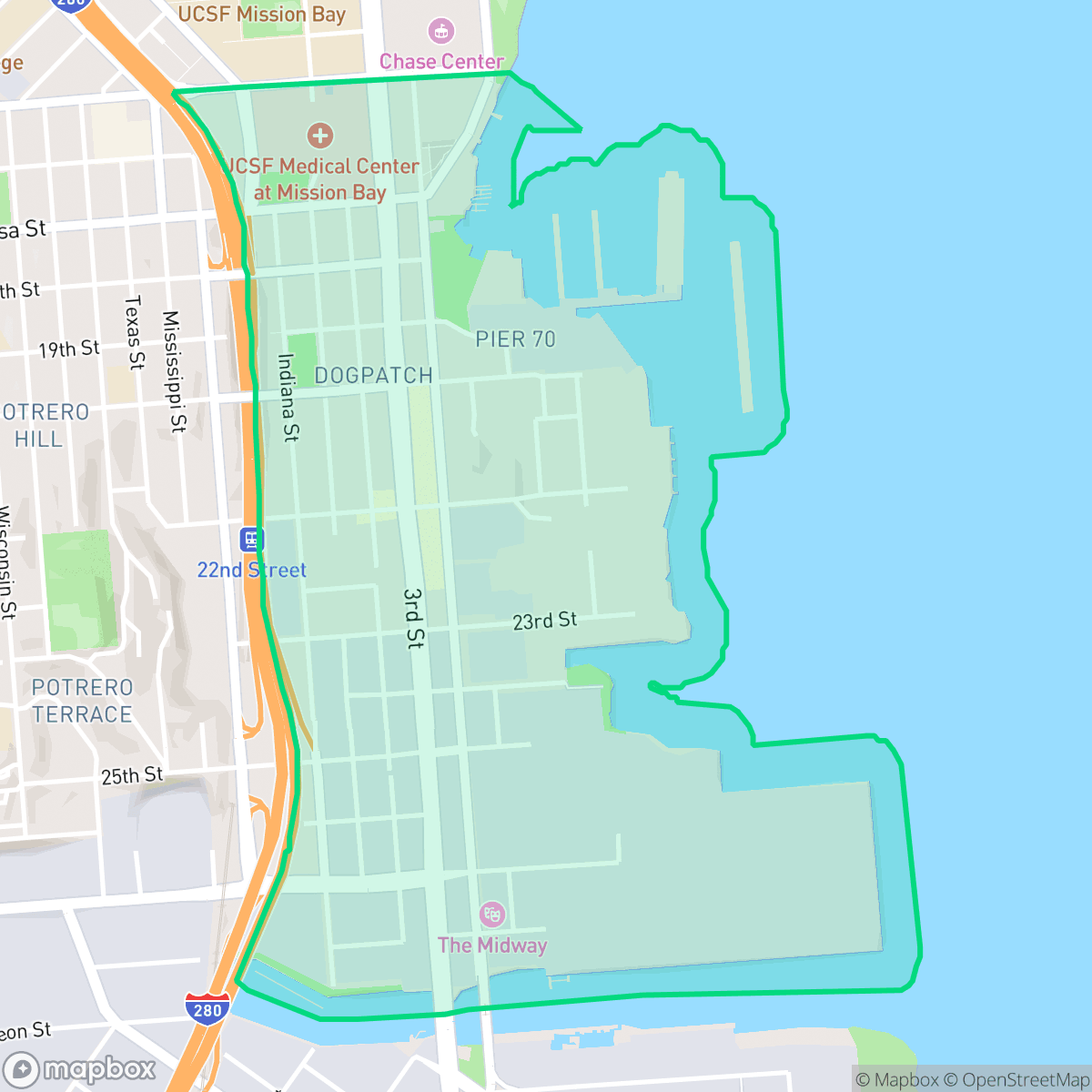
About Central Waterfront - Dogpatch
San Francisco’s Central Waterfront - Dogpatch neighborhood emerged in the early 1870s following the 1865 completion of the Long Bridge, which connected the isolated area to downtown. Developed as a residential enclave for immigrant laborers working at nearby shipyards, rope factories, and the Union Iron Works, it became the city's oldest and most intact concentration of industrial workers' housing. Dogpatch miraculously survived the 1906 earthquake and fire, preserving its distinct Victorian and Edwardian architectural character. Notable landmarks include the 1895 Irving M. Scott School—the city's oldest surviving public schoolhouse—and the "Pelton Cottages," a historic cluster of thirteen identical Eastlake-style homes on Tennessee and Minnesota Streets. Designated a historic district in 2003, the neighborhood has transitioned from a blue-collar industrial hub into a vibrant arts and residential district featuring revitalized spaces like Crane Cove Park.
The area serves as a hub for industrial activity, featuring a landscape of warehouses, logistics centers, and high-density residential buildings. It maintains a distinct identity through the adaptive reuse of industrial spaces, which now host art galleries, breweries, and specialty food establishments. Unlike more pedestrian-oriented parts of San Francisco, the neighborhood requires reliance on vehicles to navigate its concrete-heavy, infrastructure-dense blocks and reach daily necessities.
Prospective residents should consider the trade-offs of living in a high-traffic zone, as acoustic comfort is limited by consistent road noise. The area presents specific challenges regarding flood and fire safety, and the local school district currently faces significant operational and financial instability. This neighborhood is best suited for those who prioritize proximity to industrial-chic amenities and a highly liberal community over traditional suburban quiet or high walkability.
Neighborhood Scores Across 15 Qualities
Dense residential rows and shared walls result in very little separation between neighbors. This lack of buffering is consistent with the broader San Francisco average.
Wide sidewalks, frequent crosswalks, and waterfront trails provide excellent infrastructure for pedestrians. This area offers a walking experience that is nearly on par with the rest of San Francisco.
A combination of modern developments and older residential blocks creates a standard urban landscape. This level of visual variety is slightly below the San Francisco average according to iHuus data.
Access to soft ground and grassy areas is limited due to high concrete density, although central parks and waterfront paths provide some public greenery. According to iHuus data, the availability of dog-friendly vegetation and wide green verges is below the San Francisco average.
Heavy industrial infrastructure, large warehouses, and massive commercial structures dominate the landscape. This area feels significantly more urbanized and built-up than the San Francisco average, with very little natural or rural greenery present.
A predominantly industrial landscape with scattered social hubs creates a tranquil but low-density atmosphere. This area offers a significantly calmer pace of life than the more active city average, though many daily services require a car to reach.
Continuous noise from heavy rail and nearby transit corridors makes this area significantly louder than most parts of San Francisco. Residents should expect frequent auditory disruptions according to iHuus data.
Air quality remains consistently high with rare instances of elevated readings. This level of cleanliness is slightly above the San Francisco average, according to iHuus data.
Active commercial zones, breweries, and nearby maritime warehouses introduce moderate levels of daytime traffic and operational noise. This presence of light industrial activity is notably higher than the city average, including proximity to some heavy logistics and shipping operations.
Health insurance access is exceptionally high among residents, significantly surpassing the San Francisco average according to iHuus data.
Voting patterns and census indicators reflect a deeply liberal political landscape that is slightly more pronounced than the San Francisco average, according to iHuus data.
Residents live alongside a balanced spread of young adults, families, and older individuals. According to iHuus data, the age distribution is slightly more concentrated toward certain age groups compared to the city average.
Significant flood risk exists due to the area's location within a designated floodplain, making it more vulnerable than the typical San Francisco neighborhood. Residents should expect that flood insurance is likely a requirement for properties in this zone according to iHuus data.
Address-Level Insights for Central Waterfront - Dogpatch


iHuus Neighborhood Intelligence Insights
Get address-level neighborhood insights for Central Waterfront - Dogpatch
- Street-level scores — see how individual blocks compare, not just neighborhood averages
- Micro-zone boundaries — identify quiet pockets, flood boundaries, and walkable clusters before you visit
- 15 dimensions in full — walkability, noise, air quality, school quality, insurance coverage, population age profile, urban/rural index, and more
- Boundary risk alerts — know if your address sits near a block boundary where scores drop, the kind of detail no listing will ever mention
- School insights — individual school ratings and insights, not just district-level data
- Compare before you commit — side-by-side data across neighborhoods, down to block precision
No credit card required
Compare with Any Neighborhood
| Dimension | Central Waterfront - Dogpatch | Alamo Square |
|---|---|---|
| 🚶 Walkabilityavg 9.91 | ||
| 🔊 Acoustic Comfortavg 3.4 | ||
| 🤫 Privacy Indexavg 2.14 | ||
| 🎨 Visual Appealavg 6.26 | ||
| 🐕 Dog Friendlinessavg 6.55 | ||
| 🗺️ Urban-Rural Indexavg 4.07 | ||
| ✨ Neighborhood Vibeavg 6.4 | ||
| 🏥 Health Insurance Coverageavg 7.87 | ||
| 🌿 Air Qualityavg 7.78 | ||
| 🏭 Industrial Proximityavg 9.37 | ||
| 🌊 Flood Safetyavg 1.89 | ||
| 🗳️ Ideological Leanavg 9.92 | ||
| 👥 Population Age Profileavg 5.18 | ||
| 🔥 Fire Safetyavg 0.01 | ||
| 🏫 School Quality |
Central Waterfront - Dogpatch Rankings
School Districts Serving Central Waterfront - Dogpatch
School Insights for Central Waterfront - Dogpatch
Below average outcomes; significant attendance and academic challenges.
School Insights
See what's really behind every school rating near Central Waterfront - Dogpatch
- Individual school ratings — each school's own score with outcome context, not just a district average
- Enrollment & class size data — student-to-teacher ratio and how it compares to the state average
- Full demographics breakdown — ethnicity and gender composition for every school in the enrollment zone
- Every school in the district — all schools within the enrollment boundary ranked by rating, not just the closest one
- Grade levels & benchmarks — elementary through high school, with below/above state-average flags
No credit card required