Central Sunset, San Francisco
Updated · 17,526 residents
Central Sunset is a densely populated neighborhood defined by its uniform row house architecture and exceptional walkability. Residents enjoy immediate access to Golden Gate Park and a diverse, transit-oriented commercial corridor along Irving Street. According to iHuus data, the area offers a high-density urban lifestyle with limited private outdoor space.
Key Highlights
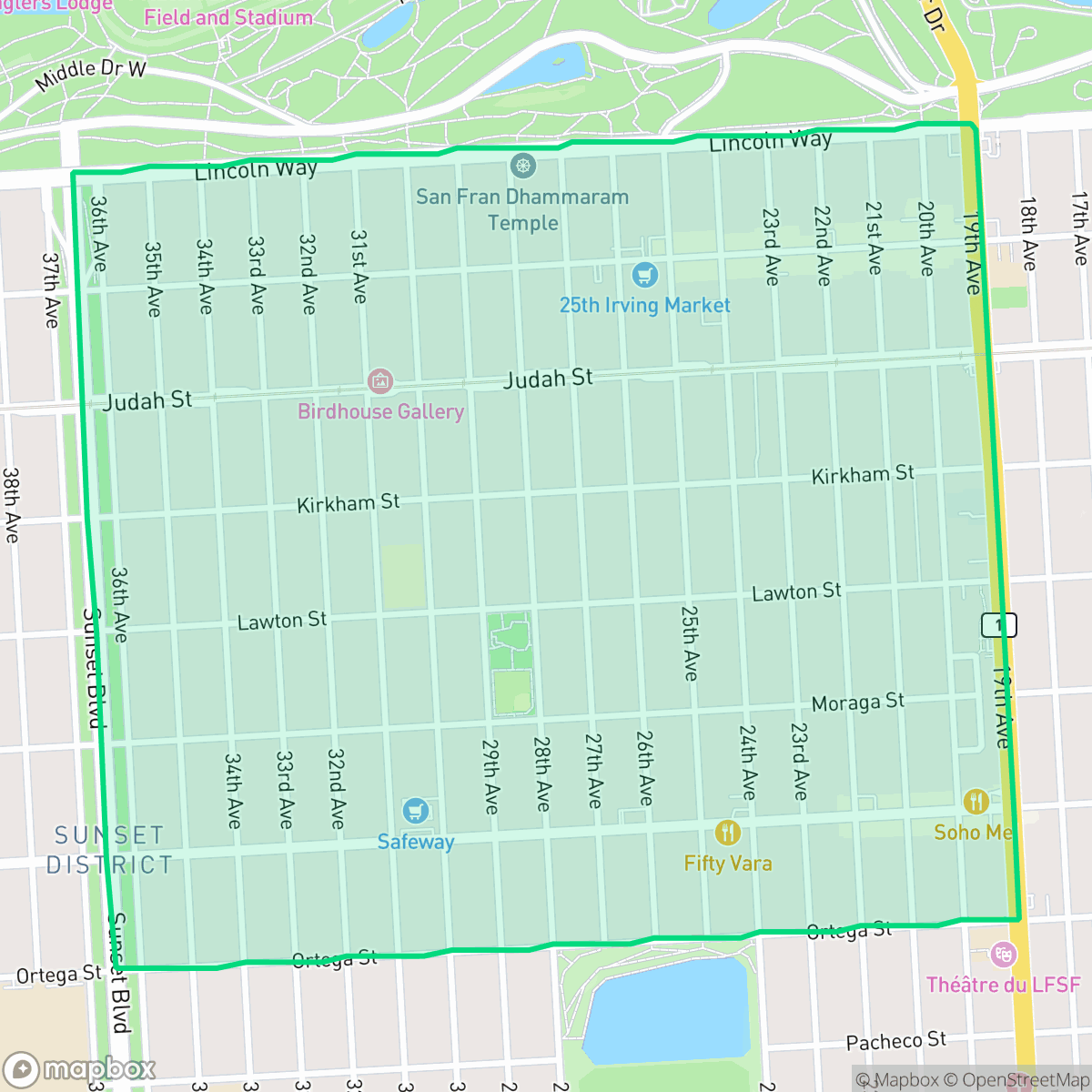
About Central Sunset
Once a vast expanse of sand dunes known as the "Outside Lands," San Francisco’s Central Sunset neighborhood began its transition from wilderness in the late 19th century, notably hosting Danish immigrant Carl Larsen’s chicken ranch. The area’s major transformation occurred during the 1920s and 1930s when merchant-builders carved residential tracts out of the sand. Architect-brothers Oliver and Arthur Rousseau heavily influenced the neighborhood’s architectural identity, constructing the celebrated "Boulevard Tract" between 34th and 36th Avenues. This tract is famous for its whimsical, storybook-style Period Revival homes featuring sunken living rooms and interior patios. Alongside Henry Doelger's prolific stucco row homes, these developments established the Central Sunset's distinct residential character, anchored by the bustling commercial corridor of Irving Street.
The neighborhood functions as a dense, grid-based residential enclave that prioritizes pedestrian access and connectivity. The streetscape is characterized by tightly packed row houses, creating a consistent visual rhythm that minimizes private outdoor space while maximizing neighborhood density. Residents benefit from the proximity to Golden Gate Park, which serves as the primary recreational hub for the area. The local commercial environment is anchored by Irving Street, providing a variety of dining options that reflect the diverse cultural composition of the district.
Living in this part of San Francisco requires adjusting to a high-density environment where shared walls and street-level noise from road traffic are common. While the area is exceptionally walkable, the noise levels average 63 decibels, reflecting the active nature of the urban grid. The neighborhood is well-suited for those who value proximity to major public green spaces and transit connectivity over expansive private yards. According to iHuus, the area maintains high levels of health insurance coverage and a strong sense of community, though prospective residents should note the challenges currently facing the local school district.
Neighborhood Scores Across 15 Qualities
Residential structures often feature shared walls or very narrow gaps between buildings. This level of density and proximity to neighbors is consistent with the city average.
Extensive sidewalk networks and frequent crosswalks ensure excellent pedestrian connectivity throughout the area. This neighborhood offers superior ease of movement on foot compared to the San Francisco average, according to iHuus data.
Standard middle-class row houses and small yards create a consistent but modest streetscape. This visual density is slightly below the San Francisco average for architectural variety.
Proximity to Golden Gate Park and Sunset Reservoir provides extensive trails and green space for pets. This access to large-scale recreation areas makes the area roughly comparable to the San Francisco average for pet owners.
Frequent open land and scattered greenery provide a more open feel than the typical dense urban core of San Francisco. This higher degree of open space is reflected in the neighborhood's more semi-rural character compared to the city average, according to iHuus data.
Suburban blocks and green spaces define much of the area, though certain sections near major highways offer more active dining options. This neighborhood feels slightly less lively than the San Francisco average, characterized by calm streets punctuated by various local eateries.
Frequent noise from nearby transit corridors and major roadways is present. According to iHuus data, acoustic comfort in this area is slightly lower than the San Francisco average.
Air quality in this area remains mostly clean with infrequent periods of elevated readings. According to iHuus data, these levels are slightly lower than the San Francisco average.
Industrial activity and warehouses are entirely absent from this area, which consists solely of residential, recreational, and light commercial land use. According to iHuus data, this lack of industrial presence is even more pronounced here than in the San Francisco average.
Health insurance access is exceptionally high for residents, significantly outpacing the average found across San Francisco. According to iHuus data, nearly all members of the community are covered.
Voting patterns and census indicators reflect a deeply liberal political leaning that is consistent with the rest of San Francisco. According to iHuus data, the area maintains a political profile that aligns with the city average.
A diverse range of age groups inhabits the area, including young professionals, families, and seniors. According to iHuus data, this demographic spread is slightly more balanced than the typical San Francisco profile.
Significant flood risk exists due to the area's location within a coastal high-hazard zone. According to iHuus data, the likelihood of wave action and flooding is notably higher than the San Francisco average, which may lead to elevated or prohibitive insurance costs.
Address-Level Insights for Central Sunset


iHuus Neighborhood Intelligence Insights
Get address-level neighborhood insights for Central Sunset
- Street-level scores — see how individual blocks compare, not just neighborhood averages
- Micro-zone boundaries — identify quiet pockets, flood boundaries, and walkable clusters before you visit
- 15 dimensions in full — walkability, noise, air quality, school quality, insurance coverage, population age profile, urban/rural index, and more
- Boundary risk alerts — know if your address sits near a block boundary where scores drop, the kind of detail no listing will ever mention
- School insights — individual school ratings and insights, not just district-level data
- Compare before you commit — side-by-side data across neighborhoods, down to block precision
No credit card required
Compare with Any Neighborhood
| Dimension | Central Sunset | Alamo Square |
|---|---|---|
| 🚶 Walkabilityavg 9.91 | ||
| 🔊 Acoustic Comfortavg 3.4 | ||
| 🤫 Privacy Indexavg 2.14 | ||
| 🎨 Visual Appealavg 6.26 | ||
| 🐕 Dog Friendlinessavg 6.55 | ||
| 🗺️ Urban-Rural Indexavg 4.07 | ||
| ✨ Neighborhood Vibeavg 6.4 | ||
| 🏥 Health Insurance Coverageavg 7.87 | ||
| 🌿 Air Qualityavg 7.78 | ||
| 🏭 Industrial Proximityavg 9.37 | ||
| 🌊 Flood Safetyavg 1.89 | ||
| 🗳️ Ideological Leanavg 9.92 | ||
| 👥 Population Age Profileavg 5.18 | ||
| 🔥 Fire Safetyavg 0.01 | ||
| 🏫 School Quality |
Central Sunset Rankings
School Districts Serving Central Sunset
School Insights for Central Sunset
Below average outcomes; significant attendance and academic challenges.
School Insights
See what's really behind every school rating near Central Sunset
- Individual school ratings — each school's own score with outcome context, not just a district average
- Enrollment & class size data — student-to-teacher ratio and how it compares to the state average
- Full demographics breakdown — ethnicity and gender composition for every school in the enrollment zone
- Every school in the district — all schools within the enrollment boundary ranked by rating, not just the closest one
- Grade levels & benchmarks — elementary through high school, with below/above state-average flags
No credit card required