Central Richmond, San Francisco
Updated · 20,457 residents
Central Richmond is defined by its dense, grid-like layout of Edwardian and mid-century row houses and its exceptional walkability. Residents enjoy immediate access to the expansive green space of Golden Gate Park, though the area is characterized by tightly packed housing with limited privacy and consistent road traffic noise.
Key Highlights
About Central Richmond
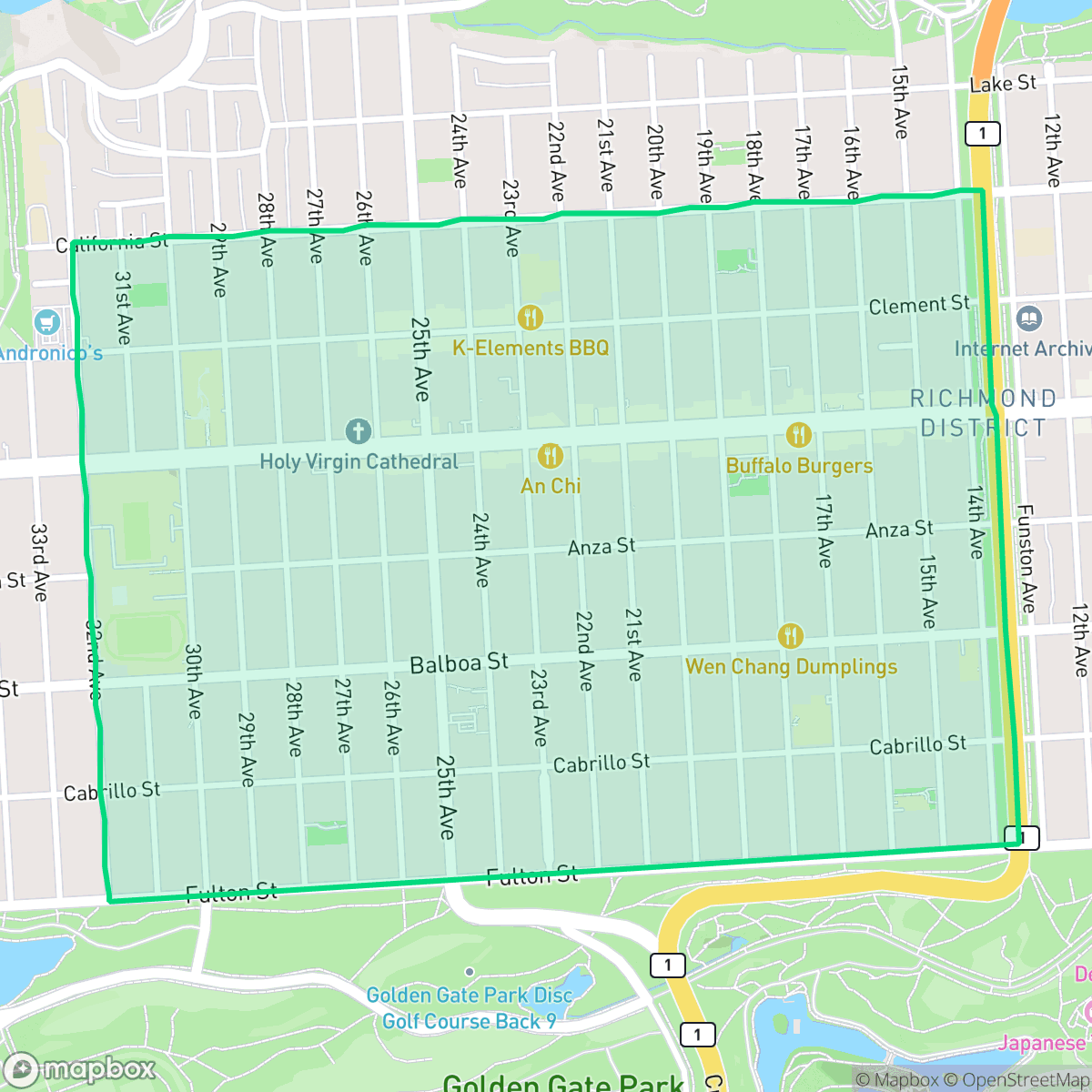
Central Richmond, bounded by Park Presidio Boulevard, California Street, Fulton Street, and 32nd Avenue, transitioned from windswept sand dunes in San Francisco's "Outside Lands" into a thriving streetcar suburb following the 1906 earthquake. The disaster spurred rapid residential development, resulting in a distinct architectural stock of Edwardian-era flats, Victorian rowhouses, and mid-century Marina-style homes. The neighborhood's commercial life centers on Geary Boulevard and Clement Street. Historically home to Irish, German, and Jewish communities, the area welcomed a wave of Russian immigrants, earning parts of Geary the moniker "Little Russia". By the late 20th century, a major influx of Chinese-American families transformed Clement Street into a vibrant commercial hub often celebrated as San Francisco's "New Chinatown".
The neighborhood functions as a dense, low-rise urban hub where the commercial corridors of Geary Boulevard and Clement Street provide a constant flow of activity. According to iHuus data, the area maintains a high level of pedestrian connectivity, allowing residents to navigate the uniform grid of streets with ease. Its proximity to the massive trails and recreational facilities of Golden Gate Park serves as a primary draw for dog owners and outdoor enthusiasts, balancing the otherwise compact, paved urban environment. The architectural character remains consistent, featuring standard row-style homes that prioritize density over private outdoor amenities.
Prospective residents should consider the trade-offs inherent in this high-density setting, including limited privacy between neighboring structures and an average ambient noise level of 60 decibels from road traffic. While the broader San Francisco Unified School District faces financial and operational instability, the immediate area hosts several highly-regarded local schools, such as Alamo and Argonne Elementary. This neighborhood is well-suited for those who value a walkable, transit-accessible lifestyle and proximity to major city parks over the seclusion of detached single-family housing.
Neighborhood Scores Across 15 Qualities
Buildings in this area feature shared walls and very narrow gaps between structures. This level of density and close proximity to neighbors is roughly in line with the city average, according to iHuus data.
A dense, consistent grid provides high connectivity with wide sidewalks and frequent crosswalks on nearly every street. This level of accessibility for pedestrians is slightly above the San Francisco average, according to iHuus data.
Uniform, boxy residential architecture and narrow lots define the area, resulting in a visual profile that is roughly average for San Francisco. While some coastal pockets feature larger manicured yards, most of the neighborhood consists of high-density row houses with minimal private green space.
Immediate access to Golden Gate Park and nearby coastal areas provides expansive trail networks and open green space for pets. According to iHuus data, these abundant park connections make the area significantly more accommodating for dog owners than the San Francisco average.
Residential streets and green spaces are found in roughly equal measure, providing a more suburban character than most of San Francisco. This balance of dense low-rise housing and proximity to managed city parks creates an environment more open than the city average.
Local social hubs and diverse dining options create a sense of activity that is higher than the city average. While some coastal blocks remain quiet and serene, many areas feature a notable concentration of restaurants and community spaces according to iHuus data.
Steady traffic noise from nearby busy streets is present, though the acoustic environment is notably calmer than the city average. According to iHuus data, residents can expect a consistent urban hum without the extreme decibel levels found in other parts of San Francisco.
Air quality levels are generally clean with rare instances of elevated readings, though they remain slightly lower than the San Francisco average according to iHuus data.
Residents will find a purely residential and recreational landscape with no detectable warehouses, factories, or heavy industrial activity. This area is even more free of industrial proximity than the San Francisco average, according to iHuus data.
Health insurance access is exceptionally high for residents in this area, significantly surpassing the San Francisco average according to iHuus data.
Voting patterns and census indicators reflect a highly liberal political orientation, mirroring the broader political landscape of San Francisco.
Residents live alongside a balanced demographic of young professionals, families, and seniors. According to iHuus data, the age distribution is largely consistent with the broader San Francisco population.
Significant flood risk exists here due to proximity to the 100-year floodplain; according to iHuus data, this risk level is comparable to the rest of the city.
Address-Level Insights for Central Richmond


iHuus Neighborhood Intelligence Insights
Get address-level neighborhood insights for Central Richmond
- Street-level scores — see how individual blocks compare, not just neighborhood averages
- Micro-zone boundaries — identify quiet pockets, flood boundaries, and walkable clusters before you visit
- 15 dimensions in full — walkability, noise, air quality, school quality, insurance coverage, population age profile, urban/rural index, and more
- Boundary risk alerts — know if your address sits near a block boundary where scores drop, the kind of detail no listing will ever mention
- School insights — individual school ratings and insights, not just district-level data
- Compare before you commit — side-by-side data across neighborhoods, down to block precision
No credit card required
Compare with Any Neighborhood
| Dimension | Central Richmond | Alamo Square |
|---|---|---|
| 🚶 Walkabilityavg 9.91 | ||
| 🔊 Acoustic Comfortavg 3.4 | ||
| 🤫 Privacy Indexavg 2.14 | ||
| 🎨 Visual Appealavg 6.26 | ||
| 🐕 Dog Friendlinessavg 6.55 | ||
| 🗺️ Urban-Rural Indexavg 4.07 | ||
| ✨ Neighborhood Vibeavg 6.4 | ||
| 🏥 Health Insurance Coverageavg 7.87 | ||
| 🌿 Air Qualityavg 7.78 | ||
| 🏭 Industrial Proximityavg 9.37 | ||
| 🌊 Flood Safetyavg 1.89 | ||
| 🗳️ Ideological Leanavg 9.92 | ||
| 👥 Population Age Profileavg 5.18 | ||
| 🔥 Fire Safetyavg 0.01 | ||
| 🏫 School Quality |
Central Richmond Rankings
School Districts Serving Central Richmond
School Insights for Central Richmond
Below average outcomes; significant attendance and academic challenges.
School Insights
See what's really behind every school rating near Central Richmond
- Individual school ratings — each school's own score with outcome context, not just a district average
- Enrollment & class size data — student-to-teacher ratio and how it compares to the state average
- Full demographics breakdown — ethnicity and gender composition for every school in the enrollment zone
- Every school in the district — all schools within the enrollment boundary ranked by rating, not just the closest one
- Grade levels & benchmarks — elementary through high school, with below/above state-average flags
No credit card required