Buena Vista Park, San Francisco
Updated · 3,377 residents
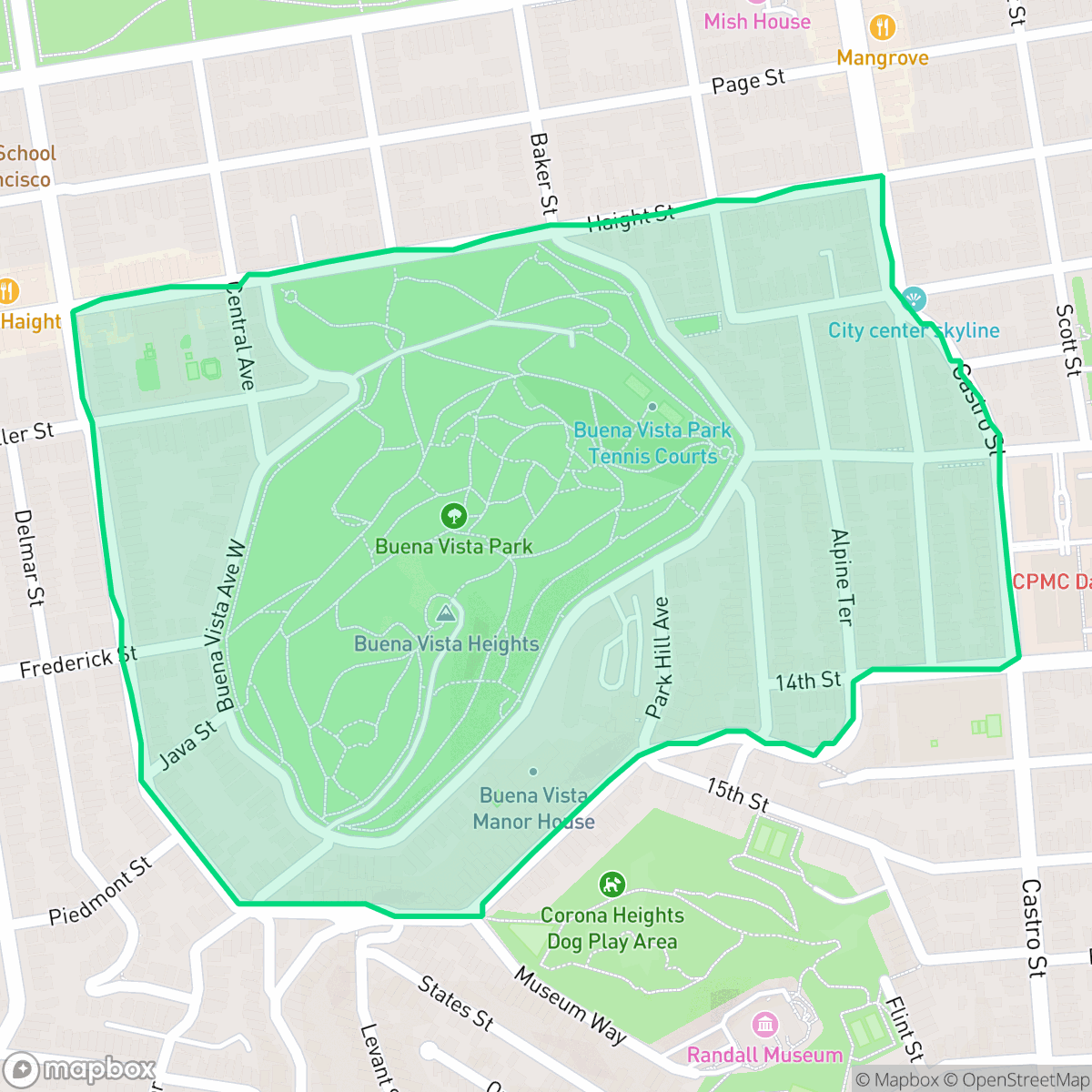
Buena Vista Park is defined by its steep, winding streets and dense residential fabric of historic Victorian and Edwardian homes. It is an exceptionally walkable area that offers residents immediate access to extensive green space, making it a premier destination for dog owners.
Key Highlights
About Buena Vista Park
Established in 1867 as "Hill Park," Buena Vista Park is San Francisco’s oldest official park. The surrounding residential enclave is renowned for its steep, winding streets lined with elegant Victorian and Edwardian homes. In the late 19th century, Parks Superintendent John McLaren supervised the forestation of the hill, planting thousands of cypress, pine, and eucalyptus trees over its native oak woodlands. One of the neighborhood's most unusual historical features is its network of park pathways and gutters, which were constructed by WPA workers in the 1930s using recycled, broken marble headstones salvaged from the city's relocated Lone Mountain cemeteries. Architecturally, the neighborhood is anchored by the historic St. Joseph’s Hospital (355 Buena Vista East), a 1928 landmark featured in Alfred Hitchcock’s Vertigo.
The neighborhood maintains a dense urban character, characterized by low-rise residential buildings that occupy nearly the entire width of their lots. This layout results in a tight-knit community feel with limited privacy between neighbors, yet it provides a quiet, purely residential atmosphere free from industrial activity. Residents benefit from high air quality and consistent access to nature, as the area is anchored by significant park infrastructure that serves as a central hub for recreation and social activity. According to iHuus data, the area maintains a moderate acoustic environment, with noise levels primarily driven by local road traffic rather than heavy industry or transit hubs.
For prospective residents, the area offers a balance of classic San Francisco charm and high-intensity walkability. While the broader San Francisco Unified School District currently faces fiscal instability, the neighborhood provides access to specialized local options like the Chinese Immersion School at Deavila. The area is best suited for those who prioritize pedestrian accessibility, proximity to nature, and a central location over the seclusion of a suburban estate. Potential buyers should note that the high density of the housing stock means that shared walls and close proximity to neighbors are standard features of the local living experience.
Neighborhood Scores Across 15 Qualities
Residential structures are closely situated with minimal separation between buildings. According to iHuus data, this density of housing is consistent with the city average.
A dense grid of continuous sidewalks and frequent crosswalks makes navigating the area on foot easy. This connectivity is slightly above the San Francisco average, providing excellent accessibility for pedestrians.
Large, well-maintained homes with complex architectural features define the local landscape, offering a higher level of visual interest than the San Francisco average. According to iHuus data, the presence of upscale amenities and spacious residential lots contributes to a refined streetscape.
Extensive access to large parks and trail networks provides significantly more outdoor space for pets than the San Francisco average. Residents benefit from immediate proximity to open fields and green spaces suitable for walking and exercise.
Residential streets and park infrastructure exist in roughly equal measure, providing a more balanced urban-rural mix than the typical San Francisco environment. This layout offers a blend of dense, low-rise residential blocks and significant access to green space, according to iHuus data.
Local energy varies between calm, residential streets and more active blocks containing diverse cafes and eateries. According to iHuus data, the overall level of activity is lower than the city average, characterized by a mix of tranquil green spaces and occasional lively dining spots.
Steady hum from nearby busy streets defines the acoustic environment, though levels remain more tranquil than the typical San Francisco average according to iHuus data.
Air quality is consistently good with rare instances of elevated readings. According to iHuus data, the atmosphere in this area is slightly cleaner than the San Francisco average.
No warehouses, heavy machinery, or industrial facilities are present within the neighborhood. This area is exclusively residential and recreational, offering a cleaner environment than much of San Francisco.
Health insurance access is nearly universal among residents, significantly higher than the San Francisco average according to iHuus data.
Voting patterns and census indicators reflect a deeply liberal political landscape, consistent with the broader San Francisco area. According to iHuus data, the neighborhood's ideological lean is slightly more pronounced than the city average.
Residents live alongside a balanced variety of young adults, families, and older populations. This demographic distribution is slightly lower than the San Francisco average, indicating a less concentrated age group.
Address-Level Insights for Buena Vista Park


iHuus Neighborhood Intelligence Insights
Get address-level neighborhood insights for Buena Vista Park
- Street-level scores — see how individual blocks compare, not just neighborhood averages
- Micro-zone boundaries — identify quiet pockets, flood boundaries, and walkable clusters before you visit
- 15 dimensions in full — walkability, noise, air quality, school quality, insurance coverage, population age profile, urban/rural index, and more
- Boundary risk alerts — know if your address sits near a block boundary where scores drop, the kind of detail no listing will ever mention
- School insights — individual school ratings and insights, not just district-level data
- Compare before you commit — side-by-side data across neighborhoods, down to block precision
No credit card required
Compare with Any Neighborhood
| Dimension | Buena Vista Park | Alamo Square |
|---|---|---|
| 🚶 Walkabilityavg 9.91 | ||
| 🔊 Acoustic Comfortavg 3.4 | ||
| 🤫 Privacy Indexavg 2.14 | ||
| 🎨 Visual Appealavg 6.26 | ||
| 🐕 Dog Friendlinessavg 6.55 | ||
| 🗺️ Urban-Rural Indexavg 4.07 | ||
| ✨ Neighborhood Vibeavg 6.4 | ||
| 🏥 Health Insurance Coverageavg 7.87 | ||
| 🌿 Air Qualityavg 7.78 | ||
| 🏭 Industrial Proximityavg 9.37 | ||
| 🌊 Flood Safetyavg 1.89 | ||
| 🗳️ Ideological Leanavg 9.92 | ||
| 👥 Population Age Profileavg 5.18 | ||
| 🔥 Fire Safetyavg 0.01 | ||
| 🏫 School Quality |
Buena Vista Park Rankings
School Districts Serving Buena Vista Park
School Insights for Buena Vista Park
Below average outcomes; significant attendance and academic challenges.
School Insights
See what's really behind every school rating near Buena Vista Park
- Individual school ratings — each school's own score with outcome context, not just a district average
- Enrollment & class size data — student-to-teacher ratio and how it compares to the state average
- Full demographics breakdown — ethnicity and gender composition for every school in the enrollment zone
- Every school in the district — all schools within the enrollment boundary ranked by rating, not just the closest one
- Grade levels & benchmarks — elementary through high school, with below/above state-average flags
No credit card required