Bayview, San Francisco
Updated · 23,910 residents
Bayview is a highly walkable neighborhood that blends residential streets with a significant industrial landscape. While it offers a quiet, suburban feel within the city, residents should be prepared for frequent traffic noise and a dense housing environment with limited private outdoor space.
Key Highlights
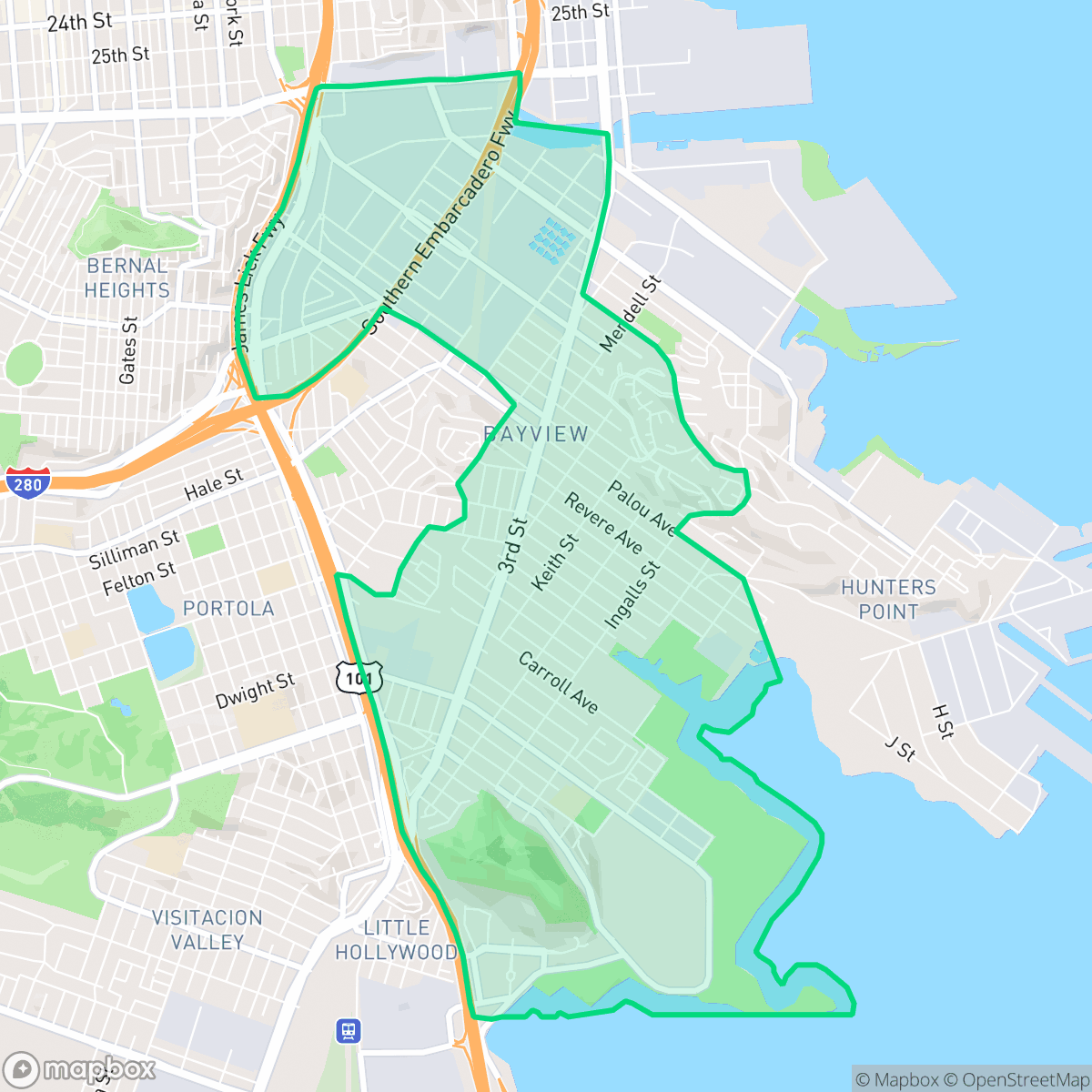
About Bayview
Historically known as South Basin, Bayview evolved from a rural area into a vital industrial hub in the late 19th century, characterized by slaughterhouses and tanneries. Its identity was fundamentally reshaped during World War II with the rapid expansion of the Hunters Point Naval Shipyard, which drew thousands of workers, particularly African Americans, to the area. This influx established Bayview as the heart of San Francisco’s African American community. The neighborhood features a mix of Victorian-era cottages and mid-century residential developments. Landmarks like the Bayview Opera House, built in 1888, stand as testaments to its enduring cultural significance. Despite significant urban renewal challenges and industrial decline in the late 20th century, the neighborhood remains a center for local activism, historic preservation, and a distinct, resilient cultural heritage.
The area is defined by its mixed-use character, where low-rise residential blocks sit alongside large-scale logistics hubs and industrial facilities. This creates a utilitarian aesthetic that prioritizes accessibility, as the neighborhood maintains a high level of walkability through its continuous network of sidewalks and clear crosswalks. While the local energy is generally calm, specific pockets feature localized dining and social hubs that serve the diverse mix of young professionals, families, and long-term residents who call the area home. According to iHuus data, the community maintains a strongly liberal political landscape that aligns with the broader city identity.
Prospective residents should consider the trade-offs of living in a region with heavy industrial activity and proximity to major transit corridors, which results in notable noise levels from nearby freeways and railroads. Housing is situated in close quarters, offering limited privacy and minimal yard space, and the area is located within a designated floodplain. Despite these challenges, the community benefits from high levels of health insurance coverage and consistently clean air, making it a functional choice for those who prioritize pedestrian access and a stable, community-oriented environment.
Neighborhood Scores Across 15 Qualities
Residential structures are situated in very close quarters with minimal separation between buildings. This density of shared walls and narrow gaps is slightly higher than the San Francisco average, according to iHuus data.
A continuous network of sidewalks and clear crosswalks makes navigating the area on foot efficient. This level of walkability is nearly identical to the San Francisco average.
Standardized row housing and industrial blocks define the landscape, providing a utilitarian aesthetic that is slightly below the city average. Residential lots feature boxy rooflines and minimal private yard space, according to iHuus data.
Walking routes for pets are largely restricted to narrow sidewalks and limited street-side trees, making the area less dog friendly than the San Francisco average. While some residents benefit from proximity to larger parks or shoreline areas, many parts of the neighborhood feature dense urban layouts with very little accessible greenery.
An even balance of residential streets and industrial infrastructure defines the area, providing a more suburban feel than the denser city average. Large warehouses and port facilities frequently intermingle with low-rise housing and multi-unit residential blocks.
Mixed-use pockets offer a variety of dining and social hubs, but the overall energy is lower than the city average due to a heavy presence of industrial zones and car-dependent corridors. Many residential blocks remain calm and suburban, though amenities are often concentrated in specific, localized clusters.
Frequent noise from nearby freeways and railroad corridors makes this area significantly louder than the San Francisco average. According to iHuus data, residents may experience regular auditory disturbances from heavy transit activity.
Air quality remains consistently high with infrequent periods of poor air. According to iHuus data, the atmosphere in Bayview is slightly better than the San Francisco average.
Heavy industrial activity and large-scale logistics hubs are much more prevalent here than in most other parts of the city. Residents may encounter frequent freight traffic, proximity to a wastewater treatment plant, and environmental considerations related to a nearby Superfund site.
Health insurance accessibility is high in this area, sitting above the San Francisco average according to iHuus data.
Voting patterns and census indicators show a deeply liberal political landscape that aligns with the city average. This ideological leaning is a defining characteristic of the local community according to iHuus data.
Residents live alongside a balanced blend of young professionals, families, and older adults. This demographic distribution is roughly in line with the overall San Francisco average, according to iHuus data.
Properties in this area are located within a designated floodplain, meaning residents should expect a notable risk of flooding and potential requirements for flood insurance. According to iHuus data, this risk level is slightly higher than the average for San Francisco.
Address-Level Insights for Bayview


iHuus Neighborhood Intelligence Insights
Get address-level neighborhood insights for Bayview
- Street-level scores — see how individual blocks compare, not just neighborhood averages
- Micro-zone boundaries — identify quiet pockets, flood boundaries, and walkable clusters before you visit
- 15 dimensions in full — walkability, noise, air quality, school quality, insurance coverage, population age profile, urban/rural index, and more
- Boundary risk alerts — know if your address sits near a block boundary where scores drop, the kind of detail no listing will ever mention
- School insights — individual school ratings and insights, not just district-level data
- Compare before you commit — side-by-side data across neighborhoods, down to block precision
No credit card required
Compare with Any Neighborhood
| Dimension | Bayview | Alamo Square |
|---|---|---|
| 🚶 Walkabilityavg 9.91 | ||
| 🔊 Acoustic Comfortavg 3.4 | ||
| 🤫 Privacy Indexavg 2.14 | ||
| 🎨 Visual Appealavg 6.26 | ||
| 🐕 Dog Friendlinessavg 6.55 | ||
| 🗺️ Urban-Rural Indexavg 4.07 | ||
| ✨ Neighborhood Vibeavg 6.4 | ||
| 🏥 Health Insurance Coverageavg 7.87 | ||
| 🌿 Air Qualityavg 7.78 | ||
| 🏭 Industrial Proximityavg 9.37 | ||
| 🌊 Flood Safetyavg 1.89 | ||
| 🗳️ Ideological Leanavg 9.92 | ||
| 👥 Population Age Profileavg 5.18 | ||
| 🔥 Fire Safetyavg 0.01 | ||
| 🏫 School Quality |
Bayview Rankings
School Districts Serving Bayview
School Insights for Bayview
Below average outcomes; significant attendance and academic challenges.
School Insights
See what's really behind every school rating near Bayview
- Individual school ratings — each school's own score with outcome context, not just a district average
- Enrollment & class size data — student-to-teacher ratio and how it compares to the state average
- Full demographics breakdown — ethnicity and gender composition for every school in the enrollment zone
- Every school in the district — all schools within the enrollment boundary ranked by rating, not just the closest one
- Grade levels & benchmarks — elementary through high school, with below/above state-average flags
No credit card required