Balboa Terrace, San Francisco
Updated · 705 residents
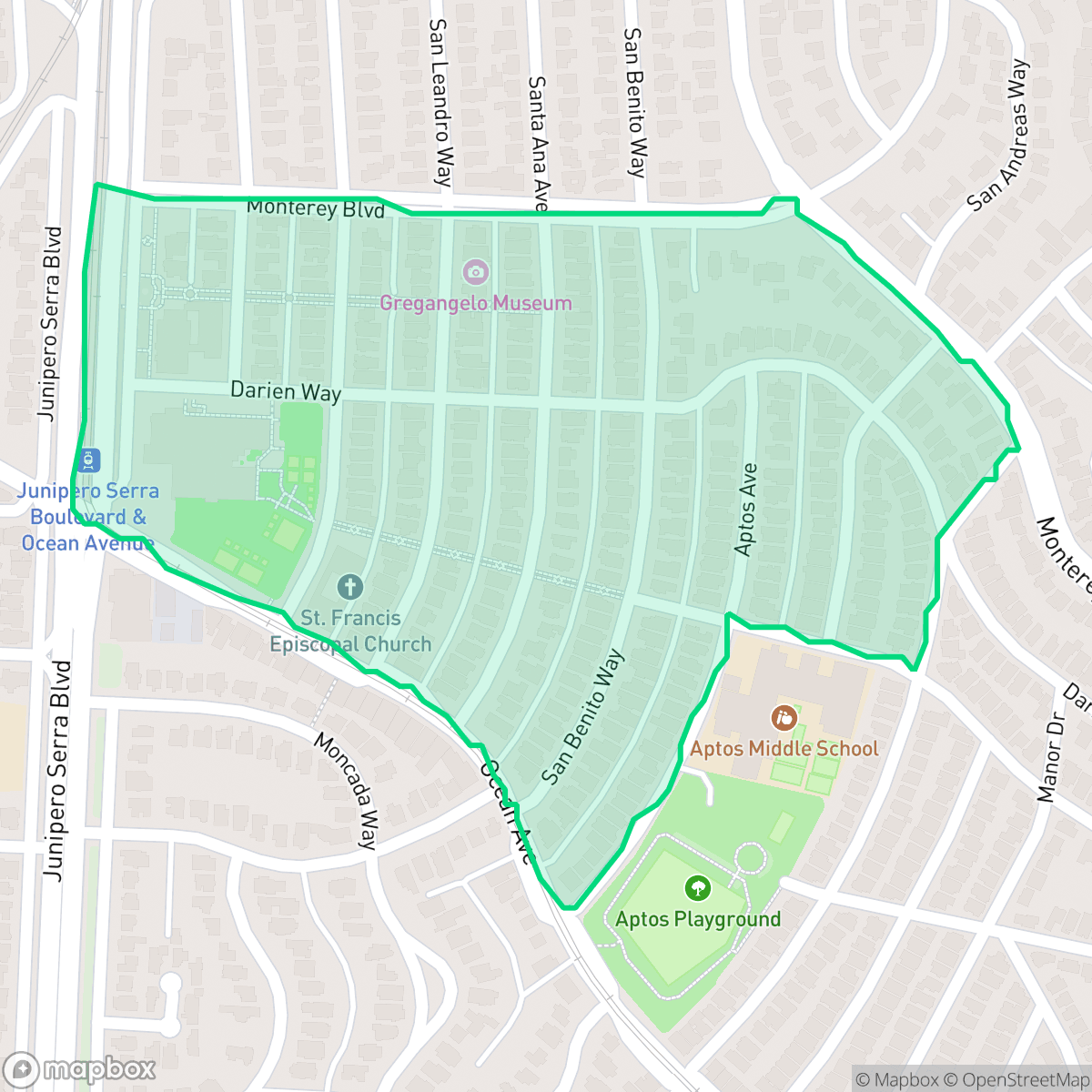
Balboa Terrace offers a highly walkable, residential environment on the slopes of Mount Davidson, characterized by its distinct architectural heritage and convenient access to local retail. While the area provides excellent pedestrian infrastructure, residents should note the significant noise levels from nearby road traffic and the relatively high density of the housing stock.
Key Highlights
About Balboa Terrace
Established in 1912 by the Baldwin & Howell realty firm, Balboa Terrace developed in the 1920s as one of San Francisco’s premier master-planned "residence parks". Located on the slopes of Mount Davidson, the neighborhood was built out by Hueter Homes and designed primarily by architect Harold G. Stoner. Stoner popularized a romantic mix of Spanish Colonial Revival, Italian Renaissance, and storybook English cottage styles. Embodying "Garden City" planning principles, Balboa Terrace features uniform setbacks, undergrounded utility wiring, and landscaped pedestrian pathways. Uniquely for San Francisco, homes feature detached rear garages accessed via private alleyways rather than front-facing driveways. The neighborhood’s grand entrance on Junipero Serra Boulevard, designed by civil engineers Punnett & Parez in 1920, is marked by a classical stone-bench gateway and ornamental light standards.
The area functions as a dense, suburban-style enclave within the city, offering residents immediate access to essential services and local dining options like Bay Pocha and Ambrosia Bakery. The neighborhood maintains a consistent, pedestrian-friendly layout that encourages outdoor activity, supported by accessible green spaces and a lack of industrial facilities. According to iHuus data, the area benefits from strong health insurance coverage and clean air, contributing to a stable living environment for its small population.
Prospective residents should weigh these benefits against specific trade-offs. The high volume of road traffic creates a consistently noisy environment, which may impact acoustic comfort for those sensitive to sound. Furthermore, the tightly packed residential lots result in limited privacy between neighbors. While the neighborhood is served by local schools, the broader San Francisco Unified School District currently faces significant fiscal and operational challenges that may influence educational planning for families.
Neighborhood Scores Across 15 Qualities
Residential structures are situated in close quarters with limited separation between homes. This level of density provides more privacy than the typical San Francisco neighborhood according to iHuus data.
Continuous sidewalks and clear crosswalks are available on nearly every street, providing a sidewalk network that is slightly more complete than the city average according to iHuus data.
Standard mid-century tract housing defines the area, featuring uniform rooflines and small yards with very little greenery. This visual consistency is slightly below the San Francisco average according to iHuus data.
Limited green verges and few accessible public parks make this area less dog friendly than the San Francisco average. While a central baseball diamond provides some public space, many residential streets feature narrow sidewalks and dense housing.
Frequent open land and scattered homes amid greenery provide a more semi-rural feel than the typical San Francisco urban density. According to iHuus data, this area features more woodland and field-like elements than the city average.
Diverse dining options and local services create a lively atmosphere that is more active than the San Francisco average. According to iHuus data, the area offers a notable blend of community spaces, educational spots, and varied eateries situated among suburban streets and green spaces.
Steady hum from nearby busy streets defines the acoustic environment. According to iHuus data, sound levels are notably higher than the city average.
Air quality in this area is consistently good, remaining slightly above the San Francisco average. Most readings show clean air with only rare instances of elevated levels according to iHuus data.
Industrial activity and heavy warehouses are entirely absent from this area. According to iHuus data, the neighborhood remains more residential in nature than most of San Francisco.
Health insurance access is exceptionally high for residents here, significantly surpassing the average seen across San Francisco. According to iHuus data, nearly all members of the community are covered.
Voting patterns and census indicators reflect a deeply liberal political landscape that is largely consistent with the broader San Francisco average, according to iHuus data.
Residents live alongside a balanced mix of young professionals, families, and seniors. According to iHuus data, this demographic spread is slightly more varied than the San Francisco average.
Flood risk is notably higher than the San Francisco average due to the area's location within a designated floodplain. Residents should be aware that flood insurance is typically required for properties in this zone, according to iHuus data.
Address-Level Insights for Balboa Terrace


iHuus Neighborhood Intelligence Insights
Get address-level neighborhood insights for Balboa Terrace
- Street-level scores — see how individual blocks compare, not just neighborhood averages
- Micro-zone boundaries — identify quiet pockets, flood boundaries, and walkable clusters before you visit
- 15 dimensions in full — walkability, noise, air quality, school quality, insurance coverage, population age profile, urban/rural index, and more
- Boundary risk alerts — know if your address sits near a block boundary where scores drop, the kind of detail no listing will ever mention
- School insights — individual school ratings and insights, not just district-level data
- Compare before you commit — side-by-side data across neighborhoods, down to block precision
No credit card required
Compare with Any Neighborhood
| Dimension | Balboa Terrace | Alamo Square |
|---|---|---|
| 🚶 Walkabilityavg 9.91 | ||
| 🔊 Acoustic Comfortavg 3.4 | ||
| 🤫 Privacy Indexavg 2.14 | ||
| 🎨 Visual Appealavg 6.26 | ||
| 🐕 Dog Friendlinessavg 6.55 | ||
| 🗺️ Urban-Rural Indexavg 4.07 | ||
| ✨ Neighborhood Vibeavg 6.4 | ||
| 🏥 Health Insurance Coverageavg 7.87 | ||
| 🌿 Air Qualityavg 7.78 | ||
| 🏭 Industrial Proximityavg 9.37 | ||
| 🌊 Flood Safetyavg 1.89 | ||
| 🗳️ Ideological Leanavg 9.92 | ||
| 👥 Population Age Profileavg 5.18 | ||
| 🔥 Fire Safetyavg 0.01 | ||
| 🏫 School Quality |
Balboa Terrace Rankings
School Districts Serving Balboa Terrace
School Insights for Balboa Terrace
Below average outcomes; significant attendance and academic challenges.
School Insights
See what's really behind every school rating near Balboa Terrace
- Individual school ratings — each school's own score with outcome context, not just a district average
- Enrollment & class size data — student-to-teacher ratio and how it compares to the state average
- Full demographics breakdown — ethnicity and gender composition for every school in the enrollment zone
- Every school in the district — all schools within the enrollment boundary ranked by rating, not just the closest one
- Grade levels & benchmarks — elementary through high school, with below/above state-average flags
No credit card required