Alamo Square, San Francisco
Updated · 3,952 residents
Famous for its iconic Victorian architecture and central park, this neighborhood offers exceptional walkability and a dense, urban environment. Residents enjoy a vibrant local dining scene, though they must contend with consistent road noise and limited privacy due to the close proximity of neighboring homes.
Key Highlights
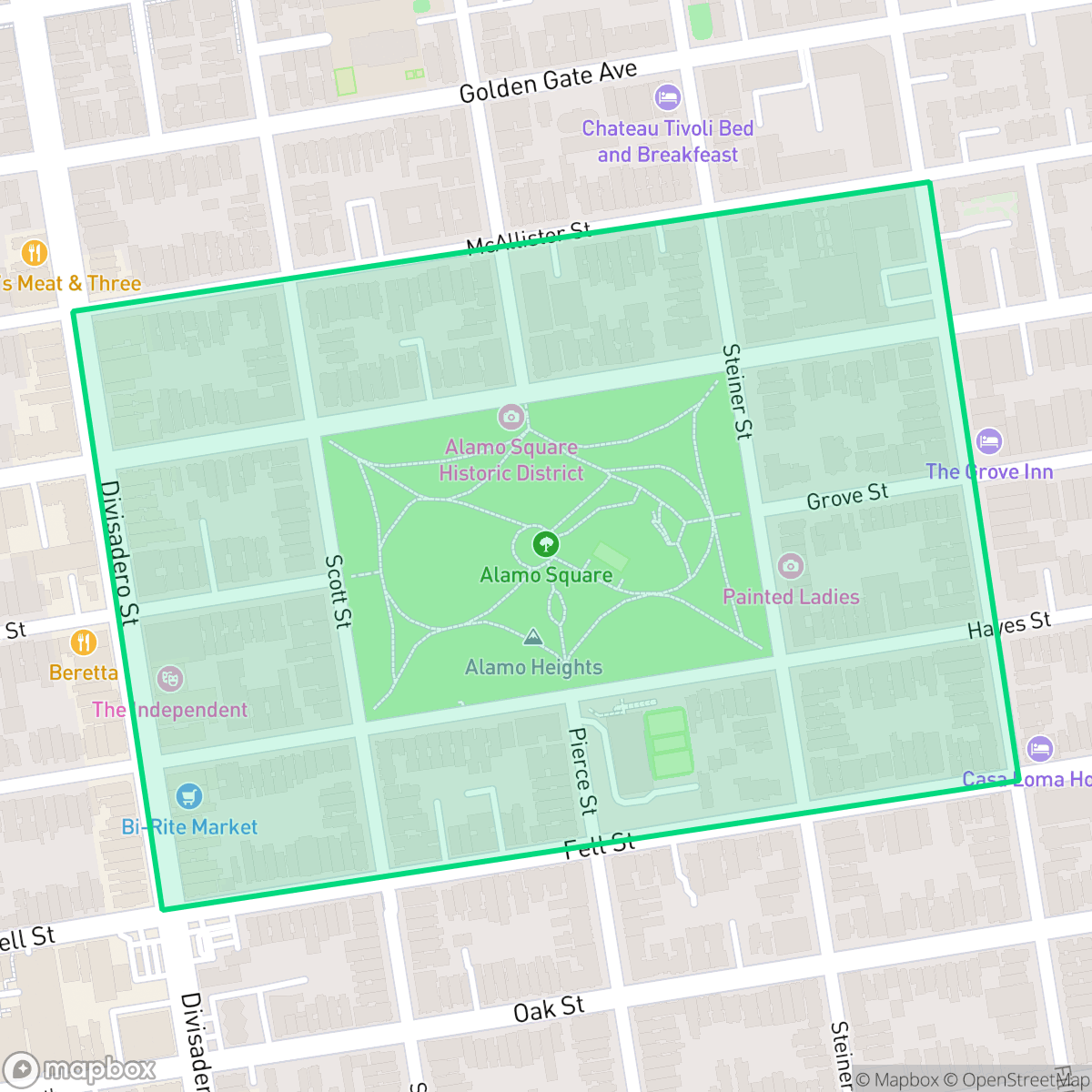
About Alamo Square
Alamo Square’s history began as a watering hole centered around a lone cottonwood tree (álamo in Spanish) along the trail between Mission Dolores and the Presidio. In 1856, Mayor James Van Ness established the 12.7-acre park. The surrounding neighborhood developed into an affluent enclave defined by a dense concentration of Victorian and Edwardian architecture built between 1870 and 1929. This includes Italianate, Stick, and Queen Anne styles, most famously represented by the "Painted Ladies" on Steiner Street, built by developer Matthew Kavanaugh between 1892 and 1896. While much of the surrounding Western Addition underwent mid-century urban renewal, Alamo Square’s historic building stock remained largely intact. Designated a historic district in 1984, the neighborhood also features prominent landmarks like the William Westerfeld House and the Archbishop’s Mansion.
The area serves as a quintessential San Francisco enclave where historic charm meets a high-density urban lifestyle. Beyond the famous park, the streets are lined with a mix of multi-story residential buildings and popular local eateries like 4505 Burgers & Bbq and the Bean Bag Cafe. The grid layout is highly accessible, making it easy for pedestrians to navigate the neighborhood and connect with adjacent districts like Hayes Valley and the Lower Haight. According to iHuus data, the area maintains a lively atmosphere that balances its residential character with a steady flow of local foot traffic and community activity.
Prospective residents should note that the neighborhood presents specific trade-offs typical of a dense city environment. Acoustic comfort is impacted by consistent road traffic, and the close proximity of row houses results in minimal privacy between units. While the area boasts excellent air quality and a lack of industrial hazards, families should be aware of the challenges facing the San Francisco Unified School District, which is currently experiencing significant fiscal and operational instability. It is best suited for individuals who prioritize walkability and proximity to cultural landmarks over expansive private space or quiet suburban conditions.
Neighborhood Scores Across 15 Qualities
Dense configurations of row houses and multi-unit complexes result in minimal separation between buildings. This lack of spacing is typical for the area and aligns closely with the city average for privacy levels.
Wide sidewalks and frequent marked crosswalks provide excellent pedestrian access and safety. The consistent street grid offers a level of walkability that is slightly above the San Francisco average, according to iHuus data.
Typical urban housing structures feature flat roofs and modest yards. This level of visual variety is slightly below the San Francisco average, according to iHuus data.
Alamo Square Park provides a primary destination for pet owners, though the surrounding urban density offers fewer grassy verges than the city average. Streetscapes are largely comprised of concrete, making the centralized green space essential for local dogs.
Multi-story buildings and row houses dominate the landscape with very little unpaved land. This level of density is roughly in line with the city average, providing a balanced mix of built environment and street-level greenery.
Diverse dining options and local cultural centers provide a level of activity that is notably higher than the San Francisco average. According to iHuus data, this area serves as a lively destination for residents due to its concentration of mid-rise urban infrastructure.
Frequent acoustic disturbances from nearby transit corridors and heavy traffic are common here. This level of noise is consistent with the average levels found throughout San Francisco.
Air quality remains mostly clean with rare instances of elevated readings, performing slightly above the San Francisco average according to iHuus data.
Industrial activity is non-existent in this area, as the neighborhood consists entirely of residential and commercial structures. This absence of warehouses or heavy industrial sites makes the area even more free of industrial proximity than the San Francisco average, according to iHuus data.
Health insurance access among residents is notably higher than the San Francisco average, according to iHuus data.
Voting patterns and census indicators show a very high concentration of liberal-leaning residents. This political leaning is slightly more pronounced here than in the rest of San Francisco, according to iHuus data.
Residents live alongside a diverse range of age groups, including young professionals, families, and seniors. According to iHuus data, this demographic spread is slightly more concentrated in certain age brackets than the city average.
Address-Level Insights for Alamo Square


iHuus Neighborhood Intelligence Insights
Get address-level neighborhood insights for Alamo Square
- Street-level scores — see how individual blocks compare, not just neighborhood averages
- Micro-zone boundaries — identify quiet pockets, flood boundaries, and walkable clusters before you visit
- 15 dimensions in full — walkability, noise, air quality, school quality, insurance coverage, population age profile, urban/rural index, and more
- Boundary risk alerts — know if your address sits near a block boundary where scores drop, the kind of detail no listing will ever mention
- School insights — individual school ratings and insights, not just district-level data
- Compare before you commit — side-by-side data across neighborhoods, down to block precision
No credit card required
Compare with Any Neighborhood
| Dimension | Alamo Square | Alkatraz Island |
|---|---|---|
| 🚶 Walkabilityavg 9.91 | ||
| 🔊 Acoustic Comfortavg 3.4 | ||
| 🤫 Privacy Indexavg 2.14 | ||
| 🎨 Visual Appealavg 6.26 | ||
| 🐕 Dog Friendlinessavg 6.55 | ||
| 🗺️ Urban-Rural Indexavg 4.07 | ||
| ✨ Neighborhood Vibeavg 6.4 | ||
| 🏥 Health Insurance Coverageavg 7.87 | ||
| 🌿 Air Qualityavg 7.78 | ||
| 🏭 Industrial Proximityavg 9.37 | ||
| 🌊 Flood Safetyavg 1.89 | ||
| 🗳️ Ideological Leanavg 9.92 | ||
| 👥 Population Age Profileavg 5.18 | ||
| 🔥 Fire Safetyavg 0.01 | ||
| 🏫 School Quality |
Alamo Square Rankings
School Districts Serving Alamo Square
School Insights for Alamo Square
Below average outcomes; significant attendance and academic challenges.
School Insights
See what's really behind every school rating near Alamo Square
- Individual school ratings — each school's own score with outcome context, not just a district average
- Enrollment & class size data — student-to-teacher ratio and how it compares to the state average
- Full demographics breakdown — ethnicity and gender composition for every school in the enrollment zone
- Every school in the district — all schools within the enrollment boundary ranked by rating, not just the closest one
- Grade levels & benchmarks — elementary through high school, with below/above state-average flags
No credit card required