Ventura College, San Buenaventura (Ventura)
Updated · 11,788 residents
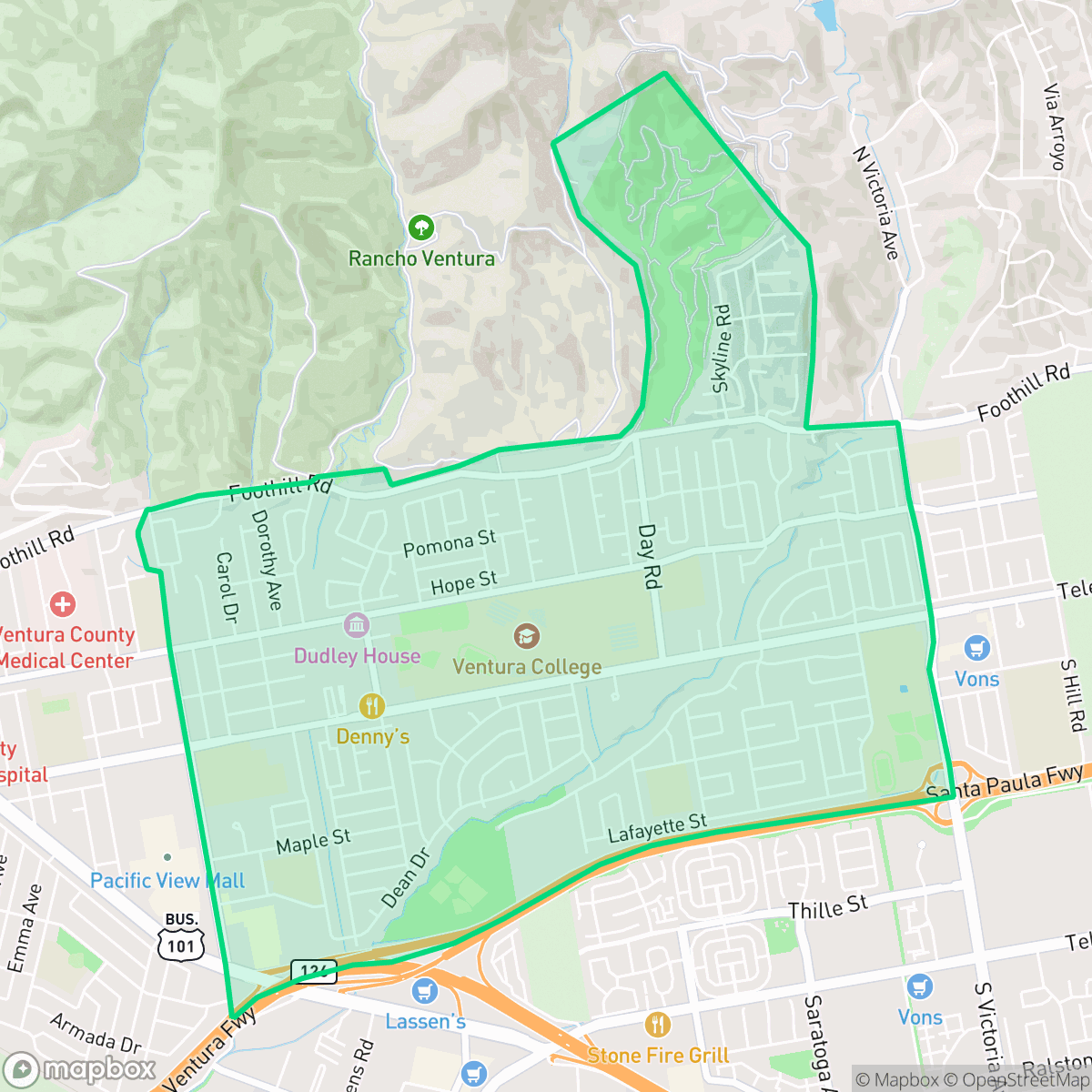
Ventura College is a quiet, highly walkable residential neighborhood centered around its namesake campus and the expansive green space of Arroyo Verde Park. Residents enjoy excellent air quality and a peaceful suburban atmosphere, though the area features a mix of modest mid-century housing with limited privacy between properties.
Key Highlights
About Ventura College
The College Area of San Buenaventura (Ventura), California, developed primarily between the 1950s and 1970s, coinciding with the relocation of Ventura College to its 112-acre hillside campus on Telegraph Road in 1955. Historically agricultural—once part of the Rancho Santa Paula y Saticoy where lima beans thrived in the late 19th century—the neighborhood transitioned into the city's educational and cultural hub. Its most prominent historic landmark is the Dudley House, a Queen Anne-style Victorian farmhouse built in 1892 by local architect Selwyn Shaw. Originally located on Telegraph Road, the house was relocated to Ashwood Avenue and Loma Vista in 1977 to preserve it as a living history museum. Today, the neighborhood is defined by its larger residential lots, expansive green spaces like Arroyo Verde Park, and the Ventura College Performing Arts Center.
The neighborhood functions as a quiet residential enclave defined by its grid-like street layout and proximity to significant local amenities. Its character is shaped by a steady rhythm of daily life, with residents benefiting from high walkability and easy access to neighborhood staples such as local dining spots and the recreational trails of Arroyo Verde Park. While the area maintains a distinct suburban feel, it remains free from industrial hazards, offering a clean environment with high air quality for its inhabitants.
Prospective residents should consider the trade-offs of living in this area, which include moderate noise levels from nearby road traffic and a lower fire safety rating compared to the city average. The housing stock consists largely of modest tract homes and multi-family units that prioritize functionality over high-end aesthetics. With a mix of schools ranging from high-performing magnet programs to those undergoing district-wide reorganization, the area is well-suited for families and students who value a pedestrian-friendly environment and a slower pace of life.
Neighborhood Scores Across 15 Qualities
Housing layouts vary between closely packed apartment clusters and traditional suburban homes with small private yards. This level of density is roughly in line with the broader San Buenaventura area according to iHuus data.
Continuous sidewalks and dedicated pedestrian paths make navigating the area on foot very efficient. This neighborhood offers superior pedestrian connectivity compared to the rest of the city, though major intersections and nearby highways can occasionally disrupt easy movement.
Uniform rooflines and modest yard sizes characterize this area, which features a mix of tract housing and multi-family complexes. This level of visual variety is consistent with the broader San Buenaventura average.
Large public parks, athletic fields, and central green belts provide ample space for pet exercise. According to iHuus data, these accessible green spaces make the area slightly more dog friendly than the city average.
Residential areas consist of dense suburban housing mixed with significant natural canyon space and undeveloped mountainous terrain. This landscape is slightly less developed than the typical Ventura area, offering a blend of single-family homes and agricultural orchards.
A balanced mix of residential life and dining options provides a moderate level of activity that is slightly higher than the city average. While various local eateries and parks are available, the area remains largely car-oriented with limited walking access to services.
Frequent sound from the nearby freeway and railroad tracks creates a higher level of acoustic disturbance than the city average. Residents may experience noticeable ambient noise throughout the day.
Air quality remains consistently excellent for residents, matching the high standard seen across San Buenaventura. According to iHuus data, there are minimal health concerns related to atmospheric pollutants in this area.
Land use in this area is limited to residential, commercial, and educational facilities. According to iHuus data, the neighborhood is notably clearer of warehouses and heavy industrial activity than the San Buenaventura average.
Health insurance access is relatively high among residents, though slightly lower than the city average according to iHuus data.
Political leanings in this area are predominantly liberal, appearing slightly more progressive than the San Buenaventura average according to iHuus data.
Residents will find a varied demographic mix of young adults, families, and seniors; this distribution is very similar to the broader San Buenaventura area according to iHuus data.
Flood risk in this area is difficult to determine because FEMA has not completed a detailed study for the neighborhood. This level of uncertainty is slightly higher than the average found across the city.
Wildfire hazards are exceptionally high in this area, representing a significantly greater danger than the typical risk found across San Buenaventura. Residents should prioritize maximum fire protection measures and strict adherence to safety protocols.
Address-Level Insights for Ventura College


iHuus Neighborhood Intelligence Insights
Get address-level neighborhood insights for Ventura College
- Street-level scores — see how individual blocks compare, not just neighborhood averages
- Micro-zone boundaries — identify quiet pockets, flood boundaries, and walkable clusters before you visit
- 15 dimensions in full — walkability, noise, air quality, school quality, insurance coverage, population age profile, urban/rural index, and more
- Boundary risk alerts — know if your address sits near a block boundary where scores drop, the kind of detail no listing will ever mention
- School insights — individual school ratings and insights, not just district-level data
- Compare before you commit — side-by-side data across neighborhoods, down to block precision
No credit card required
Compare with Any Neighborhood
| Dimension | Ventura College | Arundell |
|---|---|---|
| 🚶 Walkabilityavg 8.94 | ||
| 🔊 Acoustic Comfortavg 2.96 | ||
| 🤫 Privacy Indexavg 4.99 | ||
| 🎨 Visual Appealavg 6.55 | ||
| 🐕 Dog Friendlinessavg 6.7 | ||
| 🗺️ Urban-Rural Indexavg 6.9 | ||
| ✨ Neighborhood Vibeavg 4.55 | ||
| 🏥 Health Insurance Coverageavg 8.28 | ||
| 🌿 Air Qualityavg 9.98 | ||
| 🏭 Industrial Proximityavg 8.77 | ||
| 🌊 Flood Safetyavg 5.24 | ||
| 🗳️ Ideological Leanavg 8.09 | ||
| 👥 Population Age Profileavg 5.15 | ||
| 🔥 Fire Safetyavg 0.58 | ||
| 🏫 School Quality |
Ventura College Rankings
School Districts Serving Ventura College
School Insights for Ventura College
Below average outcomes; significant attendance and academic challenges.
School Insights
See what's really behind every school rating near Ventura College
- Individual school ratings — each school's own score with outcome context, not just a district average
- Enrollment & class size data — student-to-teacher ratio and how it compares to the state average
- Full demographics breakdown — ethnicity and gender composition for every school in the enrollment zone
- Every school in the district — all schools within the enrollment boundary ranked by rating, not just the closest one
- Grade levels & benchmarks — elementary through high school, with below/above state-average flags
No credit card required