Saticoy, San Buenaventura (Ventura)
Updated · 9,129 residents
Saticoy is a historic Ventura neighborhood defined by its agricultural heritage and a mix of dense suburban housing and industrial zones. Residents benefit from high air quality and consistent walkability, though the area experiences notable road noise and limited privacy due to closely spaced homes.
Key Highlights
About Saticoy
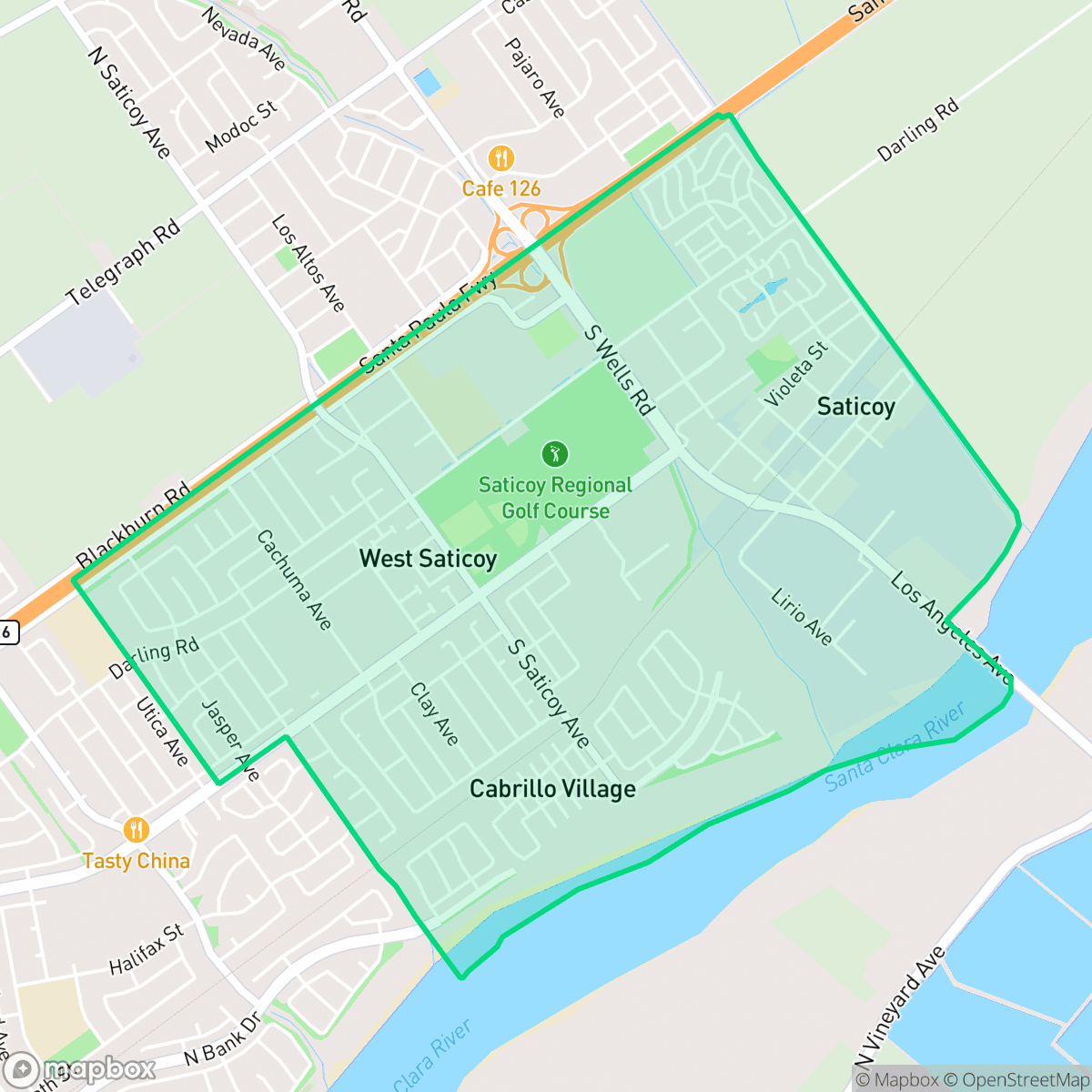
Saticoy, a neighborhood in Ventura, derives its name from the Ventureño Chumash village Sa'aqtik'oy ('sheltered from the wind'), a major indigenous settlement centered around the sacred Saticoy Springs. Modern settlement began in 1861, and 'Old Town' Saticoy was laid out in 1887 along the Southern Pacific Railroad. The area quickly flourished as a prominent agricultural hub for citrus, walnuts, and lima beans, a legacy preserved today in structures like the Saticoy (Lima) Bean Warehouse. Saticoy is also home to Cabrillo Village, a 1930s farmworker camp. In 1976, eighty-two farmworker families collectively purchased the camp to prevent its demolition, establishing Ventura County's first housing cooperative. While much of Saticoy has been annexed by the city of Ventura, its deep agricultural roots and historic Old Town remain distinct cultural landmarks.
The neighborhood maintains a distinct identity as an urban-rural fringe, blending traditional suburban tracts with light industrial and commercial sectors. Its layout prioritizes connectivity through a grid of residential streets, making it a highly walkable area for those living near local social hubs and dining options. While the landscape is largely residential, the perimeter features significant open space and agricultural fields that reflect the area's long-standing connection to the land.
Prospective residents should note that the area presents specific livability trade-offs, particularly regarding acoustic comfort. Road traffic noise is a common factor, and the proximity of industrial facilities can impact the quietude of certain residential pockets. Housing density is relatively high, resulting in limited yard space and privacy between neighbors. The area is served by a range of educational options, including the Academy of Technology and Leadership at Saticoy, and is well-suited for those who prioritize regional accessibility and clean air over absolute silence or expansive private property.
Neighborhood Scores Across 15 Qualities
Residential spacing is relatively tight, with homes and multi-family units often positioned in close proximity to one another. This density is slightly higher than the typical Ventura average, according to iHuus data.
Continuous sidewalks on both sides of residential streets and clear pedestrian crossings make navigating the area on foot easy. This level of connectivity is consistent with the city average for San Buenaventura.
Standard tract housing defines the area with uniform rooflines and modest yards. This visual profile is slightly less varied than the average for the wider city.
Nearby open riverbeds and an adjacent eastern park provide sufficient exercise space, though residential streets lack the wide green verges found more frequently across the city. According to iHuus data, the immediate residential grid features dense housing with minimal public greenery.
Residential areas feature a blend of suburban housing tracts and nearby agricultural orchards. This landscape matches the typical urban-rural balance found throughout San Buenaventura, according to iHuus data.
Low density and significant open space define this area, which offers a more subdued atmosphere than the city average. While some local dining and essential services are accessible, the landscape is primarily characterized by a quiet, suburban, and sometimes remote feel.
Frequent noise from nearby railroad tracks and heavy freeway traffic characterizes this area. According to iHuus data, acoustic comfort is notably lower than the city average.
Air quality remains consistently high with minimal health concerns. This level of air purity is on par with the rest of San Buenaventura, according to iHuus data.
Industrial presence is minimal, as the landscape consists almost entirely of residential and agricultural land. According to iHuus data, this neighborhood is notably more free of warehouses and heavy industrial hazards than the city average.
Health insurance accessibility is strong in this area, sitting slightly above the San Buenaventura average according to iHuus data.
Political leanings in this area lean liberal, though the concentration is slightly lower than the San Buenaventura average according to iHuus data.
Residents live alongside a balanced blend of young adults, families, and seniors. This demographic distribution is nearly identical to the broader San Buenaventura average, according to iHuus data.
Some residual flood risk exists within this area, though the safety level remains notably higher than the city average according to iHuus data.
Fire safety infrastructure and protection levels are notably lower than the San Buenaventura average, according to iHuus data.
Address-Level Insights for Saticoy


iHuus Neighborhood Intelligence Insights
Get address-level neighborhood insights for Saticoy
- Street-level scores — see how individual blocks compare, not just neighborhood averages
- Micro-zone boundaries — identify quiet pockets, flood boundaries, and walkable clusters before you visit
- 15 dimensions in full — walkability, noise, air quality, school quality, insurance coverage, population age profile, urban/rural index, and more
- Boundary risk alerts — know if your address sits near a block boundary where scores drop, the kind of detail no listing will ever mention
- School insights — individual school ratings and insights, not just district-level data
- Compare before you commit — side-by-side data across neighborhoods, down to block precision
No credit card required
Compare with Any Neighborhood
| Dimension | Saticoy | Arundell |
|---|---|---|
| 🚶 Walkabilityavg 8.94 | ||
| 🔊 Acoustic Comfortavg 2.96 | ||
| 🤫 Privacy Indexavg 4.99 | ||
| 🎨 Visual Appealavg 6.55 | ||
| 🐕 Dog Friendlinessavg 6.7 | ||
| 🗺️ Urban-Rural Indexavg 6.9 | ||
| ✨ Neighborhood Vibeavg 4.55 | ||
| 🏥 Health Insurance Coverageavg 8.28 | ||
| 🌿 Air Qualityavg 9.98 | ||
| 🏭 Industrial Proximityavg 8.77 | ||
| 🌊 Flood Safetyavg 5.24 | ||
| 🗳️ Ideological Leanavg 8.09 | ||
| 👥 Population Age Profileavg 5.15 | ||
| 🔥 Fire Safetyavg 0.58 | ||
| 🏫 School Quality |
Saticoy Rankings
School Districts Serving Saticoy
School Insights for Saticoy
Below average outcomes; significant attendance and academic challenges.
School Insights
See what's really behind every school rating near Saticoy
- Individual school ratings — each school's own score with outcome context, not just a district average
- Enrollment & class size data — student-to-teacher ratio and how it compares to the state average
- Full demographics breakdown — ethnicity and gender composition for every school in the enrollment zone
- Every school in the district — all schools within the enrollment boundary ranked by rating, not just the closest one
- Grade levels & benchmarks — elementary through high school, with below/above state-average flags
No credit card required