Westwood, Napa
Updated · 5,740 residents
Westwood is a quiet, tree-lined enclave known for its mid-century architecture and immediate access to the expansive Westwood Hills Park. While the area offers a peaceful, semi-rural atmosphere with excellent air quality and walkability, residents should be aware of notable noise from nearby transit corridors and higher environmental risks.
Key Highlights
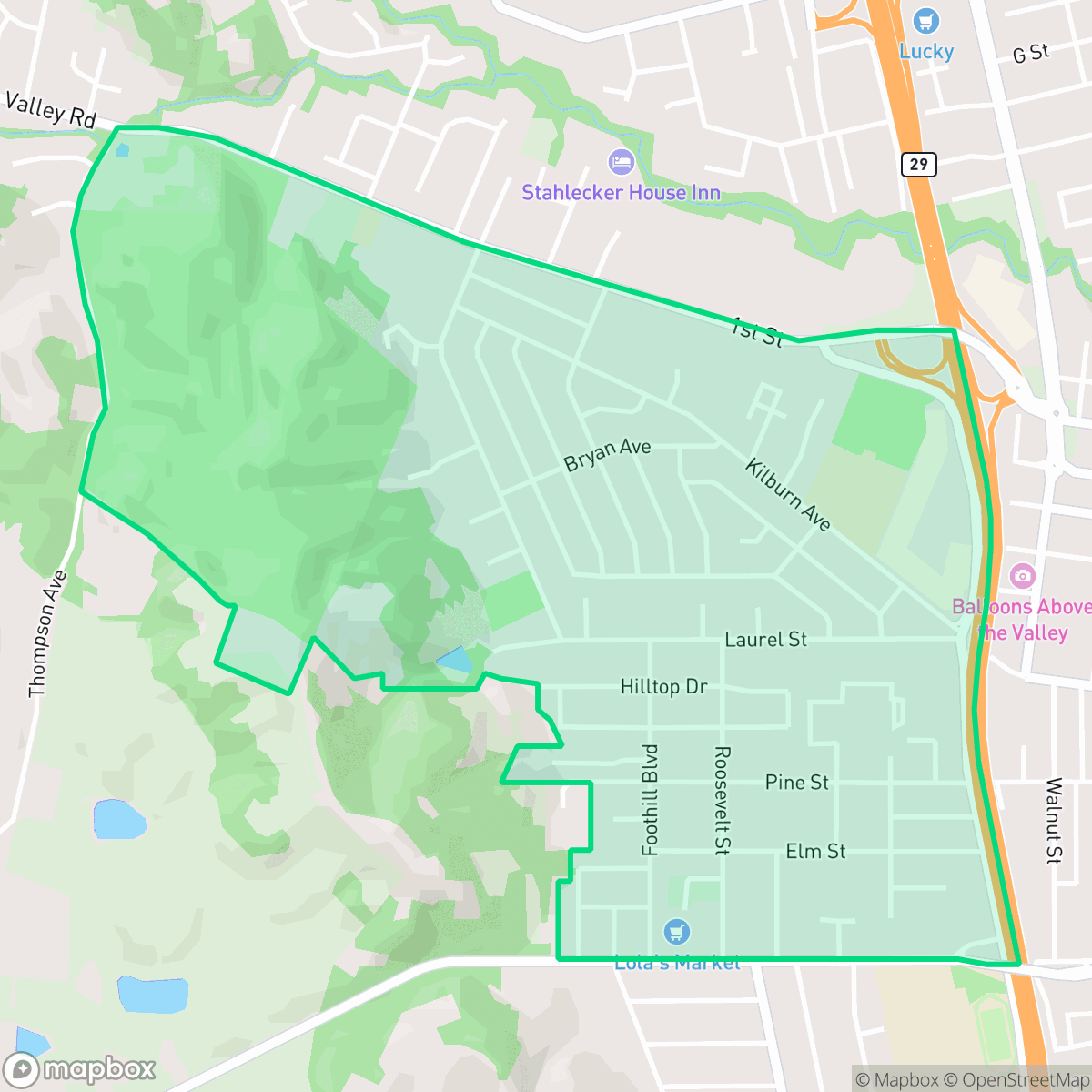
About Westwood
The Westwood neighborhood in Napa, California, was developed in the mid-20th century on land formerly characterized by orchards and prune farms. Much of the residential stock was constructed during the 1940s and 1950s, notably by the local DeVita building family. Historically, the neighborhood is recognized for its mid-century development patterns, which included the use of racially restrictive covenants that shaped its early demographics. A defining landmark is Westwood Hills Park, which the City of Napa purchased in 1975–1976 as its first dedicated open space and conservation area, eventually housing the Carolyn Parr Nature Center. Today, the neighborhood is defined by its quiet, tree-lined streets and a mix of mid-century single-family homes, serving as a residential area that bridges the transition between urban Napa and the surrounding valley hills.
The neighborhood is defined by its collection of mid-century single-family homes and its transition between urban Napa and the surrounding hills. It maintains a semi-rural aesthetic, characterized by generous greenery and a balanced demographic of families, professionals, and retirees. The area benefits from a strong sense of community and a liberal-leaning political culture, creating a stable environment supported by the Napa Valley Unified School District, which is recognized for its robust arts and technology programs. Residents enjoy a high level of air quality and a generally walkable street grid that connects to local parks and green spaces.
Prospective residents should balance the area's natural beauty and recreational access against specific logistical considerations. According to iHuus data, the neighborhood faces elevated noise levels due to its proximity to major rail and freeway routes. Furthermore, the area is situated in a zone with higher-than-average wildfire and flood risks, necessitating careful attention to insurance and emergency preparedness. While the streets are generally safe and accessible, those seeking absolute quiet or minimal environmental hazards should weigh these trade-offs against the neighborhood's suburban charm and scenic location.
Neighborhood Scores Across 15 Qualities
Residential spacing is comparable to the Napa average, featuring a mix of suburban layouts where some homes sit closely together while others maintain consistent yard buffers. According to iHuus data, neighbors are often separated by standard subdivision distances that offer a moderate level of separation.
Continuous sidewalks and safe crossings are available on many residential streets, though overall connectivity is slightly lower than the Napa average. Low traffic volumes and tree-lined cul-de-sacs provide a safe environment for pedestrians according to iHuus data.
Well-maintained properties and large homes with private amenities characterize much of the area. This visual quality is largely consistent with the average seen across Napa.
Access to wooded trails, public parks, and expansive green spaces makes this area slightly more dog friendly than the Napa average. Residents benefit from wide paths and proximity to large sports fields that are well-connected to the surrounding landscape.
Frequent open land and scattered homes amidst woodland create a landscape slightly more rural than the Napa average. This area features a mix of dense residential blocks and significant green space according to iHuus data.
A blend of quiet residential streets and lively pockets near major thoroughfares provides access to various dining and social spots, though the overall activity levels are slightly below the Napa average. According to iHuus data, the area features a variety of greenery and scattered amenities ranging from calm, low-density blocks to more active suburban strips.
Frequent noise from nearby railroad tracks and major freeway traffic is common here. This level of acoustic disturbance is higher than the typical experience found elsewhere in Napa.
Air quality remains consistently high and free from significant health concerns, matching the typical levels found throughout Napa.
Residential and light commercial zones predominate here, with no detectable warehouses or industrial hazards. This lack of heavy industry is consistent with the broader Napa area according to iHuus data.
Health insurance accessibility is lower in this area than in the rest of Napa. Residents may encounter fewer options for local coverage compared to the city average, according to iHuus data.
Voting patterns and census indicators reflect a predominantly liberal political leaning that is slightly more pronounced than the Napa average.
Residents live among a diverse range of age groups, including young professionals, families, and seniors. This demographic spread is slightly more concentrated toward middle-aged and older populations than the Napa city average, according to iHuus data.
Properties in this area are situated within a designated floodplain, which indicates a significantly higher risk of flooding compared to the Napa city average. Residents should be aware that flood insurance is typically required for homes in this zone according to iHuus data.
High wildfire vulnerability characterizes this area, presenting a greater risk than the average Napa neighborhood according to iHuus data. Residents should prioritize maximum fire protection measures and rigorous emergency preparedness.
Address-Level Insights for Westwood


iHuus Neighborhood Intelligence Insights
Get address-level neighborhood insights for Westwood
- Street-level scores — see how individual blocks compare, not just neighborhood averages
- Micro-zone boundaries — identify quiet pockets, flood boundaries, and walkable clusters before you visit
- 15 dimensions in full — walkability, noise, air quality, school quality, insurance coverage, population age profile, urban/rural index, and more
- Boundary risk alerts — know if your address sits near a block boundary where scores drop, the kind of detail no listing will ever mention
- School insights — individual school ratings and insights, not just district-level data
- Compare before you commit — side-by-side data across neighborhoods, down to block precision
No credit card required
Compare with Any Neighborhood
| Dimension | Westwood | Alta Heights |
|---|---|---|
| 🚶 Walkabilityavg 8.58 | ||
| 🔊 Acoustic Comfortavg 3.79 | ||
| 🤫 Privacy Indexavg 5.57 | ||
| 🎨 Visual Appealavg 6.84 | ||
| 🐕 Dog Friendlinessavg 7.44 | ||
| 🗺️ Urban-Rural Indexavg 7.13 | ||
| ✨ Neighborhood Vibeavg 6.19 | ||
| 🏥 Health Insurance Coverageavg 7.18 | ||
| 🌿 Air Qualityavg 9.99 | ||
| 🏭 Industrial Proximityavg 9.18 | ||
| 🌊 Flood Safetyavg 3.04 | ||
| 🗳️ Ideological Leanavg 9.09 | ||
| 👥 Population Age Profileavg 5.16 | ||
| 🔥 Fire Safetyavg 0.34 | ||
| 🏫 School Quality |
Westwood Rankings
School Districts Serving Westwood
School Insights for Westwood
Below average outcomes; significant attendance and academic challenges.
School Insights
See what's really behind every school rating near Westwood
- Individual school ratings — each school's own score with outcome context, not just a district average
- Enrollment & class size data — student-to-teacher ratio and how it compares to the state average
- Full demographics breakdown — ethnicity and gender composition for every school in the enrollment zone
- Every school in the district — all schools within the enrollment boundary ranked by rating, not just the closest one
- Grade levels & benchmarks — elementary through high school, with below/above state-average flags
No credit card required