Vineyard Estates, Napa
Updated · 4,763 residents
Vineyard Estates is a suburban neighborhood in northwest Napa defined by its proximity to expansive open spaces like Alston Park and a mix of single-family homes. While the area offers excellent air quality and a quiet, residential atmosphere, residents should be aware of elevated road noise from the nearby Highway 29.
Key Highlights
About Vineyard Estates
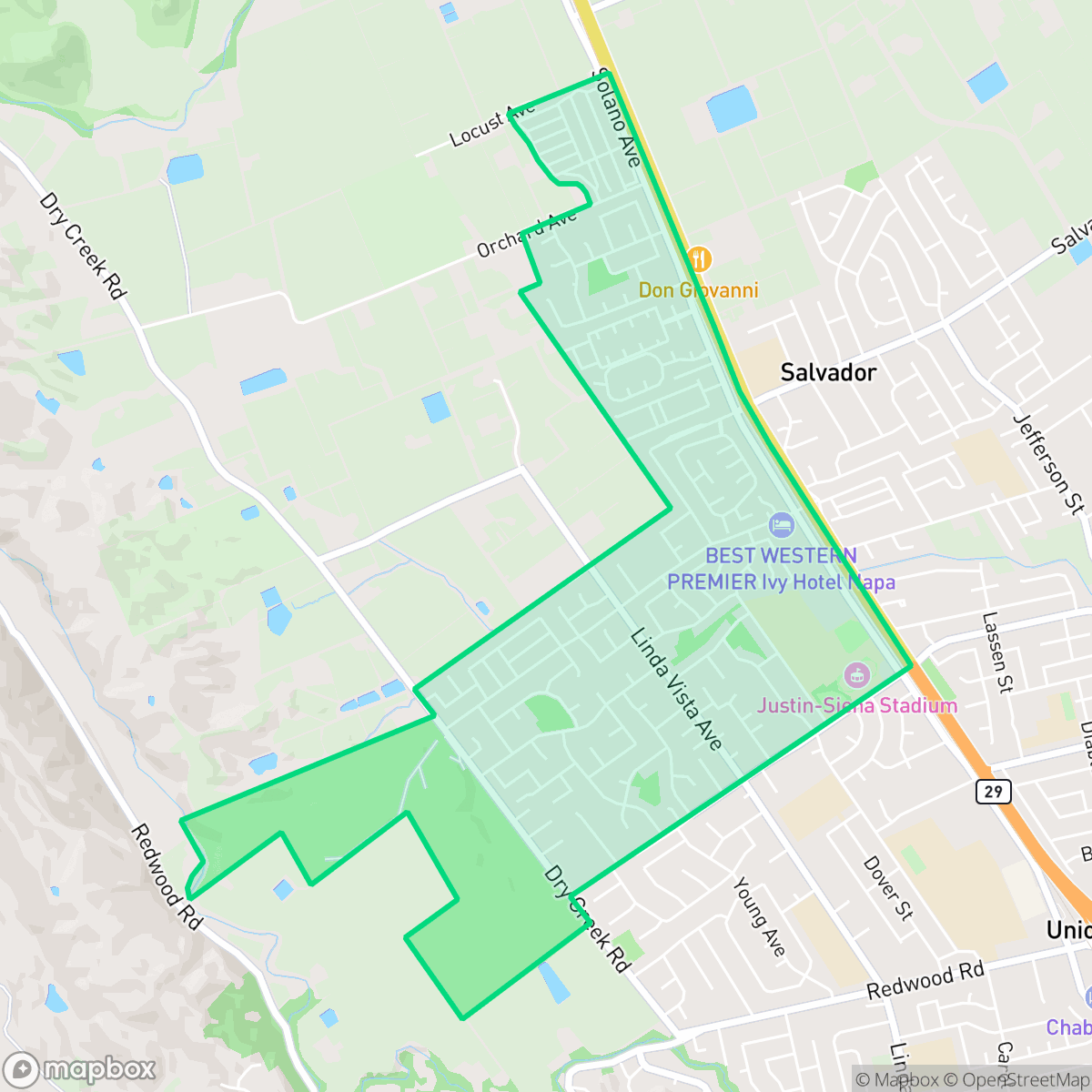
Situated in northwest Napa, the Vineyard Estates neighborhood is bounded by the city limit line to the north and west, Highway 29 to the east, and Trower Avenue to the south. Historically composed of agricultural orchards and farmland, the area transitioned into a residential community with single-family homes constructed primarily between the 1960s and 2000s. The neighborhood's character is defined by its scenic views of the surrounding valley and key local landmarks. These include the 157-acre Alston Park—a public open space established in 1991 along Redwood Creek that preserves old plum orchards and oak-dotted grasslands—as well as the Las Flores Community Center, built in 1992, and Justin-Siena High School.
The neighborhood maintains a suburban character that balances residential development with significant natural surroundings. According to iHuus data, the area features a strong visual appeal characterized by spacious lots, private pools, and a layout that transitions from suburban streets into agricultural vistas. Residents benefit from high air quality and a lack of industrial activity, making it a clean environment for those who prioritize outdoor access and proximity to regional recreational hubs.
Living in this part of Napa involves specific trade-offs, particularly regarding acoustic comfort due to its proximity to major transit corridors. While the neighborhood provides a comprehensive sidewalk network for local walking, its layout remains largely car-dependent for daily errands. The area is well-suited for families and individuals seeking a stable, quiet environment, though prospective residents should note the high fire risk profile common to the region and the necessity of navigating traffic noise in certain sections.
Neighborhood Scores Across 15 Qualities
Residential spacing offers a balance of private yards and some proximity to neighbors. This level of density is roughly in line with the Napa average, according to iHuus data.
Residential streets and arterial roads feature a comprehensive sidewalk network, though the overall walkability is slightly below the Napa average. Safe crossings are available for pedestrians navigating the area.
Large homes with complex rooflines and private swimming pools contribute to a visual profile that is slightly above the Napa average. According to iHuus data, the area features frequent high-end amenities and spacious residential lots.
Wide paths and connected greenbelts throughout the area provide ample space for pet exercise. While very pet friendly, the neighborhood sits slightly below the Napa average for dog accessibility.
Large-scale vineyards and dense forests create a more rural feel than the typical Napa residential area. According to iHuus data, this neighborhood features a higher concentration of open land and scattered structures compared to the city average.
Rural landscapes and low density development create a tranquil atmosphere that is consistent with the city average. While some pockets near highway corridors offer localized dining and social spots, much of the area remains a peaceful, car-dependent setting.
Frequent acoustic disturbances from nearby transit corridors, such as busy freeways or railroad tracks, make this area louder than the Napa average. According to iHuus data, residents can expect significant ambient noise from surrounding transportation infrastructure.
Air quality remains consistently high with minimal health concerns. This level of air purity is on par with the Napa average according to iHuus data.
Industrial activity and heavy manufacturing are entirely absent from this area. Residents enjoy a purely residential environment with only minor agricultural utilities or water storage present, which is even more secluded than the Napa average.
Health insurance enrollment levels in this area are consistent with the broader Napa average, according to iHuus data.
Political preferences in this area are largely liberal, though the neighborhood leans slightly less progressive than the Napa average according to iHuus data.
Residents live alongside a diverse mix of young adults, families, and older individuals, representing a slightly more varied age distribution than the Napa average according to iHuus data.
Flood risk levels are higher than the Napa average, though a detailed study from FEMA is currently unavailable for this specific area. According to iHuus data, the risk remains undetermined.
Extreme fire hazards characterize this area, requiring maximum protection measures. According to iHuus data, the risk level in Vineyard Estates is consistent with the average found across Napa.
Address-Level Insights for Vineyard Estates


iHuus Neighborhood Intelligence Insights
Get address-level neighborhood insights for Vineyard Estates
- Street-level scores — see how individual blocks compare, not just neighborhood averages
- Micro-zone boundaries — identify quiet pockets, flood boundaries, and walkable clusters before you visit
- 15 dimensions in full — walkability, noise, air quality, school quality, insurance coverage, population age profile, urban/rural index, and more
- Boundary risk alerts — know if your address sits near a block boundary where scores drop, the kind of detail no listing will ever mention
- School insights — individual school ratings and insights, not just district-level data
- Compare before you commit — side-by-side data across neighborhoods, down to block precision
No credit card required
Compare with Any Neighborhood
| Dimension | Vineyard Estates | Alta Heights |
|---|---|---|
| 🚶 Walkabilityavg 8.58 | ||
| 🔊 Acoustic Comfortavg 3.79 | ||
| 🤫 Privacy Indexavg 5.57 | ||
| 🎨 Visual Appealavg 6.84 | ||
| 🐕 Dog Friendlinessavg 7.44 | ||
| 🗺️ Urban-Rural Indexavg 7.13 | ||
| ✨ Neighborhood Vibeavg 6.19 | ||
| 🏥 Health Insurance Coverageavg 7.18 | ||
| 🌿 Air Qualityavg 9.99 | ||
| 🏭 Industrial Proximityavg 9.18 | ||
| 🌊 Flood Safetyavg 3.04 | ||
| 🗳️ Ideological Leanavg 9.09 | ||
| 👥 Population Age Profileavg 5.16 | ||
| 🔥 Fire Safetyavg 0.34 | ||
| 🏫 School Quality |
Vineyard Estates Rankings
School Districts Serving Vineyard Estates
School Insights for Vineyard Estates
Below average outcomes; significant attendance and academic challenges.
School Insights
See what's really behind every school rating near Vineyard Estates
- Individual school ratings — each school's own score with outcome context, not just a district average
- Enrollment & class size data — student-to-teacher ratio and how it compares to the state average
- Full demographics breakdown — ethnicity and gender composition for every school in the enrollment zone
- Every school in the district — all schools within the enrollment boundary ranked by rating, not just the closest one
- Grade levels & benchmarks — elementary through high school, with below/above state-average flags
No credit card required