Stanly Ranch, Napa
Updated · 19 residents
Stanly Ranch is a secluded, rural enclave in Napa's Carneros region characterized by high visual appeal and exceptional privacy. While the area offers a serene and quiet atmosphere, its low walkability and limited local amenities make it best suited for those seeking a tranquil, car-dependent lifestyle.
Key Highlights
About Stanly Ranch
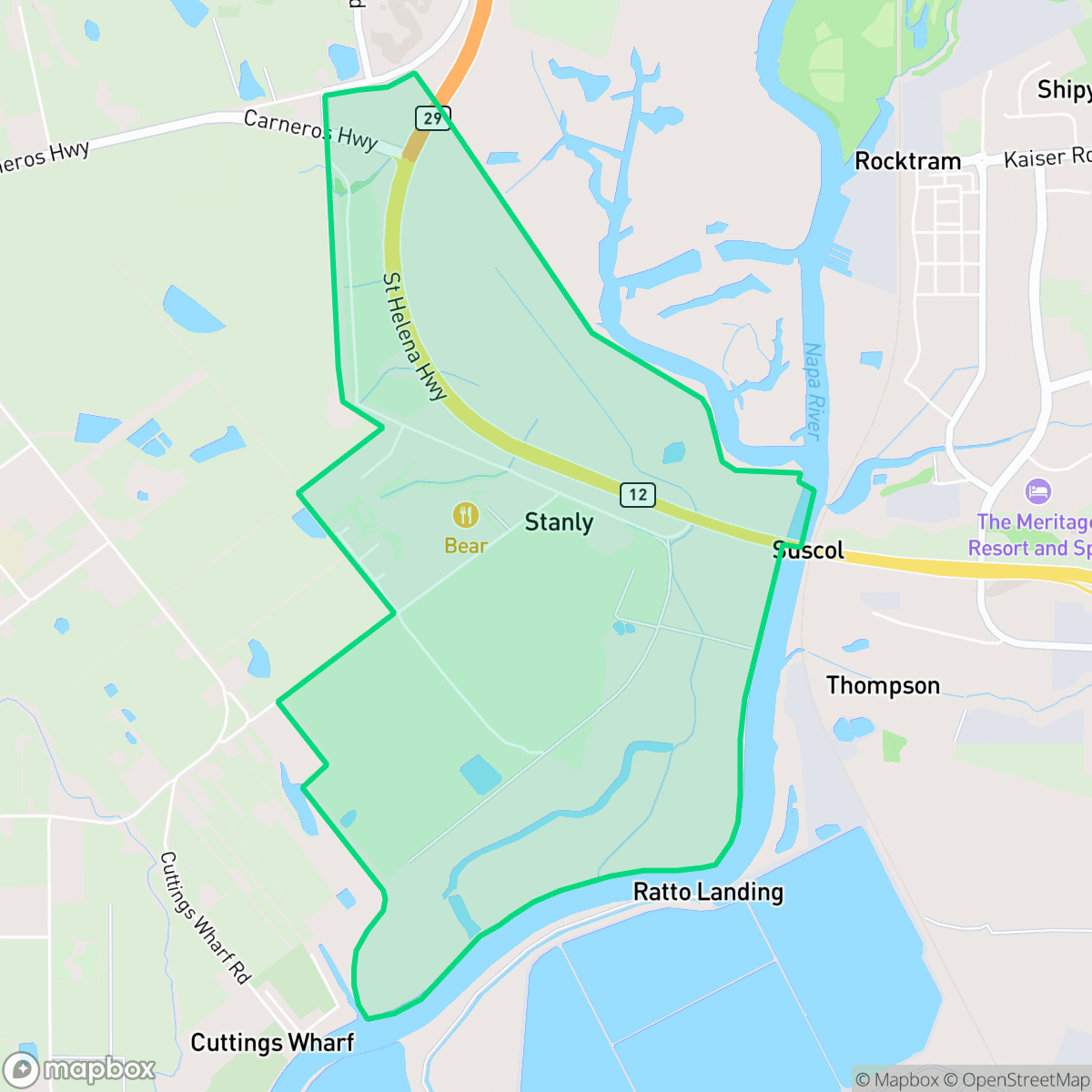
Located in Napa’s Carneros region, Stanly Ranch is a historic, 712-acre master-planned neighborhood and resort community bordering the Napa River. Originally established in 1856 by Judge Edward Stanly as a working farm, the property evolved into one of California’s most prominent early vineyards by the late 19th century. Stanly Ranch played a foundational role in American viticulture, serving as the site for pioneering Pinot Noir and Chardonnay clonal trials conducted by Louis Martini, the Wente family, and UC Davis in the 1940s and 1950s. Today, the neighborhood blends its agrarian heritage with modern luxury, featuring contemporary farmhouse-style villas and vineyard homes designed by Bob White and Overland Partners. A defining local landmark is Gordon Huether’s Corten steel "Infinity" sculpture, which stands atop the property's highest hill.
The neighborhood functions as a low-density, rural landscape that emphasizes seclusion and natural beauty. With an urban-rural index that reflects its open character, it provides a stark contrast to the denser parts of Napa, maintaining a quiet environment with noise levels averaging 40 decibels. According to iHuus data, the area features high visual appeal, making it a destination for those who value aesthetic surroundings over proximity to urban conveniences. The landscape is primarily residential, blending open green spaces with quiet streets that prioritize privacy for its inhabitants.
Living in the area requires a reliance on personal vehicles, as walkability is limited. Potential residents should be aware of environmental considerations, including specific air quality metrics and fire safety challenges common to the region. While the neighborhood provides a peaceful retreat, it is less suited for those seeking high-traffic social hubs or immediate access to city amenities. It remains an ideal choice for individuals who prefer a quiet, private environment and are prepared for a car-dependent lifestyle.
Neighborhood Scores Across 15 Qualities
Residential spacing offers a moderate level of seclusion with some buffers between neighbors. This degree of separation is slightly higher than the average for Napa.
Low sidewalk availability makes pedestrian travel difficult; however, the lack of traffic allows for walking on quiet streets. According to iHuus data, walkability in this area is significantly lower than the Napa average.
Dense housing layouts and limited greenery result in a landscape that is notably less visually diverse than the Napa average. According to iHuus data, the area consists primarily of basic residential structures with small yards and few ornamental amenities.
Expansive green spaces and wide, low-traffic paths provide a safe environment for walking dogs. According to iHuus data, this level of accessibility to outdoor areas is higher than the Napa average.
Expansive landscapes of wetlands and open space define this area, which is significantly more rural than the Napa average. According to iHuus data, the surroundings consist primarily of natural terrain and low-density development.
Minimal activity and a vast, rural landscape characterize this area, which is significantly less active than the Napa average. According to iHuus data, the environment consists primarily of residential estates and open spaces with very few local businesses or social hubs.
Frequent auditory disturbances from nearby transit corridors, such as busy highways or rail lines, characterize this area. According to iHuus data, acoustic comfort is significantly lower than the Napa average.
Occasional periods of poor air quality may affect sensitive groups, as the area experiences more frequent unhealthy days than the Napa average according to iHuus data.
Light industrial and commercial activity exists alongside residential zones, resulting in significantly higher industrial proximity than the Napa average. According to iHuus data, residents may encounter increased daytime truck traffic and construction-related activity in certain parts of the area.
Health insurance enrollment among residents is notably lower than the average for the city of Napa, according to iHuus data.
Young adults make up the majority of the resident population, creating a demographic that is significantly younger than the Napa average. According to iHuus data, there is a limited presence of families or older residents in this area.
Significant flood hazards and wave action are present in this area, making it much more vulnerable to flooding than the Napa average. According to iHuus data, residents should anticipate elevated or potentially prohibitive insurance costs due to these environmental risks.
Fire hazard levels are significantly higher than the Napa average. Residents should be aware of increased wildfire risks and the necessity for enhanced mitigation measures according to iHuus data.
Address-Level Insights for Stanly Ranch


iHuus Neighborhood Intelligence Insights
Get address-level neighborhood insights for Stanly Ranch
- Street-level scores — see how individual blocks compare, not just neighborhood averages
- Micro-zone boundaries — identify quiet pockets, flood boundaries, and walkable clusters before you visit
- 15 dimensions in full — walkability, noise, air quality, school quality, insurance coverage, population age profile, urban/rural index, and more
- Boundary risk alerts — know if your address sits near a block boundary where scores drop, the kind of detail no listing will ever mention
- School insights — individual school ratings and insights, not just district-level data
- Compare before you commit — side-by-side data across neighborhoods, down to block precision
No credit card required
Compare with Any Neighborhood
| Dimension | Stanly Ranch | Alta Heights |
|---|---|---|
| 🚶 Walkabilityavg 8.58 | ||
| 🔊 Acoustic Comfortavg 3.79 | ||
| 🤫 Privacy Indexavg 5.57 | ||
| 🎨 Visual Appealavg 6.84 | ||
| 🐕 Dog Friendlinessavg 7.44 | ||
| 🗺️ Urban-Rural Indexavg 7.13 | ||
| ✨ Neighborhood Vibeavg 6.19 | ||
| 🏥 Health Insurance Coverageavg 7.18 | ||
| 🌿 Air Qualityavg 9.99 | ||
| 🏭 Industrial Proximityavg 9.18 | ||
| 🌊 Flood Safetyavg 3.04 | ||
| 🗳️ Ideological Leanavg 9.09 | ||
| 👥 Population Age Profileavg 5.16 | ||
| 🔥 Fire Safetyavg 0.34 | ||
| 🏫 School Quality |
Stanly Ranch Rankings
School Districts Serving Stanly Ranch
School Insights for Stanly Ranch
Below average outcomes; significant attendance and academic challenges.
School Insights
See what's really behind every school rating near Stanly Ranch
- Individual school ratings — each school's own score with outcome context, not just a district average
- Enrollment & class size data — student-to-teacher ratio and how it compares to the state average
- Full demographics breakdown — ethnicity and gender composition for every school in the enrollment zone
- Every school in the district — all schools within the enrollment boundary ranked by rating, not just the closest one
- Grade levels & benchmarks — elementary through high school, with below/above state-average flags
No credit card required