Shurtleff, Napa
Updated · 4,806 residents
Shurtleff is a highly walkable community on the east side of Napa that features a quiet, residential atmosphere with convenient access to local parks. The neighborhood balances a semi-rural feel with a consistent sidewalk network, making it a practical choice for residents who value pedestrian-friendly streets and clean air.
Key Highlights
About Shurtleff
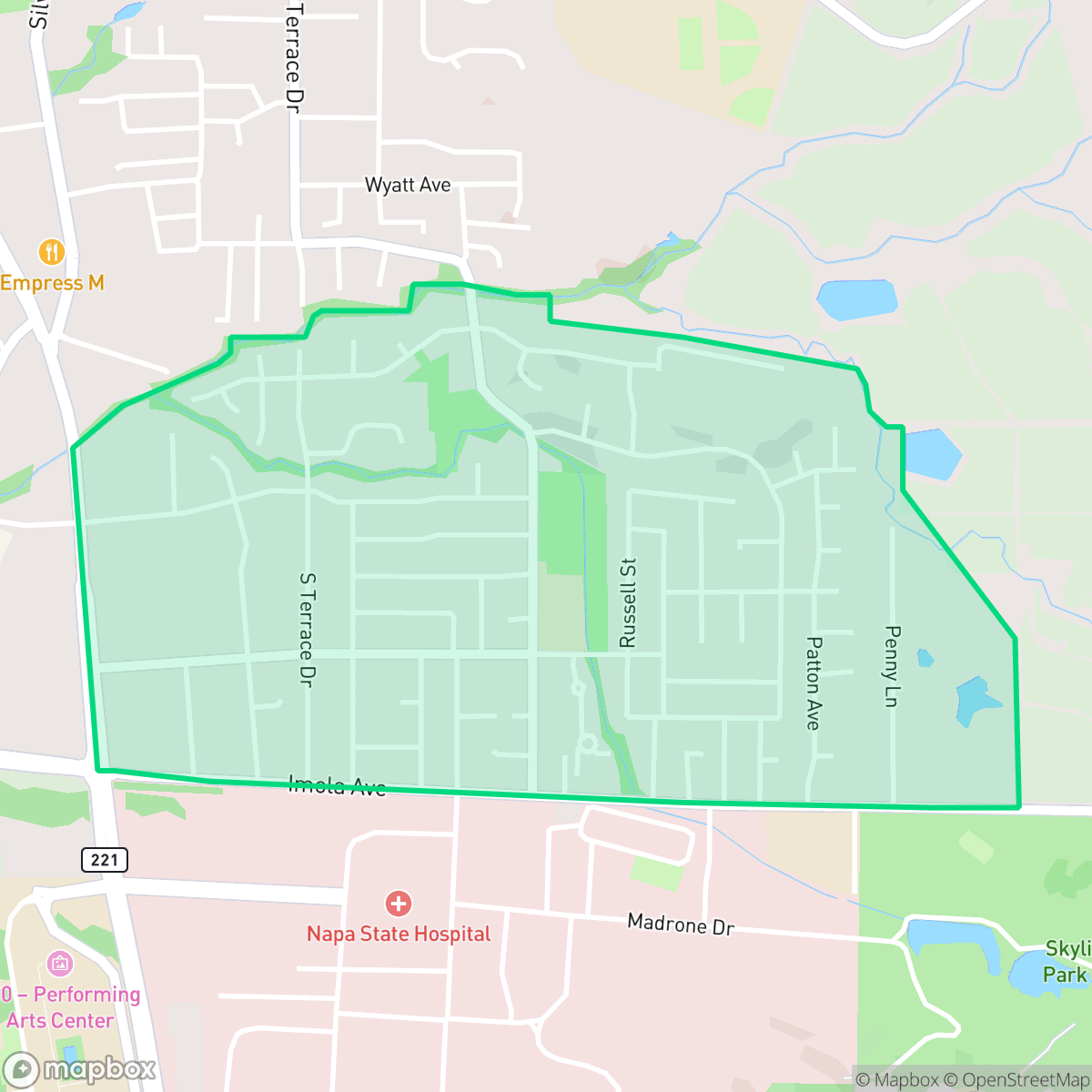
The Shurtleff neighborhood in Napa, California, is named after Dr. Benjamin Shurtleff, a prominent 19th-century physician, politician, and former mayor of Napa who also served as the director of the nearby Napa State Hospital. Situated on the city's east side, the neighborhood is bounded by Silverado Trail, Imola Avenue, and Tulocay Creek. Historically characterized by its proximity to the Napa State Hospital—a significant regional institution established in 1876—the area evolved into a residential community featuring a mix of mid-century ranch-style homes and newer developments. The neighborhood is defined by its suburban layout, including local landmarks such as Camille and Shurtleff Parks, and serves as a residential gateway near the foothills of the Vaca Mountains.
The neighborhood offers a serene living environment characterized by low noise levels and a lack of industrial activity, which contributes to its overall quiet and clean atmosphere. Its layout supports a high level of walkability, with a consistent network of sidewalks and crosswalks that connect residential blocks to local green spaces. The housing stock consists of a diverse mix of mid-century ranch-style homes and newer developments, providing a stable residential base for a demographic that includes young adults, families, and seniors. Residents benefit from a semi-rural aesthetic that feels slightly more secluded than the denser parts of the city.
Potential residents should be aware of specific environmental considerations, as the area is located within a designated floodplain and faces a higher risk of fire compared to other parts of Napa. These factors often necessitate additional safety precautions and property insurance considerations for homeowners. While the neighborhood provides a peaceful retreat, it maintains a moderate level of privacy due to the close proximity of many homes. Families in the area are served by the Napa Valley Unified School District, which is known for its strong community backing and high-performing high schools.
Neighborhood Scores Across 15 Qualities
Homes in this area are more closely situated than in much of Napa, with many residences sharing property lines or sitting quite close to one another. According to iHuus data, this density provides less physical buffer between neighbors compared to the city average.
Pedestrian movement is well-supported by a consistent sidewalk network and frequent crosswalks throughout the residential grid. This area offers slightly better accessibility for walkers than the Napa city average.
Streetscapes feature a combination of standard tract housing and apartment complexes with uniform yards, making the visual appeal roughly comparable to the Napa average.
Access to a large public park and green verges throughout residential blocks provides ample space for pets. According to iHuus data, these connected green spaces and wide paths make the area slightly more pet friendly than the Napa average.
A mix of low-density housing and significant natural forest areas defines this area. While it contains some suburban elements, the landscape is slightly less open than the Napa average according to iHuus data.
Mixed-use areas offer various dining and social hubs within walking distance, though some parts of the neighborhood remain quiet and more industrial. This level of activity is slightly below the average for Napa.
Acoustic levels remain low with only infrequent sounds from distant traffic or trains. This environment is significantly quieter than the average area in Napa, according to iHuus data.
Air quality remains consistently high with minimal pollutants present. This level of air purity is on par with the rest of Napa.
Industrial presence is virtually non-existent here, offering a clean environment that is slightly better than the Napa average. According to iHuus data, the area is composed of residential and light commercial zones without heavy industrial facilities or hazardous sites.
Health insurance access among residents is lower than the average found throughout Napa. According to iHuus data, a smaller proportion of the population in this area holds medical coverage compared to the citywide trend.
Voting patterns and census indicators show a predominantly liberal political leaning that is slightly more pronounced than the Napa city average.
Residents live alongside a balanced mix of young adults, families, and seniors. This demographic distribution is slightly more concentrated toward younger and middle-aged populations than the Napa average, according to iHuus data.
Located within a designated floodplain, this area faces significantly higher flood risks than the rest of Napa. Residents should be aware that flood insurance is typically a requirement for properties in this neighborhood, according to iHuus data.
Fire hazard levels in this area are extremely high, representing a more significant risk than the Napa average. Residents should be aware of the intense danger and the necessity for maximum protection measures, according to iHuus data.
Address-Level Insights for Shurtleff


iHuus Neighborhood Intelligence Insights
Get address-level neighborhood insights for Shurtleff
- Street-level scores — see how individual blocks compare, not just neighborhood averages
- Micro-zone boundaries — identify quiet pockets, flood boundaries, and walkable clusters before you visit
- 15 dimensions in full — walkability, noise, air quality, school quality, insurance coverage, population age profile, urban/rural index, and more
- Boundary risk alerts — know if your address sits near a block boundary where scores drop, the kind of detail no listing will ever mention
- School insights — individual school ratings and insights, not just district-level data
- Compare before you commit — side-by-side data across neighborhoods, down to block precision
No credit card required
Compare with Any Neighborhood
| Dimension | Shurtleff | Alta Heights |
|---|---|---|
| 🚶 Walkabilityavg 8.58 | ||
| 🔊 Acoustic Comfortavg 3.79 | ||
| 🤫 Privacy Indexavg 5.57 | ||
| 🎨 Visual Appealavg 6.84 | ||
| 🐕 Dog Friendlinessavg 7.44 | ||
| 🗺️ Urban-Rural Indexavg 7.13 | ||
| ✨ Neighborhood Vibeavg 6.19 | ||
| 🏥 Health Insurance Coverageavg 7.18 | ||
| 🌿 Air Qualityavg 9.99 | ||
| 🏭 Industrial Proximityavg 9.18 | ||
| 🌊 Flood Safetyavg 3.04 | ||
| 🗳️ Ideological Leanavg 9.09 | ||
| 👥 Population Age Profileavg 5.16 | ||
| 🔥 Fire Safetyavg 0.34 | ||
| 🏫 School Quality |
Shurtleff Rankings
School Districts Serving Shurtleff
School Insights for Shurtleff
Below average outcomes; significant attendance and academic challenges.
School Insights
See what's really behind every school rating near Shurtleff
- Individual school ratings — each school's own score with outcome context, not just a district average
- Enrollment & class size data — student-to-teacher ratio and how it compares to the state average
- Full demographics breakdown — ethnicity and gender composition for every school in the enrollment zone
- Every school in the district — all schools within the enrollment boundary ranked by rating, not just the closest one
- Grade levels & benchmarks — elementary through high school, with below/above state-average flags
No credit card required