Napa Abajo, Napa
Updated · 2,236 residents
Napa Abajo is a highly walkable residential area defined by its historic charm and proximity to downtown Napa. Residents benefit from excellent air quality and convenient access to local dining and riverfront trails, though the neighborhood experiences moderate noise from road traffic and rail lines.
Key Highlights
About Napa Abajo
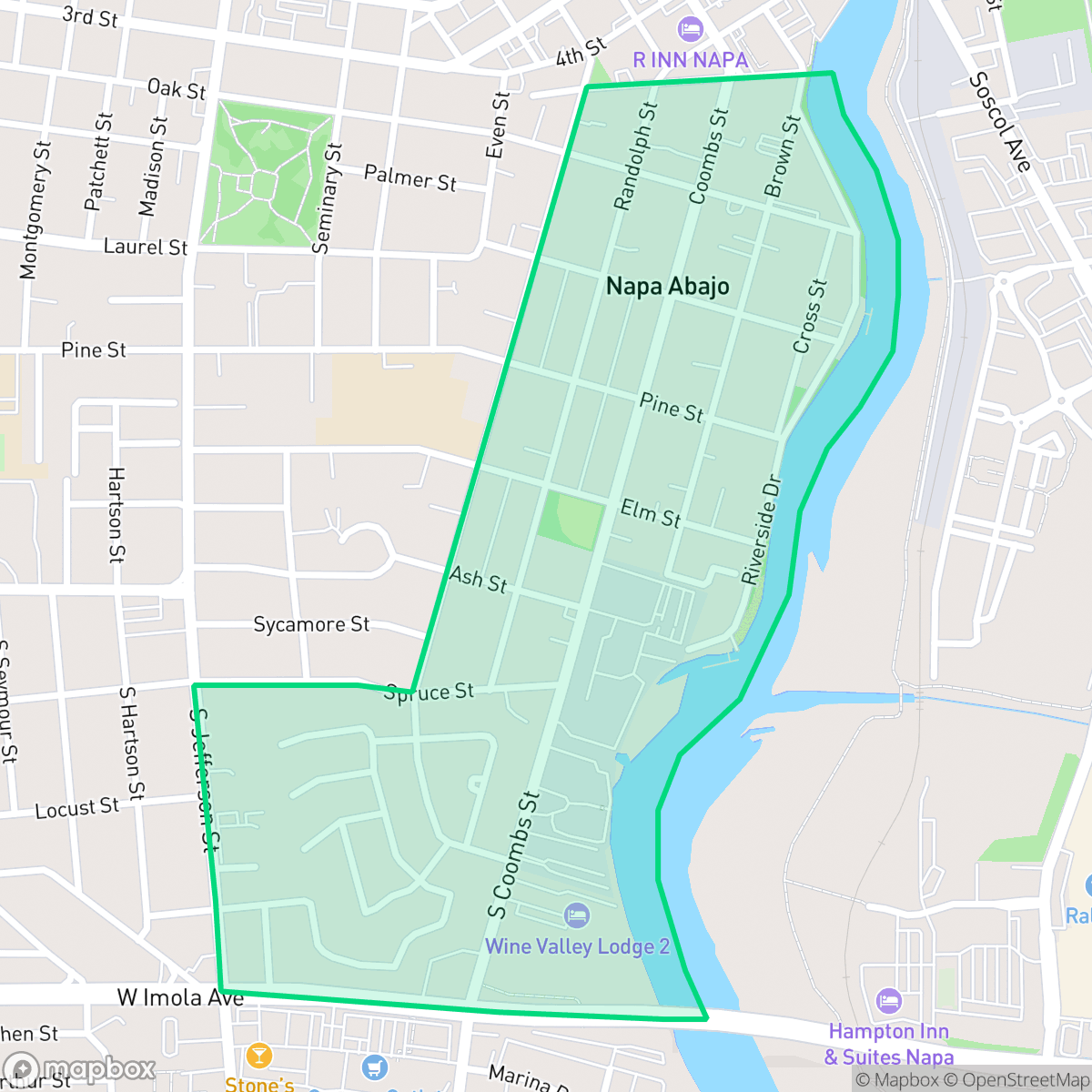
Laid out in 1853 by J.P. Thompson as a 100-acre addition, Napa Abajo (meaning "Lower Napa") historically stood in contrast to "Napa Alta" (Upper Napa). Today, this predominantly residential neighborhood is bounded by the Napa River, Division Street, South Jefferson Street, and West Imola Avenue. Celebrated for its broad, tree-lined streets, it forms the core of the Napa Abajo–Fuller Park Historic District, which was added to the National Register of Historic Places in 1997. The neighborhood showcases a rich array of late 19th- and early 20th-century residential architecture, spanning Victorian, Queen Anne, and Craftsman styles built between 1868 and 1918. A key local landmark is the grand Churchill Manor, a historic mansion that was the first property in Napa to be listed on the National Register.
This central neighborhood serves as a vibrant hub that balances historic residential character with modern urban convenience. The area features a mix of commercial blocks and established housing, providing residents with immediate access to local social hubs, art galleries, and diverse dining options. Its high walkability makes it an ideal choice for those who prefer to navigate the city on foot rather than relying on a vehicle for daily errands. Prospective residents should weigh the benefits of this central location against specific environmental considerations. The area experiences higher noise levels due to its proximity to rail lines and road traffic, and it faces specific challenges regarding flood and fire safety. It is best suited for individuals who prioritize accessibility and a lively, urban-adjacent lifestyle over the quiet of a secluded suburban setting.
Neighborhood Scores Across 15 Qualities
Housing density varies between tightly packed downtown blocks and detached homes with moderate setbacks. This level of privacy is roughly in line with the city average, according to iHuus data.
Continuous sidewalks and well-connected pedestrian trails provide safe access to local parks and commercial centers. This area offers superior pedestrian infrastructure compared to the Napa average.
Modest yards and uniform rooflines characterize this area, which offers slightly less visual variety than the Napa average. Most properties consist of standard tract housing and apartment complexes with small, tidy outdoor spaces.
Wide, tree-lined street verges, river trails, and large public parks provide ample space for pet exercise. This level of access to green space and safe walking paths is consistent with the city average.
Open land and scattered homes amidst woodlands are common here, providing a slightly more rural feel than the more densely developed areas found elsewhere in Napa.
Social hubs and local dining establishments provide a more active atmosphere than the Napa average. While some residential streets offer quiet greenery, other areas feature a concentrated presence of galleries, coffee roasters, and restaurants near light commercial units.
Frequent noise from nearby railroad tracks and major transit routes is a notable feature of this area. According to iHuus data, acoustic comfort levels are slightly lower than the Napa average.
Air quality remains consistently high and clean, matching the high standards found throughout the rest of Napa. Residents can expect minimal-to-no health concerns related to local air pollutants according to iHuus data.
Residential and light commercial uses dominate the area with no heavy industrial hazards or large warehouses. While slightly more commercial activity is present near eastern rail lines than the Napa average, the neighborhood remains primarily residential.
Health insurance accessibility is slightly lower than the average seen across Napa. According to iHuus data, a notable portion of the resident population remains uninsured.
Voting patterns and census indicators show a notably liberal political leaning, which is more pronounced than the average found throughout Napa.
Residents live alongside a balanced mix of young adults, families, and older populations. This age distribution is slightly more varied than the average found across Napa.
Properties in this area are located within a designated floodplain, which may necessitate flood insurance. According to iHuus data, this risk level is slightly higher than the average for Napa.
Address-Level Insights for Napa Abajo


iHuus Neighborhood Intelligence Insights
Get address-level neighborhood insights for Napa Abajo
- Street-level scores — see how individual blocks compare, not just neighborhood averages
- Micro-zone boundaries — identify quiet pockets, flood boundaries, and walkable clusters before you visit
- 15 dimensions in full — walkability, noise, air quality, school quality, insurance coverage, population age profile, urban/rural index, and more
- Boundary risk alerts — know if your address sits near a block boundary where scores drop, the kind of detail no listing will ever mention
- School insights — individual school ratings and insights, not just district-level data
- Compare before you commit — side-by-side data across neighborhoods, down to block precision
No credit card required
Compare with Any Neighborhood
| Dimension | Napa Abajo | Alta Heights |
|---|---|---|
| 🚶 Walkabilityavg 8.58 | ||
| 🔊 Acoustic Comfortavg 3.79 | ||
| 🤫 Privacy Indexavg 5.57 | ||
| 🎨 Visual Appealavg 6.84 | ||
| 🐕 Dog Friendlinessavg 7.44 | ||
| 🗺️ Urban-Rural Indexavg 7.13 | ||
| ✨ Neighborhood Vibeavg 6.19 | ||
| 🏥 Health Insurance Coverageavg 7.18 | ||
| 🌿 Air Qualityavg 9.99 | ||
| 🏭 Industrial Proximityavg 9.18 | ||
| 🌊 Flood Safetyavg 3.04 | ||
| 🗳️ Ideological Leanavg 9.09 | ||
| 👥 Population Age Profileavg 5.16 | ||
| 🔥 Fire Safetyavg 0.34 | ||
| 🏫 School Quality |
Napa Abajo Rankings
School Districts Serving Napa Abajo
School Insights for Napa Abajo
Below average outcomes; significant attendance and academic challenges.
School Insights
See what's really behind every school rating near Napa Abajo
- Individual school ratings — each school's own score with outcome context, not just a district average
- Enrollment & class size data — student-to-teacher ratio and how it compares to the state average
- Full demographics breakdown — ethnicity and gender composition for every school in the enrollment zone
- Every school in the district — all schools within the enrollment boundary ranked by rating, not just the closest one
- Grade levels & benchmarks — elementary through high school, with below/above state-average flags
No credit card required