Fuller Park, Napa
Updated · 4,318 residents
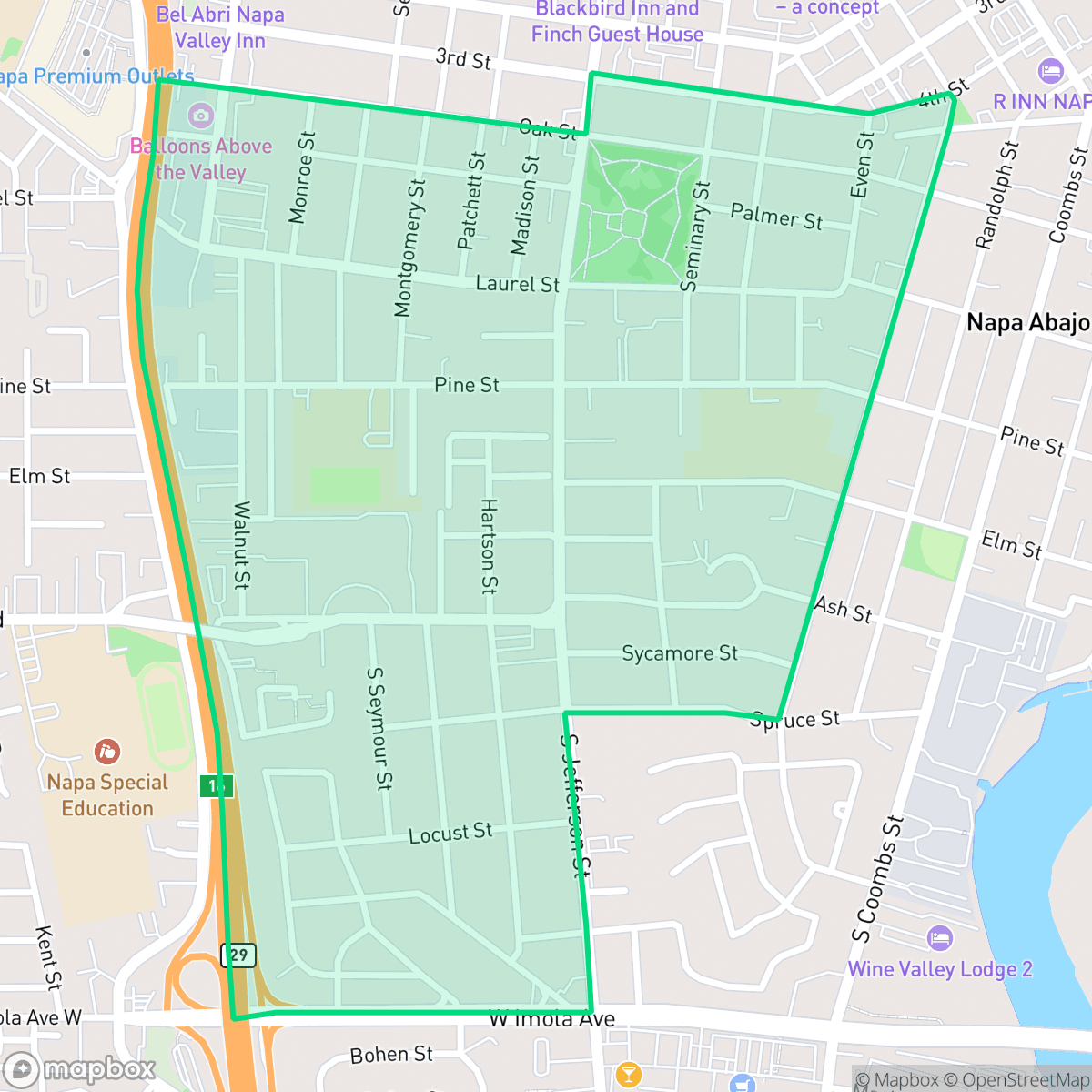
Fuller Park is a highly walkable residential neighborhood in Napa known for its grid-based street layout and proximity to local eateries like Naysayer Coffee Roasters. While the area offers excellent air quality and convenient access to daily amenities, residents should note the elevated noise levels from nearby road traffic and limited backyard privacy due to dense housing.
Key Highlights
About Fuller Park
Settled in the mid-19th century prior to Napa's incorporation, the Fuller Park neighborhood is a historic residential enclave defined by its rich architectural heritage. Along with neighboring Napa Abajo, it forms a National Register Historic District featuring nearly 300 contributing structures built between 1868 and 1918. The area showcases a diverse array of Queen Anne, Greek Revival, and Prairie-style homes designed by prominent local architects like Luther Turton and William Corlett. At the neighborhood’s heart is the block-wide Fuller Park. Originally a 10-acre orchard and community gathering space known as Campbell’s Grove, the land was purchased by the city in 1905. First opened as Oak Street Park, it was renamed in 1919 to honor Napa Mayor C.H. Fuller. Today, the park remains a central landmark, celebrated for its mature redwood and heritage trees.
The area serves as a vibrant hub where historic architectural character meets modern suburban utility. Residents benefit from a high degree of walkability, allowing for easy access to neighborhood staples such as La Hacienda Restaurant De Napa and local coffee shops. According to iHuus data, the neighborhood maintains excellent air quality and a lack of industrial hazards, contributing to a comfortable living environment for those who prioritize proximity to local services over seclusion.
Living here involves certain trade-offs, particularly regarding acoustic comfort and property density. The proximity to major roads results in consistent traffic noise, and the tightly packed housing footprint provides limited private outdoor space. While the local school district is well-regarded for its arts and extracurricular programs, prospective families should consider the performance variance between individual schools. Additionally, residents should be aware of the regional fire and flood safety profiles when considering long-term occupancy in this part of the city.
Neighborhood Scores Across 15 Qualities
Housing density is fairly balanced, offering some separation between neighbors though certain apartment and townhouse clusters sit slightly closer than the Napa average. According to iHuus data, property spacing varies from dense downtown blocks to detached homes with moderate setbacks.
Pedestrian access is excellent due to a continuous network of sidewalks on both sides of most streets and clearly marked crossings. According to iHuus data, this connectivity is even more robust than the average for Napa.
Uniform tract housing and modest yards define the landscape, which is slightly less visually diverse than the Napa average. Most properties feature consistent rooflines and limited greenery, according to iHuus data.
Wide residential verges, river trails, and nearby school fields provide sufficient space for pet walking, though opportunities for canine exercise are slightly below the Napa average.
Residential layouts feature a blend of single-family homes and apartment complexes integrated with commercial clusters. This area feels slightly more developed and less open than the Napa average, according to iHuus data.
Local social hubs and diverse dining options provide a noticeable energy that is slightly higher than the Napa average. According to iHuus data, the area features a mix of suburban greenery and accessible community spots like galleries and vineyards.
Frequent sounds from nearby railroad tracks and major freeways characterize this area. According to iHuus data, acoustic comfort in Fuller Park is lower than the Napa city average.
Air quality remains consistently high with negligible health concerns. This level of cleanliness is on par with the rest of Napa.
Primarily residential and light commercial, this area lacks heavy industrial hazards or large-scale warehouses. While some larger commercial lots exist near the highway, the presence of heavy industry is lower than the Napa average according to iHuus data.
Health insurance enrollment among residents is notably lower than the average seen across Napa. According to iHuus data, fewer people in this area have access to employer or private health coverage compared to the rest of the city.
Voting patterns and census indicators show a very strong liberal leaning, which is more pronounced here than in the rest of Napa.
Residents live alongside a balanced variety of age groups, including young adults, families, and seniors. This demographic spread is slightly more even than the typical distribution found across Napa.
Properties in this area are located within a designated floodplain, meaning flood insurance is typically required. This level of risk is higher than the average found across Napa.
Address-Level Insights for Fuller Park


iHuus Neighborhood Intelligence Insights
Get address-level neighborhood insights for Fuller Park
- Street-level scores — see how individual blocks compare, not just neighborhood averages
- Micro-zone boundaries — identify quiet pockets, flood boundaries, and walkable clusters before you visit
- 15 dimensions in full — walkability, noise, air quality, school quality, insurance coverage, population age profile, urban/rural index, and more
- Boundary risk alerts — know if your address sits near a block boundary where scores drop, the kind of detail no listing will ever mention
- School insights — individual school ratings and insights, not just district-level data
- Compare before you commit — side-by-side data across neighborhoods, down to block precision
No credit card required
Compare with Any Neighborhood
| Dimension | Fuller Park | Alta Heights |
|---|---|---|
| 🚶 Walkabilityavg 8.58 | ||
| 🔊 Acoustic Comfortavg 3.79 | ||
| 🤫 Privacy Indexavg 5.57 | ||
| 🎨 Visual Appealavg 6.84 | ||
| 🐕 Dog Friendlinessavg 7.44 | ||
| 🗺️ Urban-Rural Indexavg 7.13 | ||
| ✨ Neighborhood Vibeavg 6.19 | ||
| 🏥 Health Insurance Coverageavg 7.18 | ||
| 🌿 Air Qualityavg 9.99 | ||
| 🏭 Industrial Proximityavg 9.18 | ||
| 🌊 Flood Safetyavg 3.04 | ||
| 🗳️ Ideological Leanavg 9.09 | ||
| 👥 Population Age Profileavg 5.16 | ||
| 🔥 Fire Safetyavg 0.34 | ||
| 🏫 School Quality |
Fuller Park Rankings
School Districts Serving Fuller Park
School Insights for Fuller Park
Below average outcomes; significant attendance and academic challenges.
School Insights
See what's really behind every school rating near Fuller Park
- Individual school ratings — each school's own score with outcome context, not just a district average
- Enrollment & class size data — student-to-teacher ratio and how it compares to the state average
- Full demographics breakdown — ethnicity and gender composition for every school in the enrollment zone
- Every school in the district — all schools within the enrollment boundary ranked by rating, not just the closest one
- Grade levels & benchmarks — elementary through high school, with below/above state-average flags
No credit card required