University Town Center, Irvine
Updated · 5,535 residents
University Town Center is a highly walkable, high-density neighborhood defined by its close proximity to the University of California, Irvine. Residents benefit from extensive pedestrian networks and immediate access to diverse dining and recreational green spaces, though the area experiences notable road traffic noise and limited residential privacy due to its compact design.
Key Highlights
About University Town Center
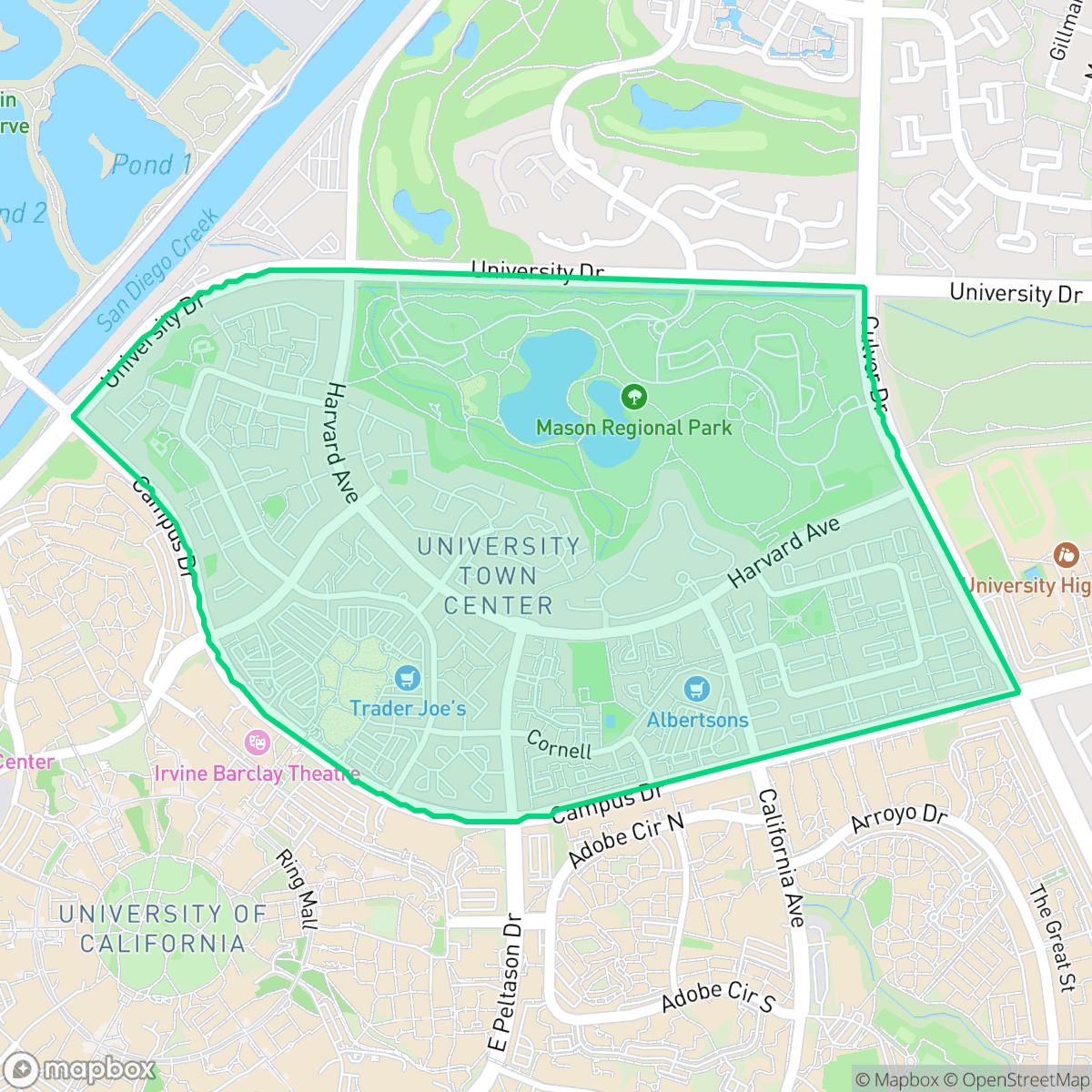
Conceived in the 1960s by master planner William Pereira and Irvine Company planner Raymond Watson, the University Town Center (UTC) neighborhood was designed to embody a "town and gown" relationship with the adjacent University of California, Irvine. Pereira envisioned UTC as a high-density, pedestrian-oriented community that would minimize automobile reliance. Developed primarily in the 1980s, the neighborhood features mixed-use condominiums and townhomes connected by extensive footpaths. A central local landmark is the Raymond L. Watson Bridge, built in 1985 to span Campus Drive and physically link the neighborhood to the university. Today, UTC remains one of Irvine's most walkable villages, bordered by the expansive William R. Mason Regional Park.
The area functions as a vibrant, transit-conscious hub characterized by multi-story apartment complexes and dense residential clusters. It maintains a distinctively energetic atmosphere, supported by a variety of local businesses, including cafes and diverse restaurants that serve the student and professional population. The neighborhood is uniquely positioned to offer an urban-suburban hybrid experience, where residents can navigate between commercial plazas and residential zones using a well-maintained system of sidewalks and bridges.
Living here involves a trade-off between convenience and acoustic privacy, as the proximity to major arterials contributes to a consistent baseline of traffic noise. The housing stock, while well-maintained and aesthetically consistent with the region's Mediterranean-inspired architecture, prioritizes density over individual lot size. This makes the area particularly well-suited for students, faculty, and professionals who prioritize walkability and access to high-performing schools in the Irvine Unified School District over quiet, low-density suburban living.
Neighborhood Scores Across 15 Qualities
Shared walls and close proximity between residential structures are common in many apartment complexes here. According to iHuus data, the level of separation between neighbors is slightly lower than the Irvine average.
Pedestrian-priority design and continuous sidewalk networks facilitate easy movement between residential sectors and commercial plazas. This level of connectivity and accessibility is consistent with the broader Irvine area.
The landscape consists of a blend of high-density apartment complexes and manicured suburban homes. According to iHuus data, the visual variety in this area is slightly lower than the Irvine average.
Connected greenbelts and landscaped paths provide safe, continuous walking routes away from traffic. These accessible natural basins and wide verges offer slightly more pet-friendly space than the Irvine average, according to iHuus data.
Planned suburban environments with dense housing clusters and large open spaces characterize this area, reflecting a landscape very similar to the Irvine average. Multi-story apartment complexes and large commercial parking lots are common features within the neighborhood according to iHuus data.
Local social and leisure hubs are notably more concentrated here than across the rest of Irvine. Diverse dining options and scattered social spots create a more vibrant atmosphere than the city average.
Steady sound from nearby busy streets is common here, though levels are notably more tranquil than the Irvine average according to iHuus data.
Air quality in this area fluctuates between acceptable and unhealthy levels, which may cause occasional concern for sensitive groups. According to iHuus data, these conditions are slightly lower than the Irvine city average.
Residential and institutional buildings comprise the entire area, with no warehouses or industrial hazards detected. This lack of heavy industry provides a cleaner environment than the Irvine average, according to iHuus data.
Health insurance enrollment is widespread among residents, though slightly lower than the Irvine city average according to iHuus data.
Voting patterns and census indicators show a significantly more liberal leaning than the Irvine average, according to iHuus data.
A majority of residents are young adults, reflecting a demographic that is noticeably younger than the Irvine average. This profile suggests a community with a modest presence of families or older residents according to iHuus data.
Address-Level Insights for University Town Center


iHuus Neighborhood Intelligence Insights
Get address-level neighborhood insights for University Town Center
- Street-level scores — see how individual blocks compare, not just neighborhood averages
- Micro-zone boundaries — identify quiet pockets, flood boundaries, and walkable clusters before you visit
- 15 dimensions in full — walkability, noise, air quality, school quality, insurance coverage, population age profile, urban/rural index, and more
- Boundary risk alerts — know if your address sits near a block boundary where scores drop, the kind of detail no listing will ever mention
- School insights — individual school ratings and insights, not just district-level data
- Compare before you commit — side-by-side data across neighborhoods, down to block precision
No credit card required
Compare with Any Neighborhood
| Dimension | University Town Center | Business District |
|---|---|---|
| 🚶 Walkabilityavg 9.44 | ||
| 🔊 Acoustic Comfortavg 2.83 | ||
| 🤫 Privacy Indexavg 4.53 | ||
| 🎨 Visual Appealavg 7.36 | ||
| 🐕 Dog Friendlinessavg 7.98 | ||
| 🗺️ Urban-Rural Indexavg 6.69 | ||
| ✨ Neighborhood Vibeavg 4.63 | ||
| 🏥 Health Insurance Coverageavg 8.7 | ||
| 🌿 Air Qualityavg 6.22 | ||
| 🏭 Industrial Proximityavg 9.32 | ||
| 🌊 Flood Safetyavg 3.93 | ||
| 🗳️ Ideological Leanavg 7.23 | ||
| 👥 Population Age Profileavg 4.73 | ||
| 🔥 Fire Safetyavg 0.41 | ||
| 🏫 School Quality |
University Town Center Rankings
School Districts Serving University Town Center
School Insights for University Town Center
Below average outcomes; significant attendance and academic challenges.
School Insights
See what's really behind every school rating near University Town Center
- Individual school ratings — each school's own score with outcome context, not just a district average
- Enrollment & class size data — student-to-teacher ratio and how it compares to the state average
- Full demographics breakdown — ethnicity and gender composition for every school in the enrollment zone
- Every school in the district — all schools within the enrollment boundary ranked by rating, not just the closest one
- Grade levels & benchmarks — elementary through high school, with below/above state-average flags
No credit card required