University Park, Irvine
Updated · 7,486 residents
University Park is a highly walkable neighborhood defined by its dense, garden-inspired layout and proximity to academic institutions. While the area offers excellent access to greenbelts and top-tier schools, residents should be aware of the high noise levels from nearby highway traffic and limited residential privacy.
Key Highlights
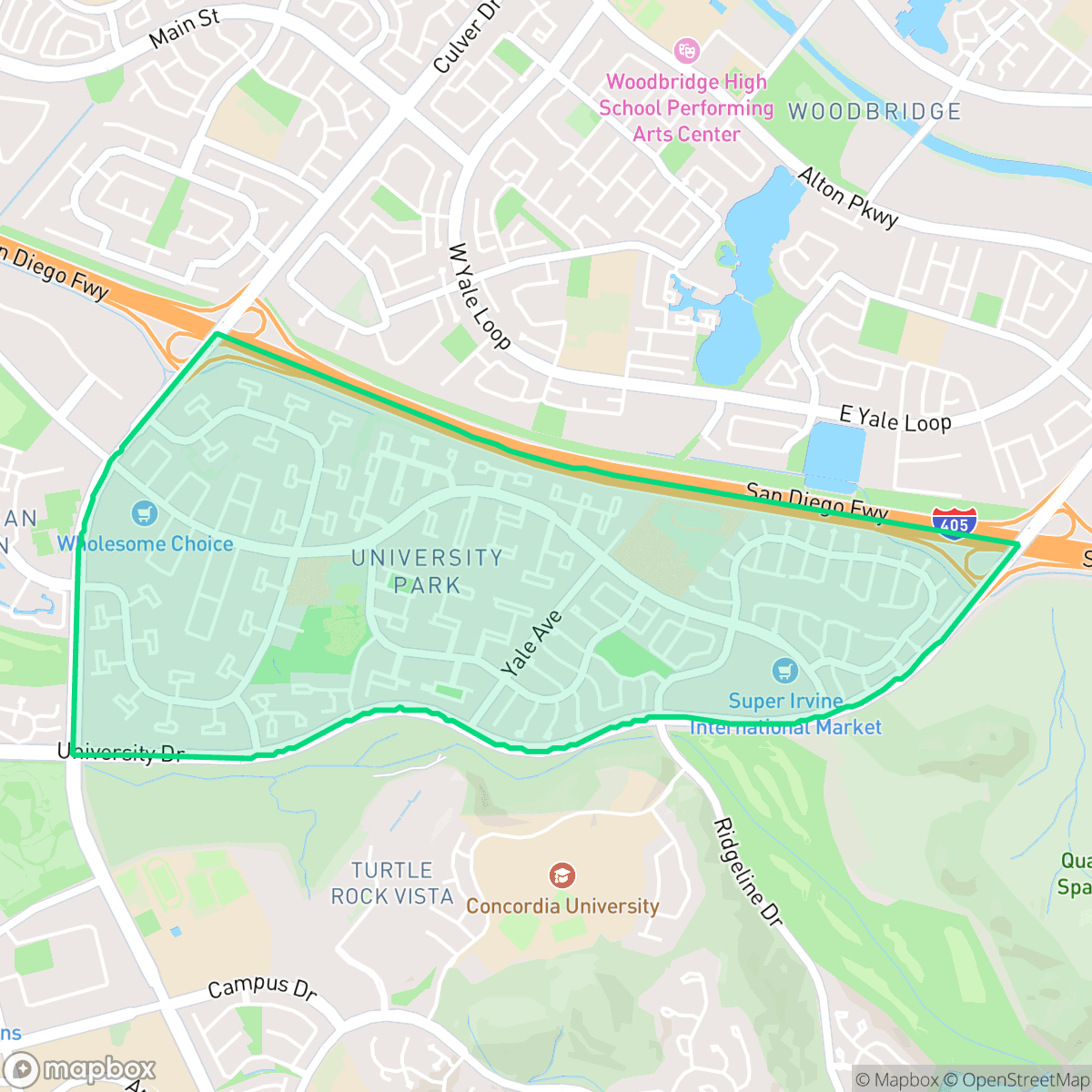
About University Park
Established in 1965, University Park is celebrated as the Irvine Company's very first master-planned "village," predating the incorporation of Irvine as a city by five years. Designed in collaboration with Sasaki, Walker and Associates, the neighborhood pioneered the Garden City planning approach. It integrated experimental design concepts, including square cul-de-sacs and clusters of homes facing public greenbelts to reduce automobile dependence. Architecturally, the neighborhood features California Modern homes defined by low-pitched roofs, clerestory windows, and zero-lot-line construction. Because of its proximity to the newly opened University of California, Irvine, it quickly became a hub for academics and families. It also introduced the city's first high school, library, and retail center, alongside the iconic Adventure Playground, where local children built forts out of recycled materials.
The neighborhood functions as a quiet, suburban enclave characterized by its extensive sidewalk network and abundant greenbelts that facilitate easy pedestrian travel. According to iHuus data, the area maintains a high level of walkability and dog friendliness, making it an attractive option for those who prioritize outdoor activity and access to local parks. The residential landscape consists of tightly clustered homes that emphasize community interaction, though this layout results in limited individual privacy compared to other parts of the city. Residents benefit from being part of the highly regarded Irvine Unified School District, with local schools consistently achieving top-tier performance ratings. While the area provides a serene, residential environment, it is important to note that the proximity to major transit corridors contributes to noticeable road traffic noise. The community is well-suited for families and academics who value educational excellence and a managed, suburban lifestyle, provided they are comfortable with the acoustic environment and the density of the housing.
Neighborhood Scores Across 15 Qualities
Residential spacing varies between closely packed townhomes and single-family dwellings with minimal setbacks. This density is roughly in line with the Irvine city average, offering some buffer between neighbors in certain areas.
Extensive sidewalk networks and dedicated pedestrian bridges over the highway provide safe, interconnected routes throughout the area. This level of connectivity is nearly on par with the rest of Irvine.
Well-maintained landscapes, community pools, and tennis courts characterize this area. According to iHuus data, the visual quality of the streetscapes and amenities is slightly above the Irvine average.
Extensive greenbelts, manicured parks, and wide grass verges provide ample walking areas for pets. According to iHuus data, these interconnected spaces and nature trails offer greater access to walking routes than the Irvine average.
Residential clusters feature a mix of single-family homes, townhomes, and multi-family complexes. This built environment is largely consistent with the typical suburban density found throughout Irvine.
Suburban streets and green spaces provide a serene atmosphere, though most daily needs require driving. According to iHuus data, the level of activity and social density is lower than the Irvine average.
Frequent aircraft noise from a nearby runway makes this area significantly louder than the rest of Irvine. According to iHuus data, acoustic comfort is notably lower here than the city average.
Air quality in this area is slightly below the Irvine average, characterized by a mix of acceptable and unhealthy days. Sensitive groups should remain aware of occasional concerns during certain periods, according to iHuus data.
Industrial activity, warehouses, and heavy machinery are entirely absent from this area. According to iHuus data, the neighborhood is exclusively comprised of residential and recreational spaces, providing a higher level of separation from industrial zones than the Irvine average.
Health insurance access is very high among residents, sitting above the Irvine city average according to iHuus data.
Political leanings in this area trend more liberal than the Irvine average. Residents will find a majority of the community aligns with liberal values, though a modest opposing presence remains.
A balanced demographic of young adults, families, and older residents defines the area, reflecting a slightly more varied age distribution than the Irvine average according to iHuus data.
Flood risk levels in this area are slightly higher than the Irvine average. According to iHuus data, detailed FEMA studies for this specific zone are currently unavailable, suggesting an undetermined level of risk.
Extreme fire hazards are present in this area, which aligns with the current city average for Irvine. Residents should be aware of significant wildfire risks and ensure they are following all necessary local safety protocols.
Address-Level Insights for University Park


iHuus Neighborhood Intelligence Insights
Get address-level neighborhood insights for University Park
- Street-level scores — see how individual blocks compare, not just neighborhood averages
- Micro-zone boundaries — identify quiet pockets, flood boundaries, and walkable clusters before you visit
- 15 dimensions in full — walkability, noise, air quality, school quality, insurance coverage, population age profile, urban/rural index, and more
- Boundary risk alerts — know if your address sits near a block boundary where scores drop, the kind of detail no listing will ever mention
- School insights — individual school ratings and insights, not just district-level data
- Compare before you commit — side-by-side data across neighborhoods, down to block precision
No credit card required
Compare with Any Neighborhood
| Dimension | University Park | Business District |
|---|---|---|
| 🚶 Walkabilityavg 9.44 | ||
| 🔊 Acoustic Comfortavg 2.83 | ||
| 🤫 Privacy Indexavg 4.53 | ||
| 🎨 Visual Appealavg 7.36 | ||
| 🐕 Dog Friendlinessavg 7.98 | ||
| 🗺️ Urban-Rural Indexavg 6.69 | ||
| ✨ Neighborhood Vibeavg 4.63 | ||
| 🏥 Health Insurance Coverageavg 8.7 | ||
| 🌿 Air Qualityavg 6.22 | ||
| 🏭 Industrial Proximityavg 9.32 | ||
| 🌊 Flood Safetyavg 3.93 | ||
| 🗳️ Ideological Leanavg 7.23 | ||
| 👥 Population Age Profileavg 4.73 | ||
| 🔥 Fire Safetyavg 0.41 | ||
| 🏫 School Quality |
University Park Rankings
School Districts Serving University Park
School Insights for University Park
Below average outcomes; significant attendance and academic challenges.
School Insights
See what's really behind every school rating near University Park
- Individual school ratings — each school's own score with outcome context, not just a district average
- Enrollment & class size data — student-to-teacher ratio and how it compares to the state average
- Full demographics breakdown — ethnicity and gender composition for every school in the enrollment zone
- Every school in the district — all schools within the enrollment boundary ranked by rating, not just the closest one
- Grade levels & benchmarks — elementary through high school, with below/above state-average flags
No credit card required