UC Irvine, Irvine
Updated · 13,067 residents
The UC Irvine neighborhood is a highly walkable community characterized by its integration of modernist institutional architecture and dense, student-oriented residential developments. The area offers abundant greenbelts and recreational spaces, though residents should anticipate moderate noise levels from local road traffic.
Key Highlights
About UC Irvine
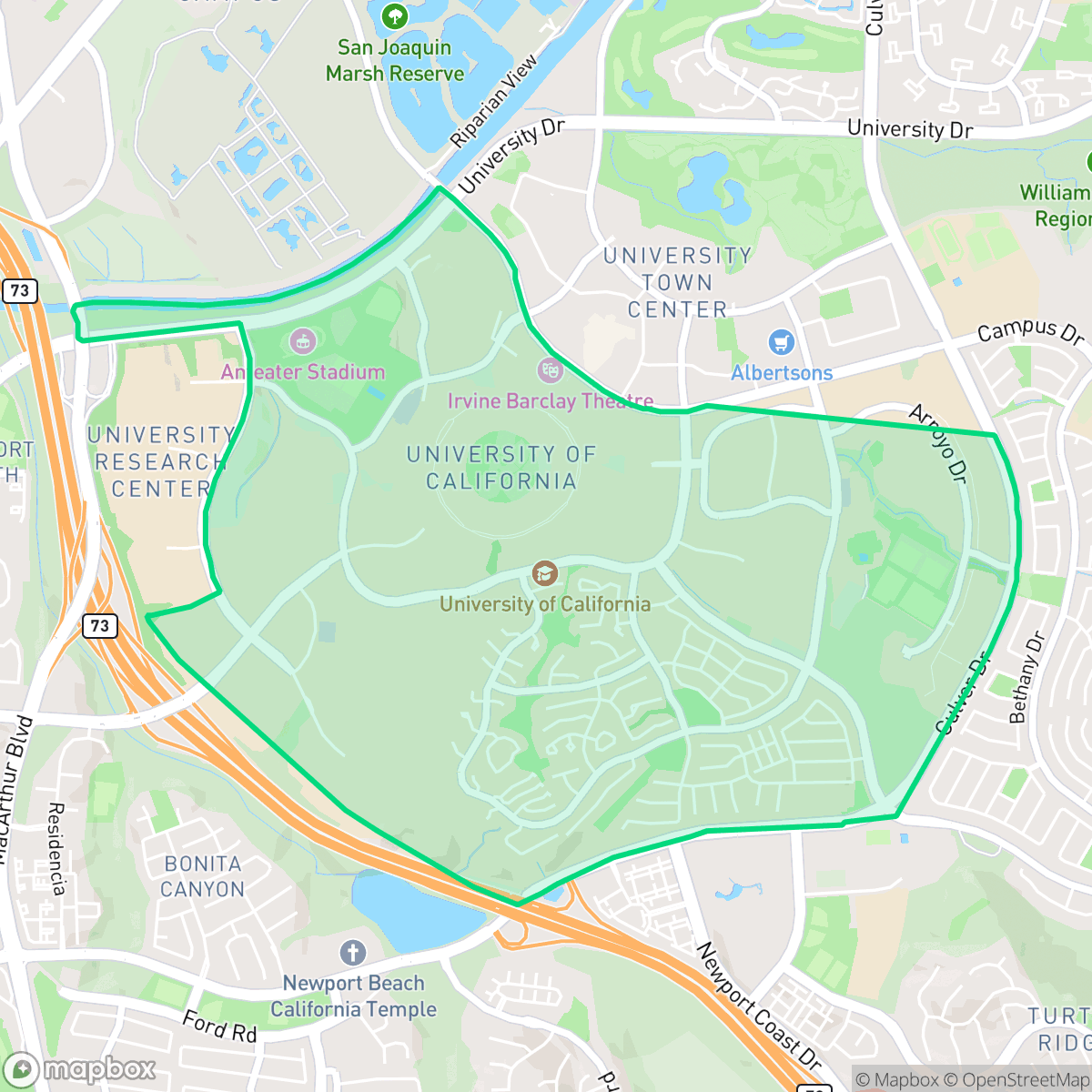
Master-planned in the early 1960s by architect William Pereira, the UC Irvine neighborhood was envisioned as a "city of intellect" and a model "town and gown" community. Built on 1,000 acres of former Irvine Ranch agricultural land, the neighborhood's layout centers around the circular Aldrich Park. Pereira’s radical modernist design eschewed traditional brick-and-mortar collegiate styles in favor of futuristic, brutalist concrete structures, which famously served as the filming location for the 1972 film *Conquest of the Planet of the Apes*. To support the campus, the adjacent University Town Center (UTC) was developed with high-density housing, pedestrian bridges, and retail spaces, creating one of Orange County’s most walkable, university-oriented neighborhoods.
The neighborhood functions as a vibrant, pedestrian-friendly hub that balances academic life with suburban living. Residents benefit from an extensive network of sidewalks and internal paths that connect housing tracts to local social spots and educational facilities. The environment is entirely residential and institutional, free from industrial activity, and supported by the top-tier Irvine Unified School District, which provides exceptional academic resources for local families. While the area provides excellent access to amenities and outdoor space, prospective residents should note the trade-offs in privacy and acoustic comfort. The proximity to major roadways results in moderate traffic noise, and the high-density nature of many housing developments means properties are often closely situated. The neighborhood is particularly well-suited for students, faculty, and families who prioritize walkability and proximity to academic institutions over complete seclusion.
Neighborhood Scores Across 15 Qualities
Housing density is slightly higher than the Irvine average, with many apartment complexes and multi-family units featuring shared walls and closer proximity to neighbors. While some areas offer standard suburban spacing, much of the neighborhood consists of tightly packed, planned developments.
Comprehensive sidewalk networks and pedestrian bridges provide seamless connectivity between residential and commercial zones. This area offers a level of walkability that is consistent with the city average.
Residential views range from high-density apartment complexes with shared amenities to upscale suburban homes featuring manicured landscaping. This area presents a slightly lower level of visual appeal than the Irvine city average due to the prevalence of standard multi-family housing units.
Extensive greenbelts, interconnected park systems, and wide landscaped paths provide safe, traffic-free environments for walking dogs. This level of accessibility to natural trails and open spaces is slightly above the Irvine average according to iHuus data.
Large undeveloped spaces and campus-style office parks provide a sense of openness that is largely consistent with the surrounding city. Residents will find a mix of dense residential clusters and expansive recreational fields throughout the area.
A diverse mix of dining, educational, and civic services provides more activity than the typical Irvine neighborhood. While many areas feature a pleasant balance of green space and social spots, the layout remains largely car-dependent for most daily needs.
Steady traffic sounds from nearby busy streets are a frequent presence here. This level of acoustic activity is notably higher than the average found throughout Irvine.
Air quality fluctuates between acceptable and unhealthy levels, with occasional concerns for sensitive groups. According to iHuus data, the air quality in this area is slightly lower than the Irvine city average.
Industrial facilities and warehouses are entirely absent from this area. This neighborhood offers a cleaner environment than the Irvine average, consisting strictly of residential, educational, and recreational spaces.
Health insurance access among residents is high and remains consistent with the Irvine city average, according to iHuus data.
Political leanings here trend significantly more liberal than the Irvine average. Residents can expect a community with a clear liberal majority and a modest opposing presence, according to iHuus data.
A significant portion of the population consists of young adults and students, making the age distribution slightly younger than the Irvine average. This demographic mix provides a stable balance of students, families, and older residents according to iHuus data.
Frequent flood risks exist due to the area's location within a designated floodplain; according to iHuus data, this risk level is slightly higher than the Irvine city average.
Extreme fire hazards are present in this area, which is slightly higher than the Irvine city average according to iHuus data. Residents should be aware of significant wildfire risks and ensure they are following all necessary safety and protection measures.
Address-Level Insights for UC Irvine


iHuus Neighborhood Intelligence Insights
Get address-level neighborhood insights for UC Irvine
- Street-level scores — see how individual blocks compare, not just neighborhood averages
- Micro-zone boundaries — identify quiet pockets, flood boundaries, and walkable clusters before you visit
- 15 dimensions in full — walkability, noise, air quality, school quality, insurance coverage, population age profile, urban/rural index, and more
- Boundary risk alerts — know if your address sits near a block boundary where scores drop, the kind of detail no listing will ever mention
- School insights — individual school ratings and insights, not just district-level data
- Compare before you commit — side-by-side data across neighborhoods, down to block precision
No credit card required
Compare with Any Neighborhood
| Dimension | UC Irvine | Business District |
|---|---|---|
| 🚶 Walkabilityavg 9.44 | ||
| 🔊 Acoustic Comfortavg 2.83 | ||
| 🤫 Privacy Indexavg 4.53 | ||
| 🎨 Visual Appealavg 7.36 | ||
| 🐕 Dog Friendlinessavg 7.98 | ||
| 🗺️ Urban-Rural Indexavg 6.69 | ||
| ✨ Neighborhood Vibeavg 4.63 | ||
| 🏥 Health Insurance Coverageavg 8.7 | ||
| 🌿 Air Qualityavg 6.22 | ||
| 🏭 Industrial Proximityavg 9.32 | ||
| 🌊 Flood Safetyavg 3.93 | ||
| 🗳️ Ideological Leanavg 7.23 | ||
| 👥 Population Age Profileavg 4.73 | ||
| 🔥 Fire Safetyavg 0.41 | ||
| 🏫 School Quality |
UC Irvine Rankings
School Districts Serving UC Irvine
School Insights for UC Irvine
Below average outcomes; significant attendance and academic challenges.
School Insights
See what's really behind every school rating near UC Irvine
- Individual school ratings — each school's own score with outcome context, not just a district average
- Enrollment & class size data — student-to-teacher ratio and how it compares to the state average
- Full demographics breakdown — ethnicity and gender composition for every school in the enrollment zone
- Every school in the district — all schools within the enrollment boundary ranked by rating, not just the closest one
- Grade levels & benchmarks — elementary through high school, with below/above state-average flags
No credit card required